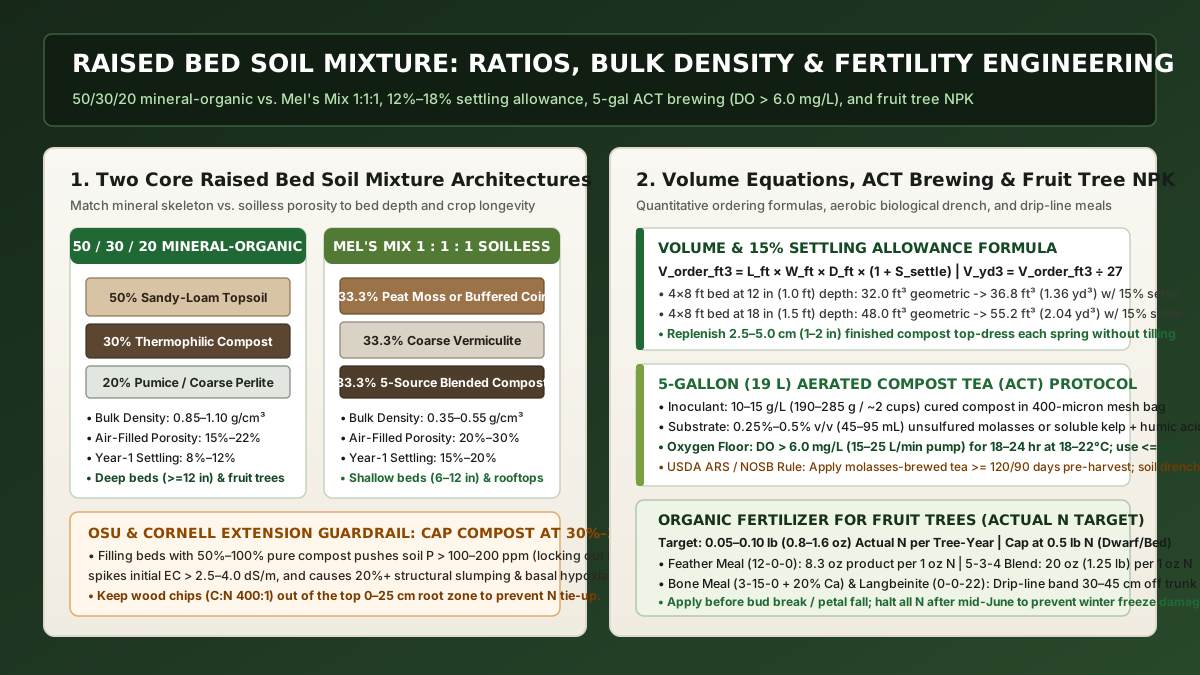
Filling a framed garden bed with unscreened native clay, 100% municipal compost, or raw wood chips mixed into the upper root zone causes perched water tables, 20% to 25% mid-season structural slumping, severe microbial nitrogen immobilization, and phosphorus-induced iron chlorosis that damage feeder roots and cause the planting to fail. A high-performing raised bed soil mixture matches volumetric mineral-to-organic ratios to bed depth and crop longevity: use a 50/30/20 mineral-organic blend (50% screened sandy-loam topsoil, 30% mature thermophilic compost, 20% coarse 3 to 6 mm pumice or perlite at 0.85 to 1.10 g/cm³ dry bulk density) for beds 12 to 24 inches deep and dwarf fruit trees, or Mel’s Mix 1:1:1 (1/3 peat or buffered coir, 1/3 coarse horticultural vermiculite, 1/3 five-source blended compost at 0.35 to 0.55 g/cm³) for 6 to 12 inch shallow vegetable beds and weight-restricted rooftop planters.
Whereas indoor germination trays and small nursery pots rely on lightweight soilless substrates to maintain air-filled porosity in a 5 to 10 cm water column (covered in our seed starting mix vs. potting soil decision sheet), outdoor raised beds bridge container physics and field soil hydrology (Penn State Extension; Cornell Cooperative Extension). Once a raised bed exceeds 30 cm (12 in) in depth, purely organic fills oxidize into carbon dioxide (CO2) at 6% to 8% per summer and compact under their own wet overburden weight unless stabilized by a non-oxidizing quartz sand and coarse aggregate skeleton (Oregon State University Extension).
This technical guide is compiled by Known Source Farms, an independent agricultural resource in our home growing library. Below, we compare four raised bed substrate architectures, calculate cubic-foot and cubic-yard order volumes with a 12% to 18% Year-1 settling allowance, detail a 5-gallon (19 L) aerated compost tea recipe compliant with USDA pathogen-safety rules, and lay out an organic fertilizer for fruit trees schedule based on trunk caliper and tree age.
| Soil Mixture Formula | Volumetric Recipe & Particle Spec | Dry Bulk Density (g/cm³ & lb/ft³) |
Air-Filled Porosity (AFP %) |
Water-Holding Capacity (WHC %) |
Year-1 Settling & Years 2+ Loss | Target C:N & CEC (meq/100g) |
Primary Crop & Bed Depth Application |
|---|---|---|---|---|---|---|---|
| 50/30/20 Extension Mineral-Organic Mix | 50% sandy-loam topsoil (< 15%–20% clay) + 30% cured compost + 20% 3–6 mm pumice, #3 perlite, or 3/8 in bark fines |
0.85–1.10 g/cm³ (0.95 midpoint; 53–68 lb/ft³) |
15%–22% (~18% nominal at container capacity) |
35%–45% by volume (50%–60% total porosity) |
8%–12% Year 1; only 3%–5%/yr thereafter |
C:N 15:1–20:1; CEC 15–25 meq/100g |
Deep beds (>= 12–24 in), indeterminate tomatoes, perennials, dwarf/espalier fruit trees |
| Mel’s Mix 1:1:1 Soilless Blend (Square Foot Gardening) | 33.3% sphagnum peat or low-EC (< 0.5 dS/m) coir + 33.3% coarse vermiculite + 33.3% 5-source compost |
0.35–0.55 g/cm³ (0.45 midpoint; 22–34 lb/ft³) |
20%–30% (~25% nominal with coarse vermiculite) |
55%–65% by volume (70%–85% total porosity) |
15%–20% Year 1 (66.7% organic mass oxidizes) |
C:N 18:1–24:1; CEC 25–40 meq/100g (mass basis) |
Shallow-to-medium beds (6–12 in), root crops (carrots, radishes), rooftop/balcony boxes |
| 70/30 Bulk Municipal Topsoil-Compost (Unamended) | 70% screened bulk topsoil + 30% municipal green-waste compost (0% coarse aggregate) |
1.10–1.30 g/cm³ (68–81 lb/ft³) |
8%–14% (slumps if clay > 20% or silt > 40%) |
30%–40% by volume (risk of perched water table) | 10%–15% Year 1 from hydraulic consolidation | C:N 16:1–22:1; CEC 12–20 meq/100g |
In-ground berming; amend with 15%–20% pumice/perlite before filling framed raised beds |
Hügelkultur Wood-Core Sub-Base (> 30 cm Deep Only) |
Bottom > 30 cm (> 12 in): logs/branches + 5 cm N-rich manure/green cap; Top 0–30 cm: 50/30/20 mix |
0.25–0.60 g/cm³ in wood core; 0.95 g/cm³ in top 30 cm |
> 30% macro-voids in base; 18% in upper root zone | Spongy wood core holds autumn/winter moisture | 15%–25% multi-year cavity slumping as wood decays | Core C:N 300:1–600:1 (never mix into top 0–25 cm) |
Tall metal or timber beds (>= 45–60 cm / 18–24 in high) reducing bulk topsoil purchase volume |
Comparing Raised Bed Soil Mixture Architectures: 50/30/20 Mineral-Organic vs. Mel’s Mix 1:1:1
Selecting a raised bed soil mixture requires balancing two competing physical demands: short-term root aeration (which favors porous soilless components like peat, coir, and exfoliated vermiculite) and multi-year structural permanence (which requires non-degrading mineral sand, silt, and volcanic rock aggregate).
1. The 50/30/20 Extension Mineral-Organic Architecture
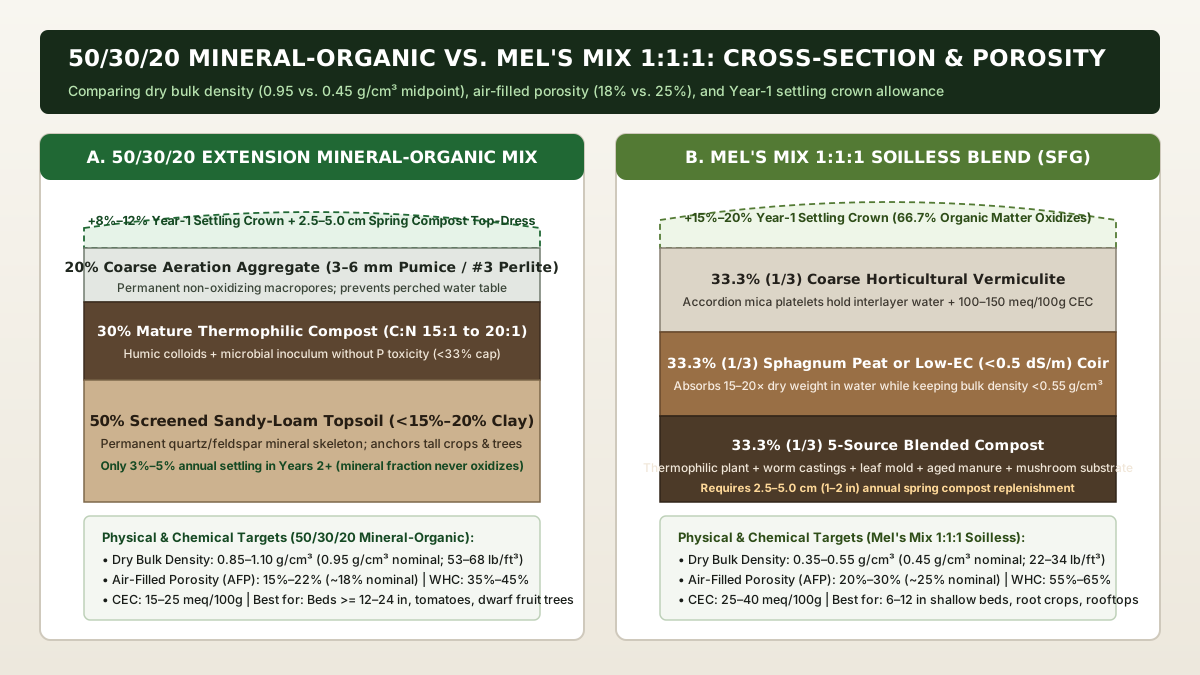
For beds 30 to 60 cm (12 to 24 in) deep, multi-bed backyard installations, staked indeterminate tomatoes, and woody perennials or dwarf fruit trees, the 50/30/20 volumetric formula provides a permanent mineral skeleton:
- 50% Screened Sandy-Loam Topsoil (
< 15% to 20%clay): Supplies quartz sand (0.05 to 2.0 mm) and silt (0.002 to 0.05 mm) particles that never oxidize intoCO2, plus enough aluminosilicate clay minerals to anchor roots and retain potassium (K+), calcium (Ca2+), and magnesium (Mg2+) on permanent cation exchange sites (15 to 25 meq/100gbulk CEC). Never use unscreened clay subsoil or fill dirt contaminated with persistent pyridine carboxylic acid herbicides (aminopyralid, clopyralid, or picloram). - 30% Mature Thermophilic Compost (
C:N 15:1 to 20:1): Supplies stable humic substances, slow-release mineralized nitrogen (1% to 2%total N by dry weight), and beneficial rhizosphere microbes while staying safely below the33%volumetric ceiling established by Oregon State University Extension. - 20% Coarse Aeration Aggregate (
3 to 6 mmparticle diameter): Incorporate washed horticultural pumice (3 to 6 mm),#3or#4coarse horticultural perlite, or3/8-inch(9.5 mm) aged pine bark fines. Pumice and coarse perlite create rigid bridging macropores (> 0.08 mmpore diameter) that drain gravitational water within 2 to 4 hours of a heavy rainstorm, locking air-filled porosity (AFP) at15% to 22%so roots receive continuous oxygen diffusion (O2).
2. Mel’s Mix (1:1:1 Square Foot Gardening Soilless Blend)
Formulated for shallow 15 to 30 cm (6 to 12 in) raised beds, elevated garden tables, and urban rooftops where native topsoil is unavailable or structural load limits prohibit 60+ lb/ft³ mineral soil, Mel’s Mix uses equal one-third volumetric parts:
- 33.3% (1/3) Sphagnum Peat Moss or Buffered Coco Coir: Pre-moisten dry sphagnum peat (pH
3.8 to 4.5, buffered with3 to 5 lbdolomitic limestone per cubic yard) or use low-salinity (EC < 0.5 dS/m) calcium/magnesium-buffered coco coir pith (pH5.8 to 6.5). Peat and coir hold15 to 20 timestheir dry weight in plant-available water while keeping dry bulk density between 0.35 and 0.55 g/cm³ (22 to 34 lb/ft³) (Cornell Cooperative Extension). - 33.3% (1/3) Coarse or Extra-Coarse Horticultural Vermiculite: Always specify coarse (
#3,2 to 4 mm) or extra-coarse (#4,4 to 8 mm) horticultural-grade vermiculite. Never substitute fine masonry or pool-liner grade vermiculite (< 1 mm), which collapses wet air-filled porosity below10%. Exfoliated mica platelets hold water between layers and contribute100 to 150 meq/100gof cation exchange capacity. - 33.3% (1/3) Multi-Source Blended Compost (Minimum 5 Feedstocks): Because peat and vermiculite contain virtually zero bioavailable NPK or trace elements, the compost third must combine at least five distinct organic inputs so micronutrient gaps in one source are covered by the others:
- Thermophilic plant and yard trimmings compost (baseline humic carbon and potassium).
- Pure vermicompost (earthworm castings) at
15% to 20%of the compost fraction (for humic/fulvic acids and plant-growth-promoting rhizobacteria; see our worm castings application rates guide). - Aged deciduous leaf mold (
12 to 24 monthsfungal decomposition for water retention and mycorrhizal fungal spores). - Composted poultry litter or aged dairy manure (thermophilically cured to supply slow-release organic nitrogen, calcium, and phosphorus).
- Spent mushroom substrate (SMS) from retired hardwood sawdust or straw fruiting blocks (see our oyster mushroom growing kit guide). Because fresh SMS often carries an electrical conductivity (
EC) of2.5 to 5.0 dS/mand high calcium carbonate, weather it outdoors for4 to 8 weeksor cap SMS at10% to 15%of total compost volume (3% to 5%of total bed volume).
3. Remediating Commercial 70/30 Bulk Topsoil-Compost Deliveries
Landscape supply yards commonly sell a pre-mixed “70/30 Garden Mix” (70% screened bulk topsoil + 30% municipal green-waste compost). While economical ($35 to $65 per yd³) for in-ground berming, pouring an unamended 70/30 blend into a 30 to 45 cm (12 to 18 in) wooden or corrugated-metal raised bed frequently reduces air-filled porosity to 8% to 14%. Without coarse aggregate, fine silt and clay wash downward during summer irrigation and seal the bottom interface, creating a perched water table.
Before filling beds with a 70/30 bulk delivery, run a mason-jar sedimentation check: shake 1 cup of the bulk mix with 2.5 cups of water and 1 teaspoon of dish soap in a quart jar, then measure settled layer heights at 1 minute (sand), 2 hours (silt), and 24 hours (clay). If clay exceeds 20% or combined silt plus clay exceeds 50%, blend in 15% to 20% by volume of 3 to 6 mm pumice, coarse perlite, or 3/8-inch aged pine bark fines (4.0 to 5.4 ft³ of aggregate per cubic yard of 70/30 mix) to restore air-filled porosity above 15%.
4. Two Extension Guardrails: Why Over-Composting and Shallow Wood Chips Fail
Soil testing laboratories at Oregon State University Extension and Cornell Cooperative Extension highlight two widespread errors in home raised beds:
- The 30% to 33% Compost Ceiling (Phosphorus Lockout & Bulk Density Distortion): Native mineral agricultural soils function optimally at
3% to 6%organic matter (OM) by dry weight. Filling a raised bed with50% to 100%pure compost pushes soil organic matter to15% to 35%by weight (50%+by volume). Within two seasons, repeat heavy compost additions drive soil test phosphorus (Mehlich-3orOlsen P) past 100 to 200+ ppm (3 to 6 times the30 to 50 ppmvegetable sufficiency range). Excess phosphate ions (H2PO4-/HPO4 2-) precipitate insoluble iron (Fe), zinc (Zn), and manganese (Mn) phosphates and suppress arbuscular mycorrhizal fungi, triggering interveinal chlorosis in new leaves. Furthermore, standard soil test laboratories measure nutrients using fixed-volume scoops calibrated to mineral field soil (1.1 to 1.3 g/cm³). When a high-compost or Mel’s Mix sample weighing only0.45 to 0.75 g/cm³is scooped in the lab, mass-based ppm readings inflate true root-zone nutrient supply by40% to 100%(see our soil test report interpretation worksheet and garden soil sampling lab checklist). - Hügelkultur Wood Cores and the
C:N 400:1Nitrogen Tie-Up Zone: Fresh or semi-decayed wood chips, bark shreds, and branches have a carbon-to-nitrogen (C:N) ratio between 300:1 and 600:1, whereas soil microbes require a24:1diet (16 partscarbon oxidized for energy plus8 partscarbon for cell synthesis per1 partnitrogen). If uncomposted wood chips are tilled into the top 0 to 25 cm (0 to 10 in) active root zone, heterotrophic fungi and bacteria scavenge all soluble nitrate (NO3-) and ammonium (NH4+) from the soil solution, starving vegetable transplants. In tall beds (>= 45 to 60 cm/18 to 24 in), restrict logs and branches strictly to the sub-base below 30 cm (12 in), cap the wood immediately with5 cm (2 in)of high-nitrogen green clippings, blood meal, or aged manure, and fill the upper30 cm (12 in)with a clean50/30/20soil mixture.
Takeaway: Choose 50/30/20 (0.95 g/cm³) for beds 12 inches or deeper and perennial/fruit crops, choose Mel's Mix 1:1:1 (0.45 g/cm³) for shallow 6 to 12 inch beds or weight-limited decks, cap compost at 30% to 33% by volume, and keep raw wood strictly below 30 cm.
Raised Bed Volume Calculator, 15% Settling Equations, and Worked Examples
Ordering only the exact geometric volume of a wooden or metal frame leaves your soil surface 4 to 8 cm (1.5 to 3.5 in) below the top rim by mid-summer. Size every bulk yardage or bagged soil order using three equations that account for Year-1 physical consolidation and biological carbon oxidation (Penn State Extension; Cornell Cooperative Extension).
1. Geometric Volume, Settling Allowance, and Bulk Weight Equations
Convert all frame measurements to feet (Inches ÷ 12 = Feet), then calculate:
V_geom_ft3 = Length_ft × Width_ft × Depth_ft
V_order_ft3 = V_geom_ft3 × (1 + S_settle)
V_order_yd3 = V_order_ft3 ÷ 27
Dry_Mass_lb = V_order_ft3 × Bulk_Density_g_cm3 × 62.428
Where:
V_geom_ft3= Internal geometric volume of the raised bed frame in cubic feet (ft³)S_settle= Year-1 Settling Allowance (0.12 to 0.18, or 12% to 18%; use0.15/15%as the standard ordering multiplier). This accounts for6% to 10%physical macropore settling after the first 2 to 3 deep soakings plus6% to 8%microbial oxidation of labile organic carbon intoCO2over the first warm season.27= Cubic feet per cubic yard (3 ft × 3 ft × 3 ft = 27 ft³ = 1.0 yd³ = 764.6 L)62.428= Density of water inlb/ft³(1.0 g/cm³ = 62.428 lb/ft³)
2. Worked Numerical Example: Filling a 4 ft × 8 ft × 18 in Deep Raised Bed
Suppose you build a 4 ft wide × 8 ft long × 18 in (1.5 ft) deep raised bed for indeterminate tomatoes and dwarf bush fruit:
- Geometric Volume:
V_geom_ft3 = 8.0 ft × 4.0 ft × 1.5 ft = 48.0 ft³(48.0 ÷ 27 = 1.78 yd³or1,359 L). - Settling-Adjusted Order Volume (
S_settle = 0.15/15%):V_order_ft3 = 48.0 ft³ × (1 + 0.15) = 55.2 ft³(55.2 ÷ 27 = 2.04 yd³or1,563 L). (At installation, mound this extra7.2 ft³into a gentle5 to 6 cmrounded crown above the top frame boards; after two deep waterings and 60 days of root growth, the surface settles flush with the upper rim.) - Option A: 50/30/20 Mineral-Organic Component Volumes & Dry/Wet Mass:
- Screened Sandy-Loam Topsoil (
50%):55.2 × 0.50 = 27.6 ft³(1.02 yd³, or37 bagsat0.75 ft³/bag). - Mature Thermophilic Compost (
30%):55.2 × 0.30 = 16.56 ft³(0.61 yd³, or17 bagsat1.0 ft³/bag). - Coarse 3–6 mm Pumice or #3 Perlite (
20%):55.2 × 0.20 = 11.04 ft³(0.41 yd³, or3 bagsof4.0 ft³professional propagation perlite/pumice). - Total Structural Mass: At a nominal dry bulk density of
0.95 g/cm³(59.3 lb/ft³), dry mix weight is55.2 × 59.3 = 3,273 lb(1.64 US tons). At40%volumetric moisture (field capacity), add55.2 × 0.40 × 62.4 = 1,378 lbof water, bringing total wet weight to4,651 lb(2.33 tons).
- Screened Sandy-Loam Topsoil (
- Option B: Mel’s Mix 1:1:1 Component Volumes & Structural Mass:
- Each One-Third Component (
33.3%):55.2 ÷ 3 = 18.4 ft³(0.68 yd³) of hydrated peat/coir,18.4 ft³of coarse vermiculite (4.6 bagsat4.0 ft³/bag), and18.4 ft³of 5-source blended compost. - (Note on compressed peat bales: A standard
3.8 ft³compressed sphagnum peat bale expands by1.8× to 2.0×when fluffed and hydrated, yielding~7.0 to 7.5 ft³of loose mix; thus18.4 ft³requires2.5 compressed 3.8 ft³ bales.) - Total Structural Mass: At
0.45 g/cm³(28.1 lb/ft³dry), dry weight is1,551 lb. At60%volumetric moisture, add2,067 lbof water for a wet weight of3,618 lb(1,033 lblighter than the mineral-organic mix for rooftop structural load calculations).
- Each One-Third Component (
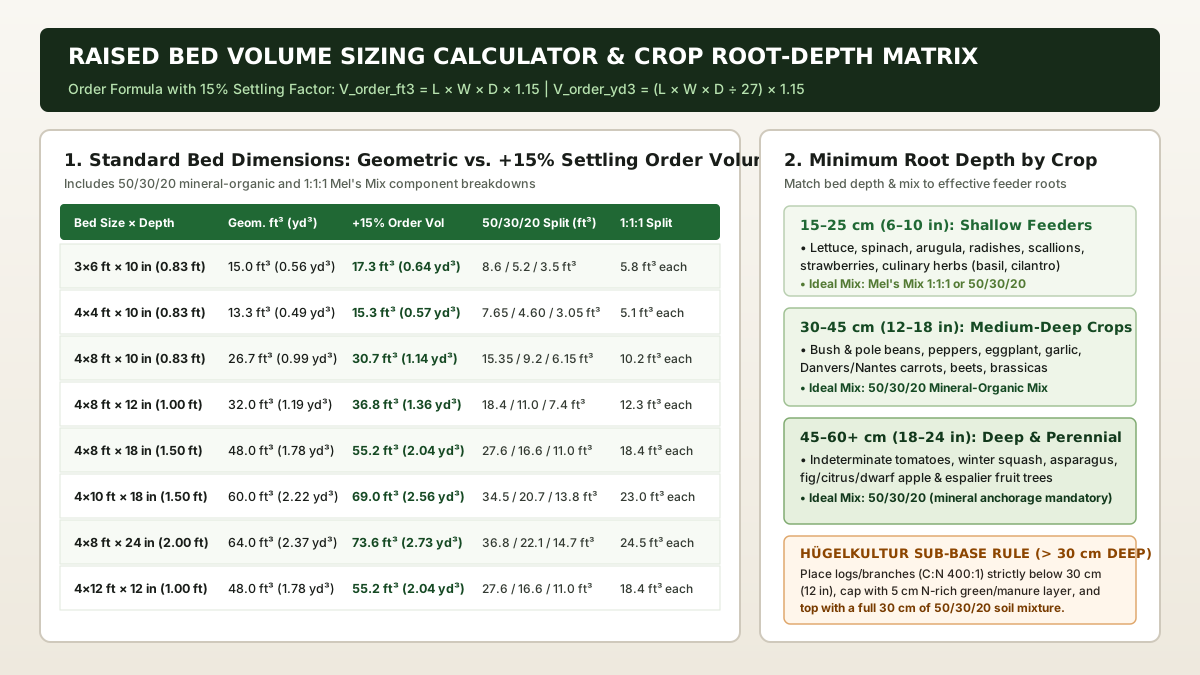
3. Standard Raised Bed Volume Reference Table (With 15% Settling Factor)
Bed Dimensions (W × L × Depth) |
Geometric Volume (ft³ / yd³) |
Order Volume w/ +15% Settling (ft³ / yd³) |
50/30/20 Split (Topsoil / Compost / Aggregate ft³) |
Mel’s Mix 1:1:1 Split (Peat / Vermiculite / Compost ft³) |
Spring Top-Dress (1.5 in / 3.8 cm Compost ft³) |
|---|---|---|---|---|---|
3 ft × 6 ft × 10 in (0.83 ft) |
15.0 ft³ (0.56 yd³) |
17.3 ft³ (0.64 yd³) |
8.65 / 5.19 / 3.46 ft³ |
5.77 / 5.77 / 5.77 ft³ |
2.25 ft³ (2.3 bags at 1 ft³) |
4 ft × 4 ft × 10 in (0.83 ft) |
13.3 ft³ (0.49 yd³) |
15.3 ft³ (0.57 yd³) |
7.65 / 4.60 / 3.05 ft³ |
5.10 / 5.10 / 5.10 ft³ |
2.00 ft³ (2.0 bags at 1 ft³) |
4 ft × 8 ft × 10 in (0.83 ft) |
26.7 ft³ (0.99 yd³) |
30.7 ft³ (1.14 yd³) |
15.35 / 9.21 / 6.14 ft³ |
10.23 / 10.23 / 10.23 ft³ |
4.00 ft³ (4.0 bags at 1 ft³) |
4 ft × 8 ft × 12 in (1.00 ft) |
32.0 ft³ (1.19 yd³) |
36.8 ft³ (1.36 yd³) |
18.40 / 11.04 / 7.36 ft³ |
12.27 / 12.27 / 12.27 ft³ |
4.00 ft³ (0.15 yd³) |
4 ft × 8 ft × 18 in (1.50 ft) |
48.0 ft³ (1.78 yd³) |
55.2 ft³ (2.04 yd³) |
27.60 / 16.56 / 11.04 ft³ |
18.40 / 18.40 / 18.40 ft³ |
4.00 ft³ (0.15 yd³) |
4 ft × 8 ft × 24 in (2.00 ft) |
64.0 ft³ (2.37 yd³) |
73.6 ft³ (2.73 yd³) |
36.80 / 22.08 / 14.72 ft³ |
24.53 / 24.53 / 24.53 ft³ |
4.00 ft³ (0.15 yd³) |
4 ft × 10 ft × 18 in (1.50 ft) |
60.0 ft³ (2.22 yd³) |
69.0 ft³ (2.56 yd³) |
34.50 / 20.70 / 13.80 ft³ |
23.00 / 23.00 / 23.00 ft³ |
5.00 ft³ (0.19 yd³) |
4 ft × 12 ft × 12 in (1.00 ft) |
48.0 ft³ (1.78 yd³) |
55.2 ft³ (2.04 yd³) |
27.60 / 16.56 / 11.04 ft³ |
18.40 / 18.40 / 18.40 ft³ |
6.00 ft³ (0.22 yd³) |
Annual Spring Replenishment Rule: Do not till established raised beds, which shatters fungal hyphae and brings dormant weed seeds to the surface. Instead, spread 2.5 to 5.0 cm (1.0 to 2.0 in) of finished compost across the surface each spring (2.7 to 5.3 ft³ per 4×8 ft bed) to replace the organic carbon oxidized during the prior year.
Takeaway: Multiply geometric volume (L × W × D) by 1.15 before ordering so Year-1 consolidation and microbial respiration leave your bed filled to the rim, then top-dress 2.5 to 5.0 cm of compost each spring.
5-Gallon (19 L) Aerated Compost Tea Recipe & USDA Pathogen-Safety Protocol
Once a raised bed is filled and planted, growers often apply an actively aerated compost tea recipe to inoculate the rhizosphere after transplanting or seasonal soil disturbance. As detailed in our companion guide on what compost tea is and how it differs from solid compost and leachate, Actively Aerated Compost Tea (ACT) is an oxygenated microbial suspension of aerobic bacteria, flagellates, amoebae, and beneficial fungi (University of Vermont Extension). Because soluble NPK levels in finished ACT typically sit in the single-digit or low tens of parts per million (ppm), ACT functions as a biological root-zone inoculant, never as a replacement for granular NPK fertilizers.
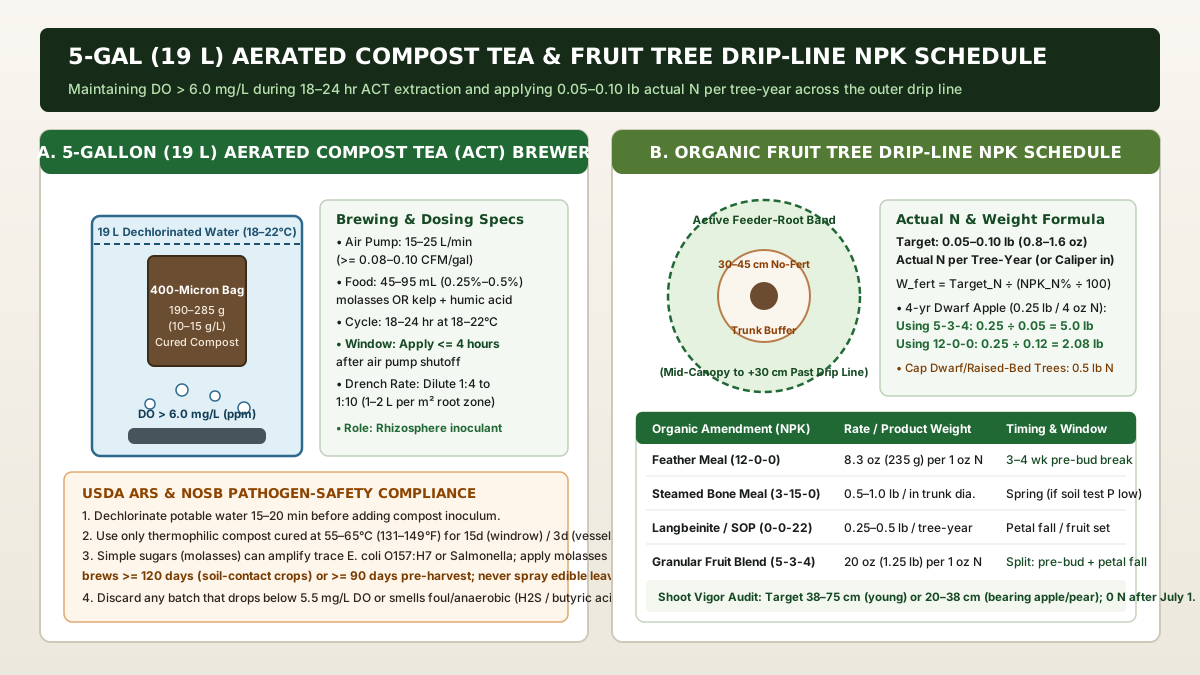
1. Standard 5-Gallon (19 L) Aerated Compost Tea Formulation
| Ingredient / Parameter | Metric Specification (19 L Batch) |
US Household Measure (5 Gal Batch) |
Physiological & Engineering Function |
|---|---|---|---|
| Dechlorinated Potable Water | 19.0 L at 18–22°C |
5.0 gallons at 64–72°F |
Bubble vigorously for 15–20 min before adding compost to off-gas free chlorine (Cl2), or add 0.05–0.1 g ascorbic/humic acid to neutralize chloramines |
| Mature Compost or Vermicompost Inoculant | 10–15 g/L (190–285 g total dry-equivalent moist weight) |
~2.0 to 2.5 cups (475–600 mL) inside a 400-micron nylon mesh bag |
Supplies dormant and active aerobic bacteria, protozoa, and fungal hyphae; 400-micron mesh lets microbes exit while retaining coarse particles |
| Microbial Food Option A: Fungal/Balanced (No Simple Sugars) | 0.10%–0.25% v/v soluble kelp (19–48 mL) + humic acid (10–20 mL) + 5 g yucca extract |
1.5–3.0 Tbsp liquid kelp + 1 Tbsp humic acid |
Cold-processed Ascophyllum nodosum kelp and humic substances feed beneficial fungal hyphae and bacteria without triggering pathogen regrowth |
| Microbial Food Option B: Bacterial Boost (Molasses) | 0.25%–0.50% v/v (45–95 mL) unsulfured blackstrap molasses |
1.5–3.0 fl oz (3–6 Tbsp) unsulfured molasses |
Rapidly multiplies aerobic heterotrophic bacteria, but spikes biological oxygen demand (BOD) and triggers USDA NOSB 120/90-day rules |
Dissolved Oxygen (DO) & Airflow |
Strictly DO > 6.0 mg/L (ppm) (minimum safety floor 5.5 mg/L) |
Commercial diaphragm air pump delivering >= 0.08–0.10 CFM/gal (15–25 L/min) |
Continuous rolling agitation detaches biofilms from compost particles and prevents anaerobic fermentation |
| Brew Duration & Application Window | 18–24 hours brew cycle; apply within <= 4 hours of pump shutoff |
Soil drench diluted 1:4 to 1:10 (1–2 L/m²) or undiluted coarse drench |
Once aeration stops, high-density microbes consume dissolved oxygen within 2–4 hours, shifting the liquid anaerobic |
2. Why Dissolved Oxygen (DO > 6.0 mg/L) and Water Temperature Govern Brew Quality
Oxygen solubility in fresh water at sea level drops as water warms: saturated dissolved oxygen is 9.09 mg/L at 20°C (68°F), 8.26 mg/L at 25°C (77°F), and 7.56 mg/L at 30°C (86°F). Simultaneously, bacterial respiration rates roughly double for every 10°C rise in temperature (Q10 ≈ 2.0).
If you brew compost tea in a hot garage above 26°C (79°F) or over-dose molasses past 0.5% v/v (> 95 mL per 19 L) using a weak aquarium air stone (< 3 to 5 L/min), bacterial multiplication strips dissolved oxygen below 2.0 mg/L within 8 to 12 hours. Below 2.0 to 5.5 mg/L DO, obligate aerobes suffocate and facultative anaerobes ferment sugars into phytotoxic short-chain volatile fatty acids (butyric, propionic, and acetic acids), reduced sulfur gases (H2S), and sour alcohol odors that damage fine root hairs on contact. Always smell the brew before application: finished ACT must smell clean, earthy, and forest-like; if it smells sour, putrid, or like sewage, dump it away from food crops.
3. USDA ARS and NOSB Food-Safety Rules for Molasses-Brewed Tea
Microbiological studies by the U.S. Department of Agriculture Agricultural Research Service (USDA ARS) and task force guidance from the National Organic Standards Board (NOSB) establish strict food-safety boundaries for home and market growers:
- The Molasses Pathogen-Amplification Mechanism: USDA ARS researchers demonstrated that if even trace cells of human enteric pathogens (Escherichia coli O157:H7 or Salmonella enterica) survive in incompletely cured manure compost, adding simple carbohydrates like molasses (
0.25% to 1.0%) causes those pathogens to multiply by 100-fold to 10,000-fold during a 24-hour aerated brew. Conversely, brewing fully cured thermophilic compost in potable water without molasses (or using only kelp and humic acid) did not support E. coli or Salmonella regrowth. - Thermophilic Compost Verification: Use only compost verified to have maintained 55 to 65°C (131 to 149°F) for at least 15 days with 5 turnings in a windrow system (or 3 consecutive days in an aerated static pile / in-vessel system), or pure vermicompost tested negative for fecal coliforms (University of Vermont Extension).
- The 120 / 90-Day Pre-Harvest Interval Rule: Under USDA NOP / NOSB rules, any compost tea brewed with supplemental simple-sugar additives (molasses, cane sugar, fruit juice) must be managed under raw-manure pre-harvest intervals: apply at least 120 days before harvest for crops whose edible portion touches the soil surface (lettuce, strawberries, carrots, radishes, bush beans) or at least 90 days before harvest for staked/trellised or tree crops where edible parts do not touch soil. Never spray molasses-brewed compost tea onto edible foliage or developing fruit; apply it strictly as a pre-plant or early-season soil drench around the base of plants.
- Between-Batch Brewer Sanitation: Biofilms inside plastic buckets, vinyl tubing, and air diffusers harbor anaerobic pockets. Immediately after emptying a batch, scrub the bucket, brew bag, and diffuser with hot soapy water followed by a
3%hydrogen peroxide or1:50household bleach sanitizing rinse, then air-dry completely.
Takeaway: Brew 10 to 15 g/L (~2 cups / 5 gal) of thermophilic compost at DO > 6.0 mg/L for 18 to 24 hours at 18 to 22°C, apply within 4 hours of turning off the air pump, and omit molasses (or observe the USDA 120/90-day soil-drench rule) on food crops.
Organic Fertilizer for Fruit Trees: Age-Based Actual Nitrogen & Drip-Line Schedule
Whether you grow dwarf apple, pear, peach, fig, or citrus trees in deep 4×4 ft or 4×8 ft raised beds (>= 18 to 24 in deep filled with the 50/30/20 mineral-organic mix) or in adjacent backyard orchard rows, woody perennial fruit trees follow a completely different nutrient calendar than annual vegetables (Utah State University Extension). While indeterminate tomatoes demand continuous summer nitrogen and potassium feeding, fruit trees must absorb their entire annual nitrogen budget in early spring so new shoots harden off before autumn frost.
1. The Extension Actual-Nitrogen Formula and Shoot-Vigor Calibration
University extension pomologists at Utah State University and Selecting and Using Organic Fertilizers (USU Extension) size annual spring nitrogen applications using tree age (years since planting) or trunk caliper (diameter in inches measured 6 inches / 15 cm above the graft union), adjusted by measuring the previous summer’s annual terminal shoot growth:
Target_Actual_N_lb = Tree_Age_Years × Rate_Factor
Weight_Fertilizer_lb = Target_Actual_N_lb ÷ (NPK_N_Percent ÷ 100)
Where:
Rate_Factor=0.05 to 0.10 lb(0.8 to 1.6 oz, or23 to 45 g) of actual Nitrogen (N) per year of tree age (or per inch of trunk caliper). Use0.05 to 0.06 lb N/yrfor dwarf/semi-dwarf rootstocks (e.g., M.9, Bud.9, G.11, G.41, Gisela 5) or trees planted in compost-amended raised beds; use0.08 to 0.10 lb N/yrfor standard trees in low-OM mineral soil.- Maximum Annual Nitrogen Caps: Never exceed
0.50 lb(8.0 oz/227 g) of actual N per year for dwarf, semi-dwarf, espalier, or raised-bed fruit trees, or1.0 lb(16 oz/454 g) of actual N for full-size mature standard trees. - Terminal Shoot-Growth Audit (Override Rule): Before applying any spring nitrogen, measure last year’s growth ring to the tip of several outer upper branches (Utah State University Extension):
- Young non-bearing fruit trees (Years 1 to 3): Target
38 to 75 cm(15 to 30 in) of new terminal shoot growth per season. - Mature bearing apple, pear, plum, sweet cherry, and apricot: Target
20 to 38 cm(8 to 15 in) of annual terminal growth. - Mature bearing peach and nectarine (which bear fruit exclusively on 1-year-old red shoot wood): Target
30 to 45 cm(12 to 18 in) of annual shoot growth. - If last season’s shoot growth exceeded the upper target (
> 38 cmon bearing apples/pears or> 45 cmon peaches), reduce the spring nitrogen rate by50%or skip nitrogen completely for one season. Over-fertilizing pome fruits with nitrogen forces lush, rank water sprouts, shades developing fruit, reduces red skin anthocyanin color and calcium concentration (causing bitter pit in apples), and drastically increases susceptibility to fire blight (Erwinia amylovora).
- Young non-bearing fruit trees (Years 1 to 3): Target
2. Worked Numerical Example: Dosing a 4-Year-Old Dwarf Apple Tree in a Raised Bed
Suppose you have a 4-year-old dwarf ‘Honeycrisp’ or ‘Fuji’ apple tree (on G.11 or M.9 rootstock, 2.5 in trunk caliper) growing in a 4 ft × 4 ft × 24 in raised bed whose terminal shoots grew 18 cm (7 in) last summer (slightly below the 20 to 38 cm bearing target):
- Calculate Target Actual Nitrogen (
0.0625 lb/1.0 ozactual N per tree-year):Target_Actual_N = 4 years × 0.0625 lb/yr = 0.25 lb(4.0 ozor113.4 g) of actual Nitrogen. - Convert to Bulk Organic Fertilizer Weight (
W_fertilizer = Target_N ÷ (NPK_N% ÷ 100)):- Option 1: Balanced Granular Organic Fruit Tree Fertilizer (
5-3-4analysis,5% N):W_5_3_4 = 0.25 lb ÷ (5 ÷ 100) = 0.25 ÷ 0.05 = 5.00 lb(80 ozor2.27 kgof product). (This5.0 lbdose simultaneously supplies5.0 × 0.03 = 0.15 lb(2.4 oz) ofP2O5and5.0 × 0.04 = 0.20 lb(3.2 oz) ofK2O.) - Option 2: Single-Ingredient Feather Meal (
12-0-0analysis,12% N) for High-Phosphorus Compost Beds: If your raised bed soil test already shows high phosphorus (> 60 to 100 ppm Mehlich-3 P) from the30%compost fraction, skip phosphorus-containing blends and use pure feather meal (see our organic fertilizer by crop guide):W_feather_meal = 0.25 lb ÷ (12 ÷ 100) = 0.25 ÷ 0.12 = 2.08 lb(33.3 ozor945 g, approximately7 cupsof12-0-0feather meal), paired with0.90 lb(14.4 oz) of langbeinite (0-0-22) to supply0.20 lbof chloride-free potassium (K2O) and0.10 lbof magnesium (Mg).
- Option 1: Balanced Granular Organic Fruit Tree Fertilizer (
3. Organic Fruit Tree Amendment Matrix & Release Kinetics
| Organic Amendment | Typical Guaranteed Analysis (N-P2O5-K2O + Secondary) |
Microbial / Chemical Release Window | Product Weight to Supply 1.0 oz (28.3 g) Actual N |
Specific Role & Soil Test Condition in Fruit Trees |
|---|---|---|---|---|
| Feather Meal (Hydrolyzed poultry keratin) | 12-0-0 to 13-0-0 |
Slow-to-moderate (4–12 weeks microbial mineralization) |
8.3 oz (235 g / ~1.75 cups) of 12-0-0 |
Primary spring nitrogen source when raised bed compost already supplies ample phosphorus (P); resists spring rain leaching |
| Blood Meal (Dried slaughterhouse protein) | 12-0-0 to 13-0-0 |
Fast (1–4 weeks; rapidly converts to NH4+ and NO3-) |
8.3 oz (235 g / ~1.5 cups) of 12-0-0 |
Rapid early-spring rescue for pale, N-deficient young trees; split into 2 half-doses to prevent root salt burn |
| Alfalfa Meal or Pellets | 2.5-0.5-2.5 + triacontanol |
Moderate (3–8 weeks) |
40.0 oz (2.50 lb / 1,134 g) |
Gentle soil conditioner and mild N-K booster for young trees and berry bushes; stimulates rhizosphere fungi |
| Steamed Bone Meal | 3-15-0 + 18%–22% Calcium (Ca) |
Slow (2–6 months; requires pH < 7.0 to solubilize) |
Apply by P need: 0.5–1.0 lb per inch of trunk caliper |
Supplies phosphorus for feeder-root branching and flower bud differentiation; apply only when soil test P is low (< 30 ppm) and pH is < 7.0 |
Sulfate of Potash (0-0-50) or Langbeinite (0-0-22) |
0-0-50 (SOP) or 0-0-22 + 11% Mg + 22% S |
Moderate-to-fast (water-soluble mineral sulfate; < 2% Cl) |
Apply by K need: 0.25–0.50 lb Langbeinite per tree-year (cap 2.0 lb) |
Drives fruit sugar accumulation (°Brix), skin color, cell turgor, and winter wood hardiness without chloride toxicity |
| Kelp Meal (Ascophyllum nodosum) | 1-0-4 + 60+ chelated trace minerals & cytokinins |
Slow (4–16 weeks) |
0.5–1.0 lb (225–450 g) per tree in early spring |
Supplies boron (B), zinc (Zn), iron (Fe), and manganese (Mn) critical for pollen tube growth and fruit set |
| Granular Organic Fruit Tree Blend | 4-4-4 or 5-3-4 + mycorrhizal inoculant |
Staged slow release (2–10 weeks) |
25.0 oz (1.56 lb) of 4-4-4 or 20.0 oz (1.25 lb) of 5-3-4 |
All-in-one spring feeding when soil test P and K sit in the medium sufficiency range |
4. Concentric Drip-Line Placement Geometry and Phenological Cutoffs
How and when you place organic fertilizers around a fruit tree determines whether nutrients reach active feeder roots or trigger crown rot and winter freeze injury (Utah State University Extension):
- The 30 to 45 cm (12 to 18 in) Trunk Buffer Zone: Never pile granular organic fertilizers, fresh compost, or wood-chip mulch directly against the bark of the root crown or within 30 to 45 cm (12 to 18 in) of the trunk. Heavy woody anchor roots near the trunk have suberized bark with minimal nutrient absorption capacity, and concentrating damp organic nitrogen against the graft union invites Phytophthora crown and collar rot.
- Drip-Line Band Broadcasting: Fine absorbing feeder roots concentrate in the top
15 to 35 cm(6 to 14 in) of soil in an expanding ring extending from halfway out under the branch canopy to 30 cm (12 in) beyond the outer branch drip line (or across the outer perimeter ring of a raised bed). Rake back surface mulch, broadcast your weighed organic amendments evenly across this concentric band, scratch them 2 to 5 cm (1 to 2 in) into the upper topsoil so poultry/feather proteins do not volatilize ammonia (NH3) on the surface, water deeply with2.5 cm (1 in)of irrigation, and pull the mulch back into place (keeping mulch 10 to 15 cm off the trunk). - Phenological Timing & The July 1 Nitrogen Cutoff: Because organic proteins like feather meal (
12-0-0) and alfalfa meal require 2 to 4 weeks of warm soil microbial mineralization (> 10°C / 50°Fsoil temperature) to release plant-available ammonium (NH4+) and nitrate (NO3-), apply 100% of annual nitrogen 3 to 4 weeks before spring bud break (or split50%at3 to 4 weeks pre-bud breakand50%atpetal fall / fruit set). Never apply nitrogen fertilizers after mid-June to July 1. Late-summer nitrogen release forces tender, unlignified autumn terminal shoots that fail to set dormant winter buds and split or die back during the first hard autumn freeze (< -4°C / 25°F).
Takeaway: Dose fruit trees at 0.05 to 0.10 lb (0.8 to 1.6 oz) of actual N per tree-year (W_fert = Target_N ÷ (NPK_N% ÷ 100)), calibrate against last season’s terminal shoot growth (20 to 38 cm for bearing apple/pear; 30 to 45 cm for peach), broadcast in a concentric drip-line band 30 to 45 cm away from the trunk before bud break, and halt all nitrogen before July 1.