University of Maryland Extension says a standard soilless transplant mix is enough for sowing most vegetable seeds indoors. A finer mix sold as seed starter helps extremely small seeds, and Maryland says you can skip it for ordinary vegetable seed. The nutrient question is separate. Utah State University Extension tells you to read the bag: some mixes include a starter charge that lasts a few weeks at most, and soilless mixes in general do not hold enough nutrients to keep a seedling growing. Maryland, in its August 2026 seed-starting guide, describes the common case differently: soilless media often include a small charge that supports plants for 6 to 8 weeks after germination.
Use the sheet below on the bag you are holding. Copy the printed claim, the texture, the drainage ingredients, and the fertilizer line. If a line is missing, write unknown. The words “seed starting” on the front do not mean the mix is fertilizer-free, and the words “potting soil” do not mean the bag contains garden soil.
This page covers home vegetable sowing and moving those seedlings into a larger pot indoors, in US conditions described by these extension guides. It does not rank brands or set in-ground fertilizer rates. Those rates are on the organic fertilizer by crop guide. Known Source Farms is an independent information site and does not sell mix, seed, or fertilizer.
| What you are deciding | What the extension pages support | What you still copy from the bag |
|---|---|---|
| Sowing ordinary vegetable seed | A standard all-purpose transplant mix (Maryland, 2023 and 2026) | Claim, texture, drainage, fertilizer |
| Sowing extremely small seed | A finer seedling mix is useful; it is not required for general vegetable seed | Whether the bag actually says “fine” |
| Moving a seedling to a larger pot | Same soilless media jobs: air, water, nutrients, root room, support | Fertilizer line for that second bag |
| When to start feeding | Only after the label says what is already in the mix | Analysis, “starter charge,” or “none” |
Copy four fields before you pick a stage
Open the label and write only what is printed. A similar bag from last year does not fill a blank. Maryland lists the names shoppers actually see: potting soil, planting mix, potting mix, transplant mix, container substrate, and seed starter. Those names describe a marketing category. The four fields below describe the material.
| Field | What to copy | If the bag is silent | How it changes sowing or potting up |
|---|---|---|---|
| Product claim | The use words on the front: seed starter, potting mix, transplant mix, potting soil | Unknown. Leave the use unset. | A “seed starter” claim is a hint to check texture. It does not pass the other three rows. |
| Texture | Fine and even, standard, or chunky with bark or the words “forest products” | Unknown. Do not call it fine because the name says seed. | Maryland limits the finer mix to extremely small seeds. A standard mix covers general vegetable sowing. |
| Drainage | Named soilless ingredients (peat, coir, perlite, vermiculite, rice hulls) or the words soil, topsoil, or forest products | Unknown. “Potting soil” on the front is not proof the bag is soilless. | Sow and pot up in a light soilless mix. Skip garden soil and heavy forest-product mixes in a tray or a small pot. |
| Fertilizer | A printed analysis, a starter-charge sentence, or a sentence that says none | Unknown. Leave it unknown. | Do not start Maryland’s 6-week wait, and do not start Utah State’s weekly feeding, from the product name. |
Copy this blank block for the bag on the bench:
| Field | Your bag |
|---|---|
| Product claim | |
| Texture | |
| Drainage | |
| Fertilizer line | |
| Stage | Sow, pot up, or wait |
A filled example, using only the categories Maryland names, shows the rule. It is not a product we opened.
| Field | Teaching example | Stage note |
|---|---|---|
| Product claim | All-purpose transplant mix | Candidate for sowing ordinary vegetable seed |
| Texture | Standard; the label does not say fine | Keeps the fine-mix exception unused |
| Drainage | Peat, perlite, and vermiculite; no soil or forest products listed | Fits a tray at least 2 inches deep with drain holes |
| Fertilizer | “Starter charge included”; no week count printed | Follow that label. Do not write in Maryland’s 6 to 8 weeks unless the bag says so |
Takeaway: Four copied fields, with blanks left as unknown, are the decision. The front-of-bag name is only the first field.
When the fertilizer line is missing
Maryland and Utah State both tell you that nutrients matter, and they do not describe a typical bag the same way. Treat that disagreement as a reason to read your label, not as a number you can average.
Maryland’s August 2026 guide says soilless growing media often contain a small amount of fertilizer, enough to support plants for 6 to 8 weeks after germination. In the watering section of the same guide, Maryland says most potting mixes contain enough fertilizer to grow a seedling for at least 6 weeks, and to wait before you add more. When you do add fertilizer, use a water-soluble product and follow the label dose for indoor plants or transplants. Rinse any liquid fertilizer off the leaves. Young seedlings are easily damaged by too much fertilizer, especially if the roots have dried out.
Utah State’s February 2025 fact sheet says soilless mixes used for seedlings, and potting soil, generally do not have the nutrients required to sustain growth. Some mixes include a starter fertilizer that lasts a few weeks at most. Check the label to see what, if anything, is present. Utah State also says fertilizer will be necessary when you grow in soilless media. If you move a seedling into a larger container, a slow-release granular fertilizer can be a fit. For a liquid or water-soluble fertilizer, use the seedling rate on that fertilizer’s label. If the fertilizer label has no seedling rate, Utah State’s fallback is half the usual concentration, once a week. Too much fertilizer pushes soft growth and weak stems. Utah State says it is better to stay a little lean.
Put those statements on the sheet like this:
| What the bag says | What you may do | What you leave off the sheet |
|---|---|---|
| A starter charge or an analysis is printed | Follow that bag’s own timing and dose. Maryland’s rinse-and-label warning still applies when you add more later. | Maryland’s 6 to 8 weeks, unless the bag prints a time |
| The bag says no fertilizer is included | You can sow in a light soilless mix. Plan to feed from a fertilizer label. Use Utah State’s half-strength weekly fallback only when that fertilizer label has no seedling rate. | Any assumption that “most mixes” already fed this bag |
| The fertilizer line is absent | Write unknown. You may still sow if texture and drainage pass, because the seed’s first need is a warm, moist medium. | Both the 6-week wait and the weekly feed, until a label tells you which one fits |
Maryland’s 2023 containers page adds a class description you can use only when the bag matches it. Conventional mixes have lime and chemical fertilizer added. Organic mixes use organic fertilizers and often contain compost. Mixes certified organic by the Organic Materials Review Institute differ, in the 2026 guide, by using organic fertilizers and natural wetting agents such as yucca extract. If your bag does not say conventional, organic, or OMRI, leave that box blank too.
After the plants are in garden soil, nutrient rates come from a soil test and a fertilizer analysis. Use the organic fertilizer guide for beds, lawns, and fruit trees. That guide excludes containers, which is why the mix sheet lives here.
Takeaway: A silent fertilizer line stays unknown. Neither extension’s typical-bag sentence is a substitute for your label.
Is a potting mix fit for sowing?
Maryland’s 2023 containers page answers this for vegetable seed trays: buy a soilless growing mix (also called growing mix, transplant mix, or potting mix) and use a standard all-purpose transplant mix. A special finer seedling mix is useful only for extremely small seeds. The August 2026 guide repeats the exception and widens it slightly: seed-starter media have a finer texture that helps very small seeds germinate, and they are not essential for general vegetable seed starting.
Skip two materials both Maryland pages name. Garden soil is too dense for a container. The 2026 guide puts soil at about 75 pounds per cubic foot, against about 10 pounds per cubic foot for high-quality soilless media. Soil holds water in small pores and can drown roots, especially in the shallow trays used for seed. It may also carry weed seed and pathogens. Heavy, dense potting mixes that contain “forest products” are the other skip. If the label lists forest products, do not use that bag for the tray.
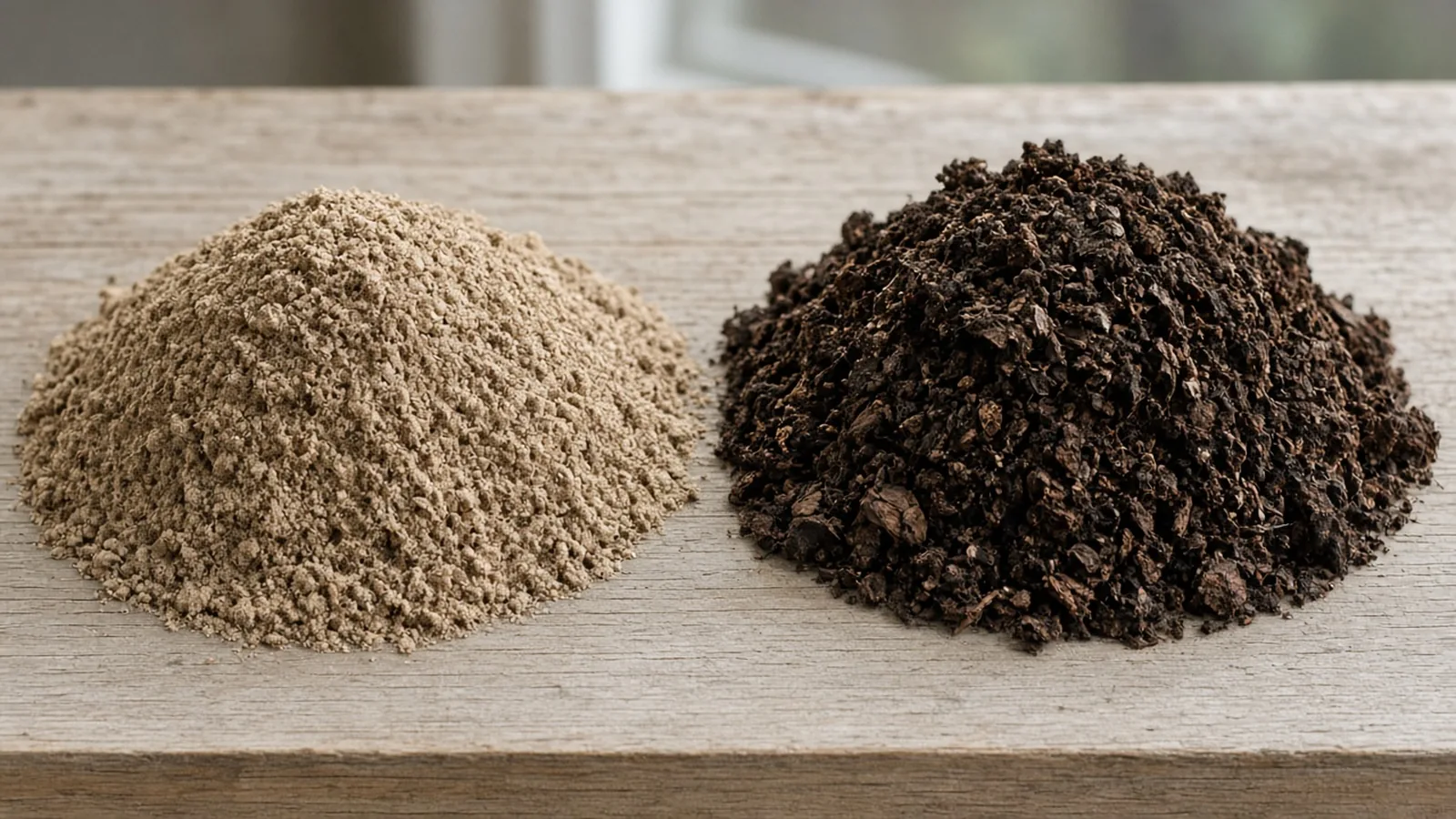
Figure 1. Texture you can compare with the bag: a fine, even mix beside a coarse, barky mix. This is an illustration of the difference Maryland describes, not a test of two brands.
Soilless mixes earn their place because peat holds water while large pores let the excess drain. Maryland names sphagnum peat, coconut coir, perlite, vermiculite, composted bark, compost, and rice hulls as common ingredients. The 2023 page notes that some organic mixes replace peat and perlite with coir and rice hulls. Those are ingredient families, not a contents list for an unlabeled bag. If the ingredients are not printed, the drainage field stays unknown.
The container is part of the drainage field. Both Maryland pages say almost any clean container works if it drains and is at least 2 inches deep. Flats without holes are for catching drips. Do not sow in an undrained flat and then leave it full of water.
Dry peat sheds water. Before you fill pots, Maryland says to moisten the mix, especially if it contains peat, until it feels like a wrung-out sponge. Fill to within an inch of the top and firm it lightly. A suitable sowing depth is about twice the seed’s diameter. Lettuce can stay on the surface or under a very light cover. A potting-mix temperature of 65 to 75°F suits germination of most vegetable seeds in the 2026 guide. After sprouts appear, take off any humidity cover. Saturated mix displaces oxygen, stops roots, and favors the water-mold diseases Maryland groups under damping-off.
Utah State adds a practical check once seedlings are up: heft a freshly watered tray, and water again when it is clearly lighter. The mix color shifts from dark to light brown as it dries. A mix that has gone too dry shrinks away from the pot wall. Let the medium dry moderately between waterings. Bottom-watering in 1 to 2 inches of water is fine if you discard the leftover water so the tray does not reabsorb it. Occasional watering from above flushes salts that build up from fertilizer and from dissolved minerals.
One published blend sits outside this sheet’s job. Maryland’s 2023 page says some gardeners mix finished, screened compost 1:2 with soilless media. Compost is heavier, about 25 pounds per cubic foot, and it supplies nutrients. This page does not test blends. If you make one, mark the fertilizer field “compost added” and still record texture and drainage.
Takeaway: A standard light soilless mix is Maryland’s sowing medium for ordinary vegetable seed. Finer seed mix is the small-seed case. Soil and heavy forest-product mixes stay out of the tray.
Can seed-starting mix go into a larger pot?
A seed-starting mix can be the medium you pot into when it passes the same drainage test as any other soilless mix: light ingredients, no garden soil, no heavy forest products. Maryland defines growing media by the jobs they do, which are the same at sowing and at potting up: supply air, water, and nutrients, give roots room, and hold the plant up. The name “seed starting” does not retire the mix, and it does not tell you how long any nutrients will last. Use the fertilizer row from the earlier section for the bag you fill the new pot with.
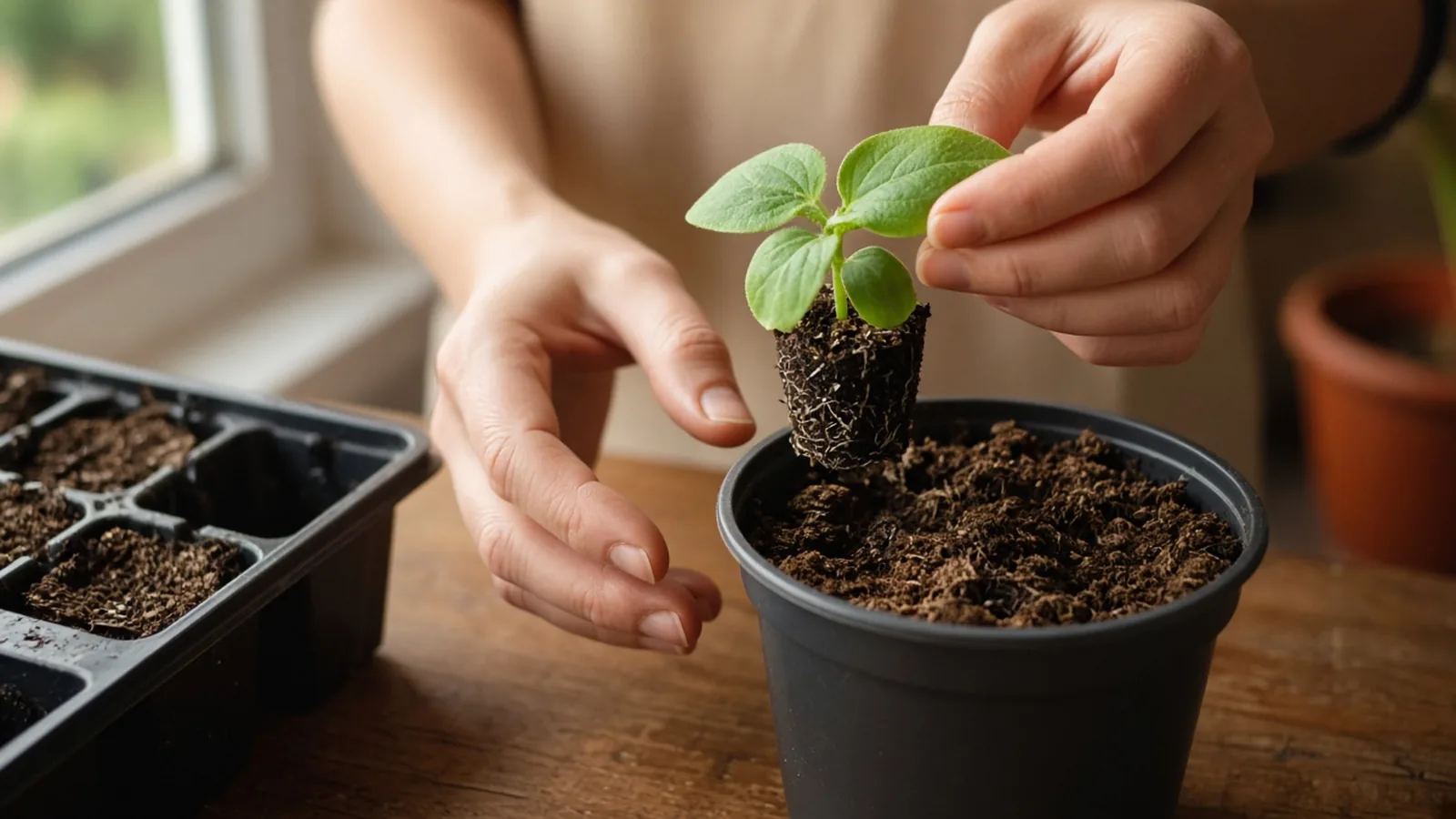
Figure 2. The indoor move from a cell tray into a larger pot. Maryland says to hold a leaf. The photo illustrates that move. It is not a record of root density or of a particular mix.
When to move the plant depends on how you sowed it. Maryland and Utah State give different cues. Use the cue that matches your tray, and write that cue on the sheet.
| How the seed was sown | Cue to pot up | Source |
|---|---|---|
| A shared flat, seedlings not already in their own cells | Soon after the first true leaves appear above or between the seed leaves | Maryland, August 2026 |
| Tomato, pepper, or eggplant started one seed per cell | Into a larger container 2 to 3 weeks after germination | Maryland, August 2026 |
| Leaves of neighbors overlapping, or a thick root mat on the bottom | Lift by a leaf and check; then move up | Utah State, February 2025 |
How deep to set the stem is also unresolved between these two pages. Maryland, describing the move out of a seedling flat, says to set the plant so the leaves and growing point sit only slightly above the mix, and that most of the stem can be buried. Utah State, describing the move out of an open flat, says to plant at the same depth the seedling already grew. Do not blend those into one depth. Pick the guide you are following for that move and write it on the sheet. Planting a tall tomato into a trench outdoors is a later step in Maryland’s guide, and it is outside this page.
Utah State says to handle the seedling by the leaves. Some roots will break when you separate plants from an open flat. Water after you firm the mix. The number of later moves depends on the starting container, how fast the plant grows, and how long it will stay indoors. This page stops at the indoor pot. Hardening off and planting into the garden are separate jobs.
Takeaway: Seed-starting mix can fill the next pot when the drainage field passes. The fertilizer line, the pot-up cue, and the planting depth each stay attached to the source that stated them.
Mark the stage only after the blanks are honest
Use the copied sheet, not the product name, to mark one stage.
| Sheet result | Stage you can mark |
|---|---|
| Texture and drainage unknown, or the label lists soil, topsoil, or forest products | Wait. Do not sow this bag in a shallow tray, and do not pot up into it. |
| Soilless and light, and you can see a fine or standard texture (or the label says so); fertilizer printed, none, or unknown | Sow ordinary vegetable seed. If fertilizer is unknown, sow without starting either feeding schedule. |
| Soilless, and the label says fine | Use it for extremely small seeds. Ordinary vegetable seed can still go into a standard mix. |
| Soilless and light, and you are moving a plant that has hit a cue in the table above | Pot up. Apply a feeding schedule only when this bag, or the fertilizer you add, prints one. |
| Any field unknown on a bag that will hold a transplant for weeks | Leave the feeding plan blank until you have a label. |
Pre-moisten peat mixes, keep the medium moist, and empty standing water from an undrained tray. Those steps come from the Maryland and Utah State pages cited above. They do not change a failed drainage row into a pass.
Takeaway: Sow when texture and drainage pass. Feed only from a printed line. Pot up on one extension cue, at one stated depth.
What this sheet does not decide
Outdoor transplanting, hardening off, and garden fertilizer rates are outside this page. Cell size is too: Maryland lists suggested cell areas by crop in the 2026 guide, and that choice is about root room in the tray, not about which bag to buy. Brand comparisons and home recipes are outside it as well, apart from the single compost ratio Maryland published, which this page does not retest.
Maryland’s guides already explain the standard-mix choice and the small-seed exception. The sheet exists so a real label can be written down, including the fields the printer left off.
Takeaway: If the next decision is the garden bed, switch to the fertilizer guide. If it is still the bag, stay on the four fields.
Method and sources
Compiled on 11 October 2026 from University of Maryland Extension’s seed-starting guide (updated 14 August 2026), Maryland’s containers and potting-soil page (updated 20 February 2023), and Utah State University Extension’s peer-reviewed seedling-culture fact sheet (18 February 2025). Weight, time, and temperature figures are those publications’ descriptions of media and seedling care. They are not measurements of a bag sold under a brand name. Where the two universities describe fertilizer content or planting depth differently, both wordings are kept and the sheet tells you which blank to leave open.
This site does not sell growing media and is not the Texas farm that previously used this domain. Other notes are in the home growing articles and the article list.
Takeaway: Use Maryland for the mix type and the small-seed exception, Utah State and Maryland together for the fertilizer line, and the bag itself wherever either page would have to guess.