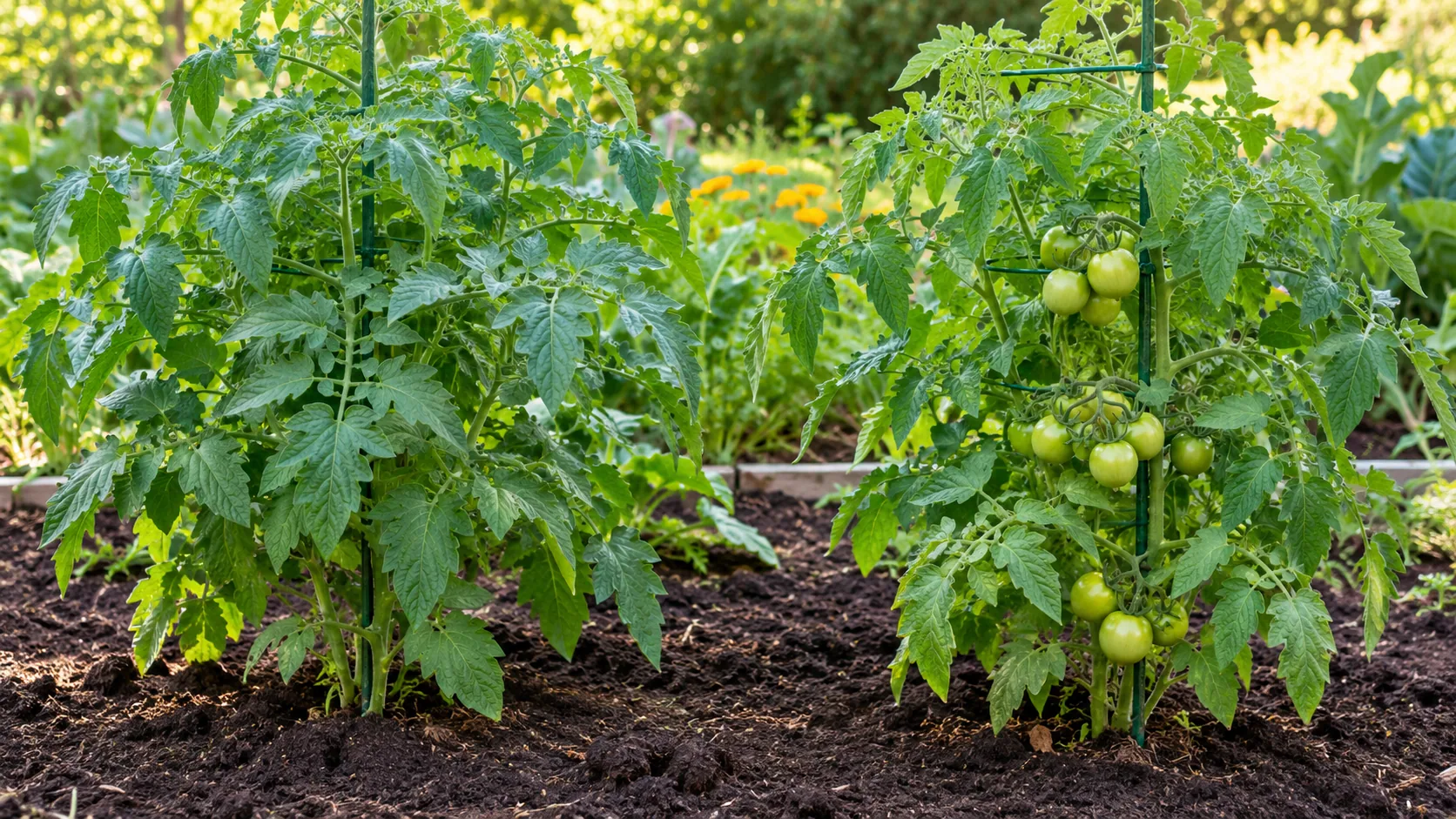
Too much nitrogen late in the season fails the fruiting stage. University of Minnesota Extension says nitrogen promotes leafy growth, and too much of it late can minimize or delay fruiting.
This page separates that home-garden warning from a high-tunnel foliar range. Yellow leaves on seedlings in a tray stay on the seedling log. Crop-wide bag math stays on the fertilizer-by-crop guide. This site is an independent information site. It is not the Texas farm that previously used this domain, and it does not sell fertilizer.
| Stage | What the page records | Dominant failure mode and prevention |
|---|---|---|
| Vegetative growth, home garden | UMN fertilizing guide: nitrogen promotes leafy growth. The tomato guide: too much nitrogen makes plants bushy, leafy, and slow to bear fruit | Another nitrogen application on a plant that is already all leaf. Prevention: stop adding nitrogen and use the soil test |
| First fruits enlarge | UMN tomato guide: side-dress 1/2 cup of 46-0-0, or 1 cup of 27-3-3, or 3-1/2 cups of 10-3-1 per 100 feet of row, in a six-inch band | Reading those three products as organic, or as “use the highest nitrogen.” Prevention: they are the measured alternatives on that page, scratched into the surface |
| Late season | UMN fertilizing guide: too much nitrogen late can minimize or delay fruiting | Blood meal or another high-nitrogen organic because fruit is slow. Prevention: do not add more nitrogen late |
| High-tunnel tissue test | Cornell, May 2017: 4–5% N in vegetative growth and 3.5–4% N during fruiting | Using the vegetative percent after fruit has set. Prevention: match the percent to the stage of the sample |
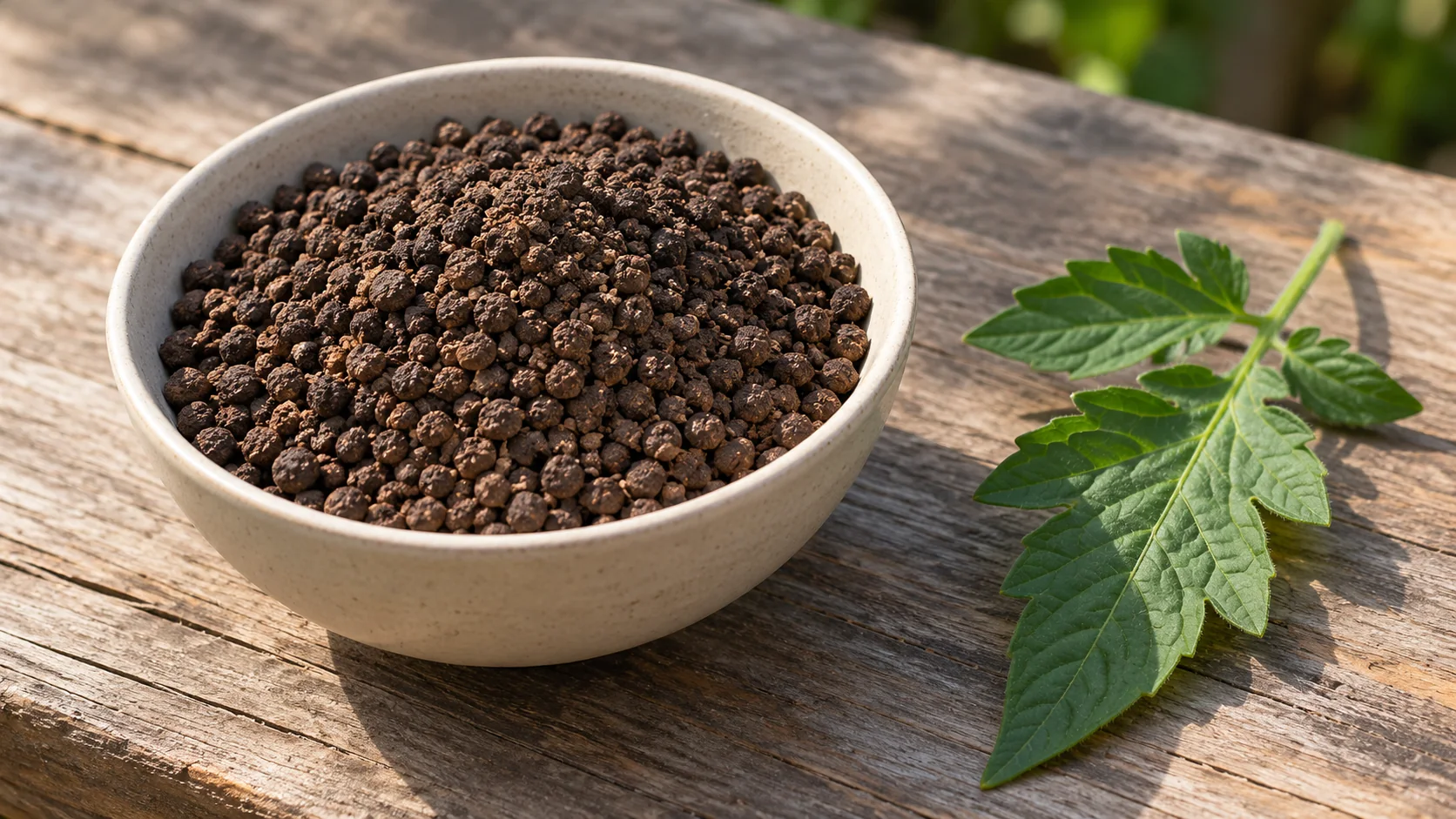
| Organic bag choice | UMN examples: blood meal 13-2-0, organic tomato fertilizer 3-6-4, fish fertilizer 5-1-1 | Choosing the bag because it says tomato. Prevention: multiply the printed percent by the bag weight and compare it with the soil-test nitrogen |
What the two stages are asking for
On the home-garden pages, vegetative growth is the leafy stage and fruiting is the stage nitrogen can delay. The fertilizing guide says plants lacking nitrogen yellow on older, lower leaves, while too much nitrogen causes excessive leafy growth and delayed fruiting. Phosphorus, on that page, supports root growth and fruiting, and potassium supports disease resistance and hardiness. Phosphorus and potassium are applied and incorporated before planting. They are not a switch to turn on when the first flower opens.
The tomato guide’s side-dress comes when the first fruits start to enlarge. The amounts are 1/2 cup of 46-0-0, or 1 cup of 27-3-3, or 3-1/2 cups of 10-3-1, for every 100 feet of row, spread in a six-inch band and scratched in. Those three analyses are the products named for that pass. The organic examples are on the other page. Compost or composted manure in spring or fall can mean no further fertilizer, depending on how much organic matter went on. Fresh manure is excluded because of bacteria and weeds.
A high tunnel is a different system. Cornell’s May 2017 sheet, “Nitrogen Fertility Options for Organic High Tunnels,” is about tunnel tomatoes in New York, not a backyard row. It says most organic nitrogen sources are not injectable and go on before planting, often with unbalanced phosphorus, calcium, and magnesium. Foliar samples in those tunnels started sufficient or even excess in nitrogen, then fell at mid-season. The foliar target it calls ideal is 4–5% N during vegetative growth and 3.5–4% N during fruiting. The fruiting target is lower than the vegetative target. It is not a reason to raise the bag’s nitrogen number when fruit appears.

Rules of thumb
If the plant is bushy and slow to set fruit, do not add nitrogen. That is the tomato guide’s failure, and the fertilizing guide’s late-season failure is the same nutrient.
If the first fruits are enlarging, use a measured side-dress only when you are following the product and the row length on the tomato guide. A bag of blood meal is not 1/2 cup of 46-0-0.
If a tissue test is the record you have, use 4–5% N only for the vegetative sample and 3.5–4% N only for the fruiting sample. Both numbers are the high-tunnel sheet. A home-garden bag does not print them.
If the soil test already recommends no extra phosphorus, the fertilizing guide says not to exceed that phosphorus recommendation. The organic tomato example it prints, 3-6-4, carries more phosphorus than nitrogen. Blood meal 13-2-0 is the high-nitrogen example. Fish fertilizer 5-1-1 sits between them.
A bag-weight example
Nutrient weight = bag weight × analysis ÷ 100.
The fertilizing guide’s own case is 10 pounds of 17-18-28 tomato food: 10 × 0.17 = 1.7 pounds of nitrogen, 10 × 0.18 = 1.8 pounds of P2O5, and 10 × 0.28 = 2.8 pounds of K2O. That 17-18-28 product is the inorganic tomato-food example on the same page. It is not one of the organic examples.
The same arithmetic on 10 pounds of the organic analyses that page lists:
| Analysis on the UMN page | Nitrogen | P2O5 | K2O |
|---|---|---|---|
| Blood meal 13-2-0 | 10 × 0.13 = 1.3 lb | 10 × 0.02 = 0.2 lb | 0 |
| Organic tomato fertilizer 3-6-4 | 10 × 0.03 = 0.3 lb | 10 × 0.06 = 0.6 lb | 10 × 0.04 = 0.4 lb |
| Fish fertilizer 5-1-1 | 10 × 0.05 = 0.5 lb | 10 × 0.01 = 0.1 lb | 10 × 0.01 = 0.1 lb |
Ten pounds is the weight in their 17-18-28 sentence, reused so the three organic bags can be compared. It is not a dose for a garden row. Cornell’s blood meal line is a different table: 12-0-0, hot enough to burn roots, and listed for side-dress rather than as a soluble inject. Do not swap 13-2-0 and 12-0-0.
The tunnel check uses the area they print. A 3,000 square foot tunnel is 0.07 acre. At the top of their 125–150 pounds of nitrogen per acre: 150 × 0.07 = 10.5 pounds of nitrogen. At the bottom: 125 × 0.07 = 8.75 pounds. They summarize that tunnel as roughly 9–11 pounds of total nitrogen. Both products of the multiplication sit next to that summary. The 10.5 pound result is inside it. The 8.75 pound result is just under the “roughly 9” they printed. Neither number is a home-garden cup measure.
What to write down
Write the stage: before planting, leafy growth, first fruit enlarging, or late season. Write the soil-test nitrogen and whether extra phosphorus was recommended. Write the bag analysis, not the crop name on the front. For a side-dress, write the product, the cup measure, and the row length. For a tunnel tissue test, write the percent and whether the sample was vegetative or fruiting.
A seedling that yellows in a tray is not this record. Use the seedling log for moisture, light, and the mix label before any fertilizer goes into the cell. Blossom-end rot, on the fertilizing guide, is often uneven watering, excess moisture, or root damage rather than a low calcium number in the soil. The tomato guide ties it to moisture that swings while fruit is growing, and it calls one inch of water per week ideal.
When this does not apply
The cup rates are the Minnesota tomato guide’s side-dress for 100 feet of row. They are not a seedling dose and not a pot dose. The 4–5% and 3.5–4% figures are foliar nitrogen on the Cornell high-tunnel sheet, May 2017, for tunnel tomatoes. Feather meal on that sheet is 13-0-0 and can be hot. Soybean meal is 7-1-2, applied two weeks before transplant so it does not burn plants. Alfalfa meal is 3-1-2 and varies. Composted plant material is usually around 2-1-1, and the sheet says not to rely on it alone for nitrogen. Chilean nitrate is 16-0-0 on that sheet, with a note to check a certifier before use on certified organic ground. Nothing here is a yield, a survival rate, or a fertilizer price.
Method and sources
The bushy-plant sentence, the side-dress volumes, the six-inch band, compost versus fresh manure, and the one-inch water line are from University of Minnesota Extension, “Growing tomatoes in home gardens,” reviewed in 2024. The organic definition, the 13-2-0, 3-6-4, and 5-1-1 examples, the 10-pound 17-18-28 arithmetic, the late-season nitrogen sentence, and the blossom-end rot causes are from University of Minnesota Extension, “Quick guide to fertilizing plants,” reviewed in 2024. The 125–150 pounds per acre, the 0.07 acre tunnel, the roughly 9–11 pounds, the 4–5% and 3.5–4% foliar targets, and the pre-plant meal analyses are from Cordelia Machanoff and Judson Reid, CCE Cornell Vegetable Program, “Nitrogen Fertility Options for Organic High Tunnels,” May 2017. The multiplications use only those printed percents, weights, and acres.