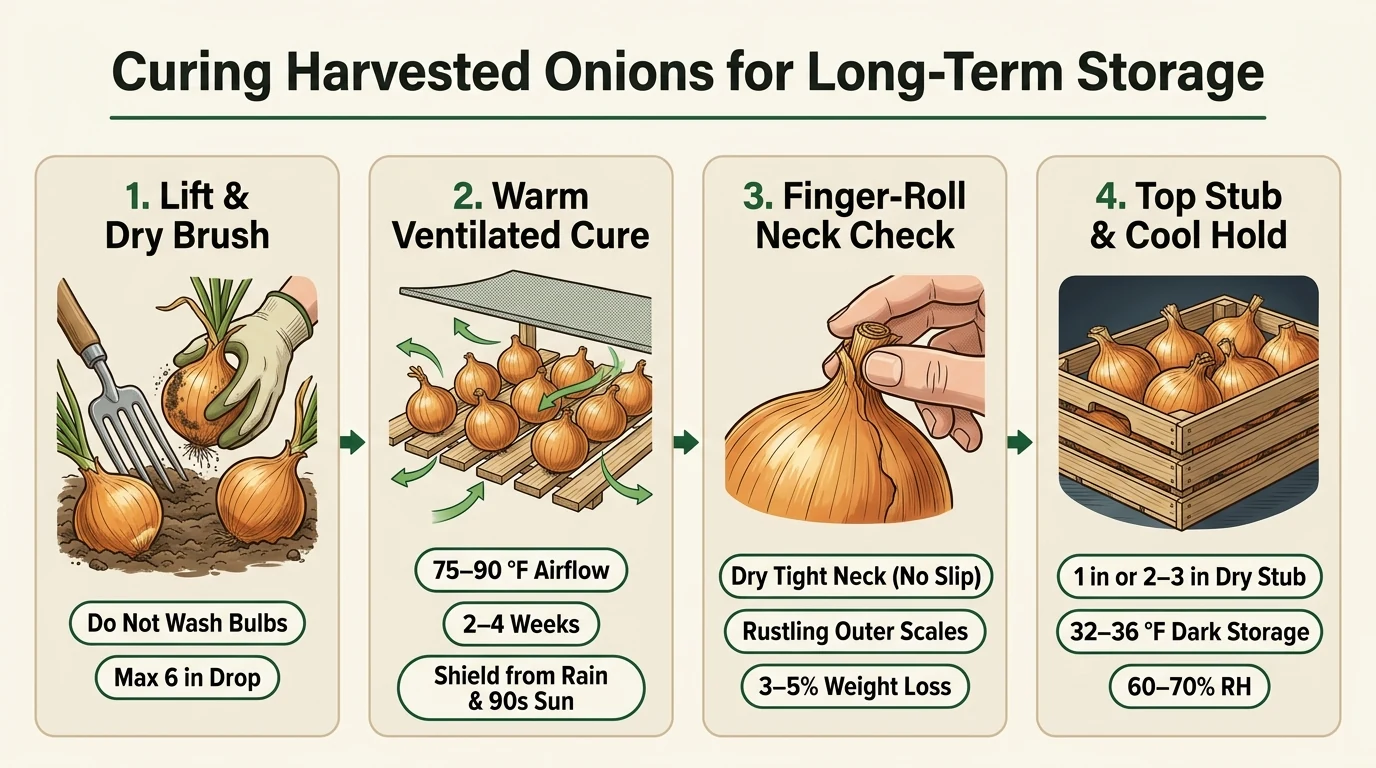
Lift mature onions gently without washing the bulbs, brush off loose soil, and cure them at 75 to 90 °F with steady airflow out of rain and hot sun for 2 to 4 weeks until outer scales rustle and rolled necks feel tight, then leave a 2 to 3 inch dry neck stub for cool dark storage.
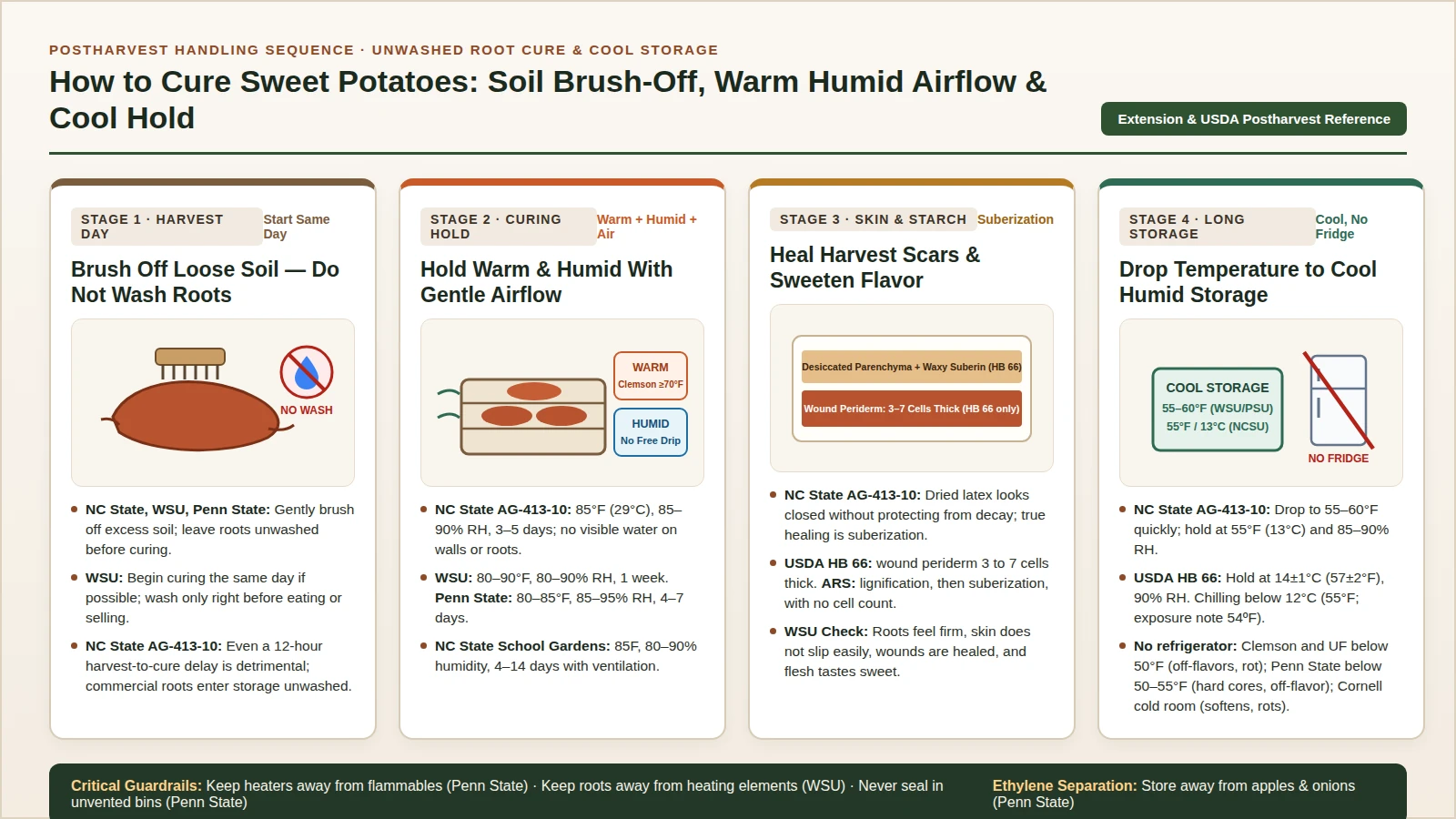
Careful harvest handling sets up the entire drying period. University of Nebraska–Lincoln Extension advises lifting bulbs gently by their foliage or with a garden fork worked underneath the row and brushing remaining dirt away with a gloved hand or soft brush rather than washing. UMass Amherst Extension adds that keeping harvest drops to 6 inches, padding sharp crate edges, and grading out bruised bulbs limits moisture release and decay in storage. This postharvest guide sits alongside other crop references on the growing blog, including our sweet potato curing guide; pre-plant bed drainage mixes belong in our raised bed soil mixture guide, and seasonal nutrient selection belongs in our organic fertilizer by crop guide.
Do You Have to Cure Onions Before Storing Them?
Yes—any onion harvest kept for storage must be cured first so outer skins dry and the neck seals against gray mold rot, whereas bruised bulbs, thick-necked onions, and high-moisture sweet varieties do not keep well in storage and belong in the kitchen for prompt fresh eating, freezing, or dehydrating.
Skipping curing leaves succulent tissue open to decay organisms. Both UMass Amherst Extension and Nebraska Extension report that inadequately cured onions decay readily in storage, with UMass identifying gray mold rot (Botrytis)—called neck rot because decay starts at the top of the bulb—as the primary storage disease. University of Maine Cooperative Extension likewise names proper curing, where green tops are removed without stripping the dry papery outer skin, as the first step in long-term onion storage to curb mold and rot.
Checking Bulb Maturity Before You Lift the Crop
Storage quality starts before bulbs leave the ground, and extension guides balance yield against dormancy:
- Maximum storage dormancy (UMass Amherst Extension): Optimum harvest for maximum storage life before bulb sprouting takes place while 30 to 40% of the onion foliage remains erect, well before tops lie flat and dry. Yields can climb 30 to 40% between initial top fall-over and complete leaf drying, yet leaving bulbs to over-dry in the field raises the risk of bald onions losing their outer scales in storage.
- Pinching the growing neck (UGA Extension, cited by UMass): Because heavy wind, rain, or drought stress can knock green tops over prematurely, pinching the neck gives a truer maturity check than counting fallen leaves alone. Immature necks feel stiff, optimally mature necks feel soft and limber, and over-mature necks become too weak to hold up the tops.
- Home-garden top fall-over and flavor window (Nebraska Extension): Home gardeners lift bulbs once roughly two-thirds of the tops have fallen over and dried naturally and necks have started to shrivel and turn papery. Optimum sweetness and flavor develop at 80% foliage die-back, after which growers should harvest within one or two weeks before bulbs rot or regrow and bolt to seed.
- Skip bending green leaves: Nebraska Extension warns against stomping or bending green, growing onion tops over to speed maturity; crushing live leaves cuts off carbohydrate production and shrinks final bulb size. University of Minnesota Extension also notes that changes in bulb and leaf physical appearance and plant health can be caused by the environment, plant diseases, insects, and wildlife, making a correct diagnosis essential when inspecting damaged plants.
How Long Do You Leave Onions to Dry After Harvest?
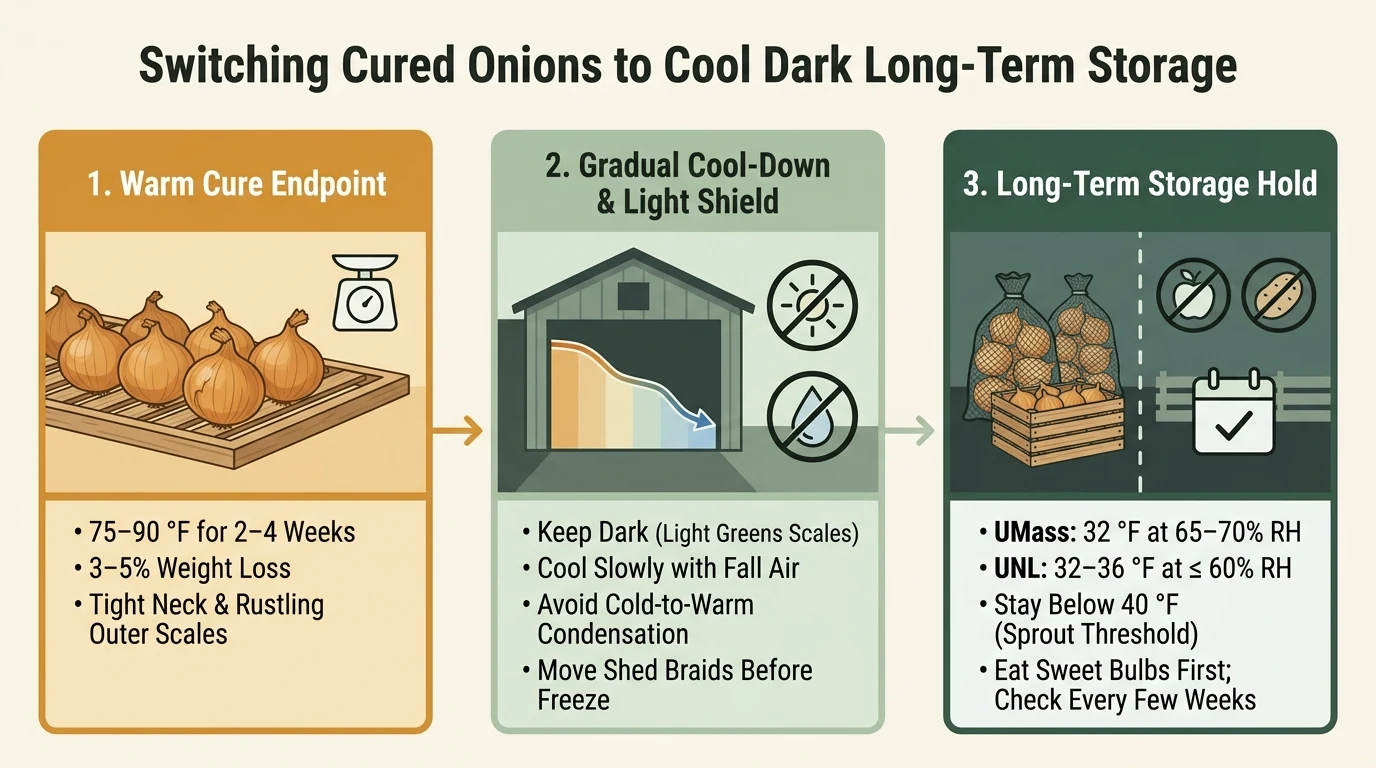
Leave harvested onions to cure for 2 to 4 weeks depending on weather and air circulation, judging completion by physical bulb cues rather than calendar days alone: curing finishes once outer skins and necks turn papery, outer scales rustle when handled, bulbs shed 3 to 5% of harvest weight, and necks stay tight.
Both UMass Amherst Extension and University of Nebraska–Lincoln Extension publish the same 2 to 4 week curing window for bulbs dried in the field or under open, rain-sheltered structures. Humid spells, cool air, thick necks, or crowded trays push batches toward the four-week mark, whereas warm breezes over single-layer racks dry outer scales faster.
Instead of pulling bulbs off the drying rack on a fixed day, check all three UMass Amherst Extension cure endpoints together:
- Dry, rustling outer scales: Outer wrapper skins turn dry and papery and make an audible rustling sound when handled, while a few intact papery outer leaves remain around each bulb to protect it during storage (Nebraska Extension).
- Measured 3 to 5% weight loss: Cured bulbs reach the dry-scale, tight-neck threshold once they have lost 3 to 5% of their harvest weight.
- Zero slip at the neck: Rolling the neck between thumb and forefinger confirms the inner stem tissue has dried tight and no longer slides.
What Temperature and Airflow Suit Curing Onions?
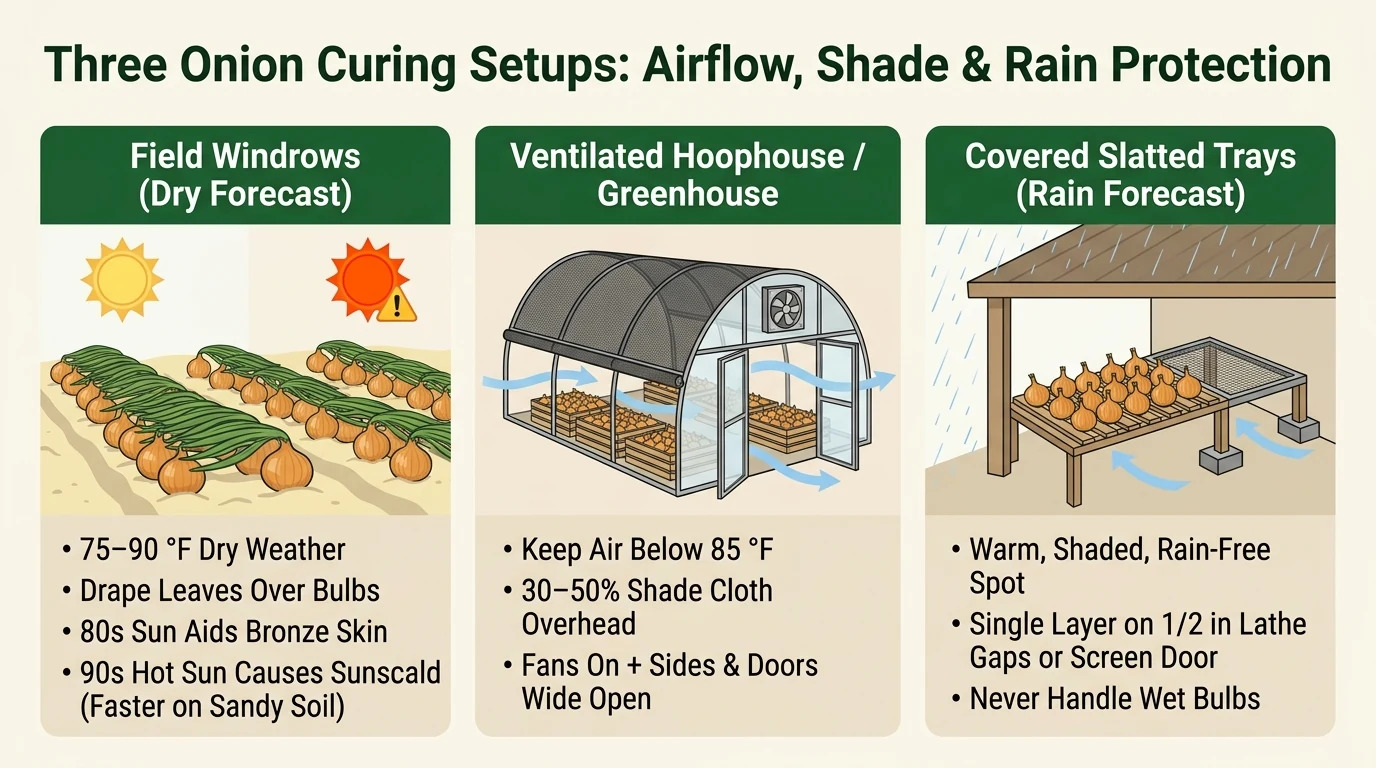
Cure harvested onions at 75 to 90 °F with steady air circulation in a dry field or rain-protected open shed, hold ventilated greenhouses below 85 °F using open sides, fans, and 30 to 50% shade cloth, or spread bulbs in single layers under cover on slatted lathe trays or a screen door.
Warmth and moving air work together during curing onions to seal the neck and develop wrapper color. UMass Amherst Extension and Nebraska Extension both cite 75 to 90 °F with good airflow for curing, and UMass notes that warm curing temperatures paired with 80% relative humidity and strong air movement produce desirable bronze skin color. Notice how onion curing differs sharply from root-crop wound healing in our sweet potato curing guide, because onions dry down outer scales and stem tissue before shifting into cold, low-humidity storage.
| Extension Source | Curing Temperature & Airflow | Cure Readiness Check | Long-Term Storage Hold |
|---|---|---|---|
| UMass Amherst Extension | 75 to 90 °F in field or open shed for 2 to 4 weeks (80% RH with good airflow favors skin color); keep hoophouses below 85 °F with fans, open sides/doors, and 30–50% shade cloth | Tight neck (tissue does not slide between fingers), dry rustling outer scales, and 3–5% bulb weight loss | 32 °F at 65–70% relative humidity in darkness, cooled slowly with fall air |
| University of Nebraska–Lincoln Extension | 75–90 °F in a well-ventilated field or rain-sheltered spot for 2 to 4 weeks; single layers on lathe strips with one-half-inch gaps or an old screen door | Outer leaves and neck completely dry and papery; firm bulbs only (cull bruised or thick-necked bulbs) | 32–36 °F (do not freeze; sprouts at 40 °F or higher) and 60% or less relative humidity |
| University of Maine Cooperative Extension | Cure thoroughly before storage, removing green tops while keeping dry outer skins intact | Curing complete before prioritizing varieties; eat high-moisture sweet onions first | Cool, dry cabinet, pantry, basement, or unheated garage before deep cold; inspect every few weeks |
| University of Minnesota Extension | Dry bulbs thoroughly after harvest before braiding or topping | Bulbs and necks properly dry; diagnose any disease, insect, wildlife, or environmental bulb damage | Braid dry tops for hanging or cut tops off cured bulbs for storage |
Can You Dry Onions in Direct Sun?
Mild sunshine with temperatures in the 80s improves bronze skin color when windrowed leaves partially cover adjacent bulbs, whereas intense direct sun and temperatures in the 90s cause sunscald—especially on fast-heating sandy soil—and sunlight after curing turns outer scales green, making shaded ventilated shelters safer during hot or wet weather.
In commercial rows, UMass Amherst Extension notes that onions are undercut with rod-weeder diggers or knife undercutters, lifted, and windrowed most commonly with tops left on to shield bulbs from sunscald. Nebraska Extension applies the same shading principle to garden rows: lay harvested plants so leaves partially drape over neighboring bulbs to prevent sunburn and greening while outer leaves and necks dry down. Watch soil texture as well as air temperature, since UMass points out that onions curing on sandy soil heat up faster than bulbs resting on heavier soil.
Protecting Harvested Bulbs When Rain Threatens
Wet weather interrupts field drying and raises neck-rot risk. UMass Amherst Extension advises avoiding field curing altogether if rain is in the forecast, staying out of moist weedy beds where weeds trap humidity and block air circulation, and waiting until rained-on onions dry completely before touching them—do not handle wet bulbs. Where commercial windrows get rained on, mechanical fluffing after each rainfall restores airflow and shortens field drying before topping.
When rain is predicted during a garden or small-farm harvest, Nebraska Extension moves curing under cover out of direct sun:
- Brush loose dirt off freshly lifted bulbs without washing them.
- Trim away bulky leaf blades while leaving a 1-inch stem section at the neck if curing on indoor racks (whereas UMass cautions in very wet years not to final-top bulk storage onions until curing is complete).
- Arrange bulbs in a single layer on flat slatted trays built from wooden lathe strips spaced one-half inch apart, or set them across an elevated old screen door so warm, dry air circulates beneath and around every onion.
How Do You Check Neck Tightness Before Topping Onions?
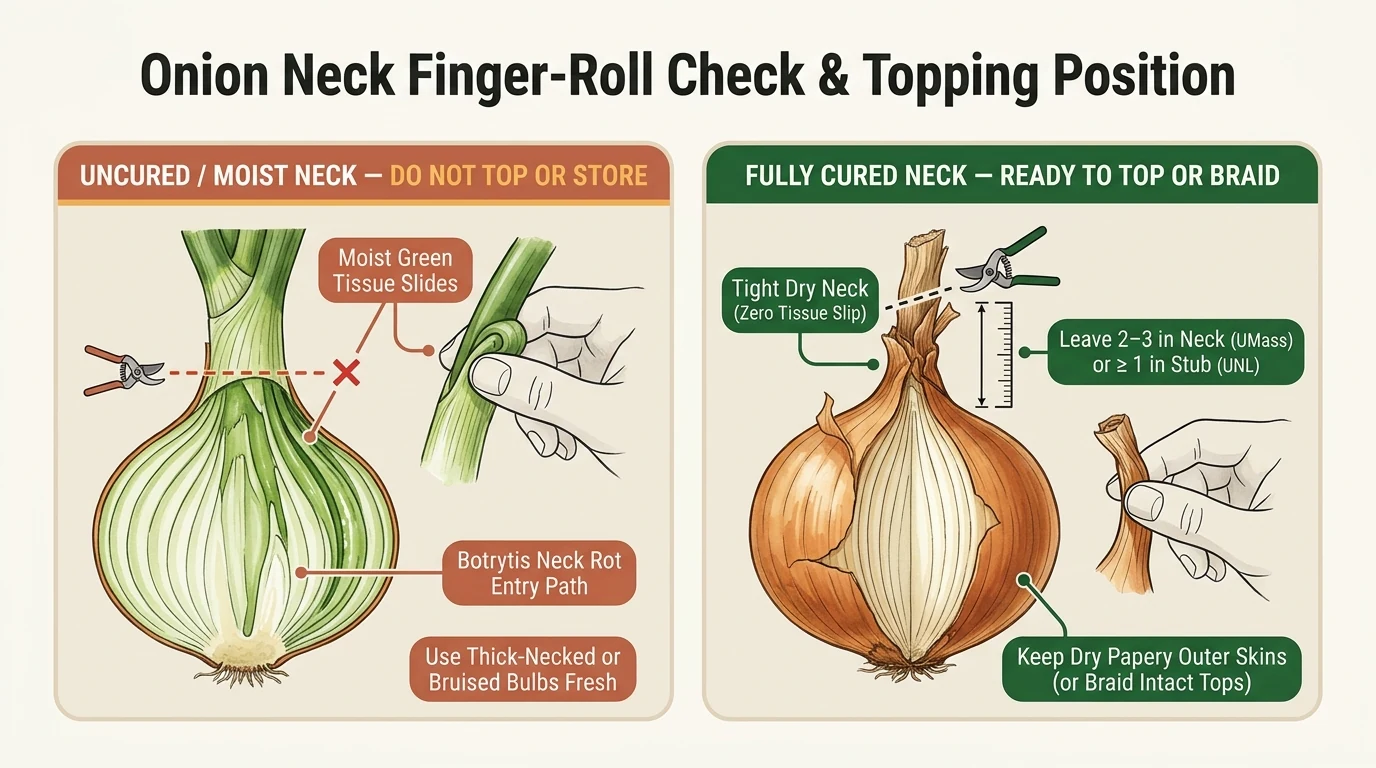
Roll each cured onion neck between your fingers before cutting any foliage to confirm the neck feels dry, papery, and tight with no sliding inner tissue, then trim only completely dry tops while leaving 2 to 3 inches of neck per UMass Extension or at least 1 inch per Nebraska Extension.
Topping too early or too close to the shoulder is the classic postharvest mistake that ruins winter storage batches. UMass Amherst Extension explains that bacterial diseases and Botrytis gray mold neck rot move into onion bulbs through green or moist stem tissue, whereas those pathogens do not travel through dry tissue. If inner layers slip or feel damp when you roll the collar between thumb and forefinger, return the bulb to the ventilated drying rack rather than cutting it.
Once the finger-roll check confirms a dry, tight neck, sort and trim the batch carefully:
- Leave a dry protective neck stub: UMass Amherst Extension advises leaving 2 to 3 inches of dry neck on topped bulbs to lengthen the path any pathogen would have to cross from the cut end to the bulb scales; Nebraska Extension specifies leaving at least 1 inch of dry stem and warns that trimming too close to the bulb invites storage rot.
- Keep papery outer skins on the bulb: Both Nebraska Extension and UMaine Extension advise leaving dry papery outer wrapper scales intact rather than peeling bulbs down to slick inner rings.
- Cull thick-necked and bruised bulbs: Grade out nicked, dropped, or thick-necked onions before loading crates or mesh bags, and route them to immediate fresh cooking (UMass Extension; Nebraska Extension).
How Do You Cure Onions by Hanging or Braiding?
Wait until field-cured outer leaves and necks turn completely dry and papery before braiding intact dried tops into hanging strings instead of cutting stems, then move shed-hung braids before freezing weather arrives while avoiding sudden shifts from cold air into warm rooms that cause moisture condensation inside the skins.
Both University of Nebraska–Lincoln Extension and University of Minnesota Extension treat braiding as a post-curing storage format rather than a green-top harvest shortcut: dry the onions first until outer leaves and necks are papery, then plait the intact dried foliage into strings for hanging in a dry, airy spot. Bulbs braided while stems still hold green sap trap moisture inside the tightly plaited neck zone.
Seasonal temperature swings create a second hazard for hanging strings in northern climates. UMaine Cooperative Extension highlights a common late-autumn failure: onions left hanging in an unheated shed until near-freezing weather develops condensation inside their skins when carried abruptly into a warmer house, causing the entire string to rot. That household observation matches UMass Amherst Extension’s storage rule against holding cold bulbs in contact with warmer, moister air, since chilled bulbs draw moisture out of warm air and encourage decay. Move shed-hung braids indoors incrementally before deep cold sets in, and place them in the coolest, driest ventilated corner available.
How Do You Store Cured Onions Long Term?
Hold cured, firm storage onions in a dark, dry, ventilated space cooled slowly to 32 °F with 65 to 70% relative humidity per UMass Extension or 32 to 36 °F at 60% or less humidity per Nebraska Extension, staying below the 40 °F sprouting threshold without freezing and separating bulbs from apples and potatoes.
Prompt dark placement protects cured bulbs as soon as drying ends. UMass Amherst Extension warns that leaving cured onions exposed to sunlight induces greening of the outer scales, and recommends bringing bulbs down toward 32 °F gradually—for example, holding crates in a shaded barn or garage so bulb temperature steps down alongside late-summer and autumn outdoor air. An uninsulated barn works for onions used or sold within a couple of months, while multi-month winter holding calls for an insulated storage space that prevents freezing without letting temperatures climb to 40 °F or higher, where Nebraska Extension notes sprouting begins.
Household Storage Spots, Cultivar Order, and Monthly Checks
Cultivar genetics set an upper ceiling on how to store onions long term regardless of room setup. Nebraska Extension recommends checking seed, set, or transplant descriptions for short, medium, or long storage ratings, and UMaine Cooperative Extension notes that sweeter, high-moisture onions will not store well anywhere—eat sweet varieties first, or chop and freeze or dehydrate surplus bulbs. When a home lacks a 32 to 36 °F cold room, UMaine Extension splits the harvest across breathably ventilated spots such as a basement, pantry, cabinet, or unheated garage (before severe winter cold arrives), keeping short-keeping bulbs handy near the kitchen and long-keeping pungent cultivars in the coolest, driest dark area. Keep onions and garlic away from apples and potatoes so those crops do not absorb onion odor (Nebraska Extension), and inspect stored containers every few weeks to pull any softening bulb before spoilage spreads to neighbors (UMaine Extension).
Postharvest Drying, Neck Check, and Storage Intake Checklist
Use this batch checklist from lifting day through winter bin checks so no moist neck or bruised bulb enters long-term storage.
| Postharvest Stage | Hands-On Action | Readiness Check Before Moving Forward |
|---|---|---|
| Pre-harvest maturity check | Pinch necks in the bed and check natural foliage fall-over without bending live green tops | Necks feel soft and limber rather than stiff (UGA/UMass); 30–40% erect tops for max commercial dormancy (UMass) or two-thirds to 80% natural die-back for garden harvest within one or two weeks (UNL) |
| Gentle lifting and dry cleaning | Undercut or fork-lift bulbs gently, limit drops to 6 inches, and brush soil off dry | Zero washing with water (UNL); padded crate edges and bruised or damaged bulbs graded out immediately (UMass) |
| Ventilated warm curing | Cure for 2 to 4 weeks at 75–90 °F in shaded rows, open sheds, below 85 °F shaded hoophouses, or single-layer lathe/screen racks | Protected from rain and 90s sunscald (UMass, UNL); zero wet-bulb handling (UMass); one-half-inch air gaps under indoor tray layers (UNL) |
| Cure endpoint and finger-roll neck test | Weigh a sample batch, handle outer skins, and roll each neck between thumb and forefinger | Bulbs have lost 3–5% weight, outer papery scales rustle, and rolled neck tissue stays tight without sliding (UMass) |
| Topping or braiding and sorting | Braid dry papery tops or cut dry stems while keeping papery outer scales intact | Leave 2–3 inches of dry neck (UMass) or at least 1 inch of stem (UNL); set aside thick-necked, bruised, and sweet high-moisture onions for fresh kitchen use, freezing, or dehydrating (UNL, UMaine) |
| Dark cool-down and storage inspection | Move promptly out of light, cool gradually with autumn air, and store in breathable trays, crates, or mesh bags | Hold at 32 °F and 65–70% RH (UMass) or 32–36 °F and 60% or less RH below 40 °F without freezing (UNL); separate from apples and potatoes (UNL); inspect every few weeks and remove spoiling bulbs (UMaine) |