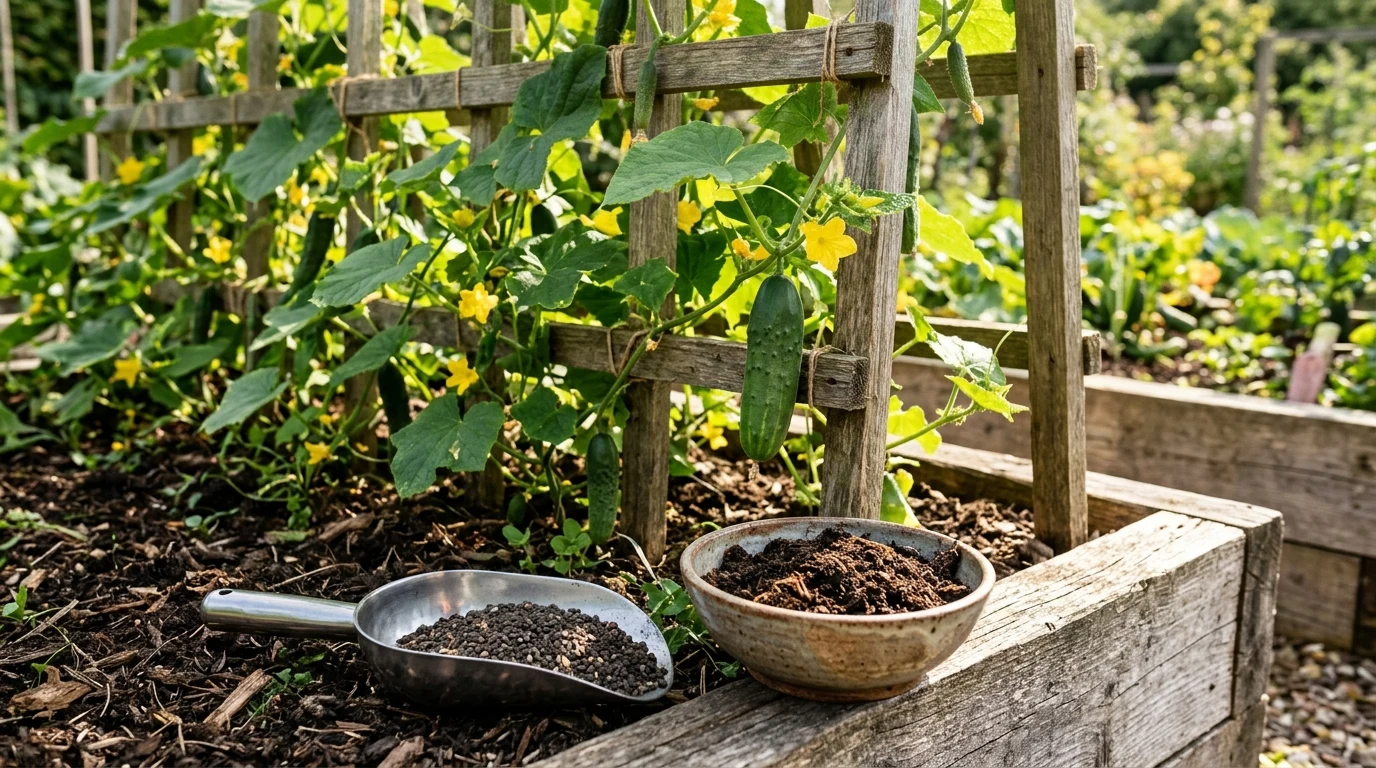
University of Maryland Extension states that cucumbers have a moderate requirement for nutrients from soil organic matter or fertilizers, and recommends side-dressing one week after blossoming begins and, if needed, 3 weeks later.
In cucumbers, stunted plants with pale leaves indicate low fertility, whereas vigorous plants that fail to bloom or set fruit indicate excessive fertility.
Early-maturing cucumber varieties require as little as 50 days at relatively high temperatures (75 to 85°F) to reach harvest, while late-maturing varieties may take up to 70 days.
Plants take up nitrogen as NO3- (nitrate) or NH4+ (ammonium) ions from either organic or synthetic sources; in organic fertilizers, soil microorganisms transform organic nutrients into plant-available forms over days to weeks.
Organic Fertilizer for Cucumbers: Pre-Plant and Flowering Stage Summary
| Extension Guideline | Fertilizer Benchmark and Rate | Timing and Placement Direction |
|---|---|---|
| OSU Extension specifies | applying one pound of a pre-plant fertilizer (such as 10-10-10) per 100 square feet | before planting cucumbers. |
| Iowa State University Extension states that if a soil test has not yet been conducted, | gardeners should apply and incorporate 1 to 2 pounds of all-purpose garden fertilizer (such as 10-10-10) per 100 square feet | prior to planting cucumbers. |
| If a soil sample is not taken, | UGA Extension specifies a preplant application of 5-10-10 | at the rate of 3 lb per 100 square feet. |
| One week after cucumber flowering begins, | side-dress with 1.5 oz of ammonium sulfate | per 10 feet of row. |
| UGA Extension specifies side-dressing cucumbers one week after blooming begins and again three weeks later | using 1 lb of 33-0-0 per 100 square feet of bed, | applied along one side of the row approximately 6 in. from the plant’s base and covered with soil. |
For commercial and small-scale field cucumber production in Pennsylvania, Penn State Extension lists a nitrogen recommendation of 75 pounds per acre for processing and fresh-market types, with half applied before planting and the remainder injected through the drip irrigation system during the growing season.
Pre-Plant Incorporation: Soil pH, Compost, and Immobile Phosphorus and Potassium
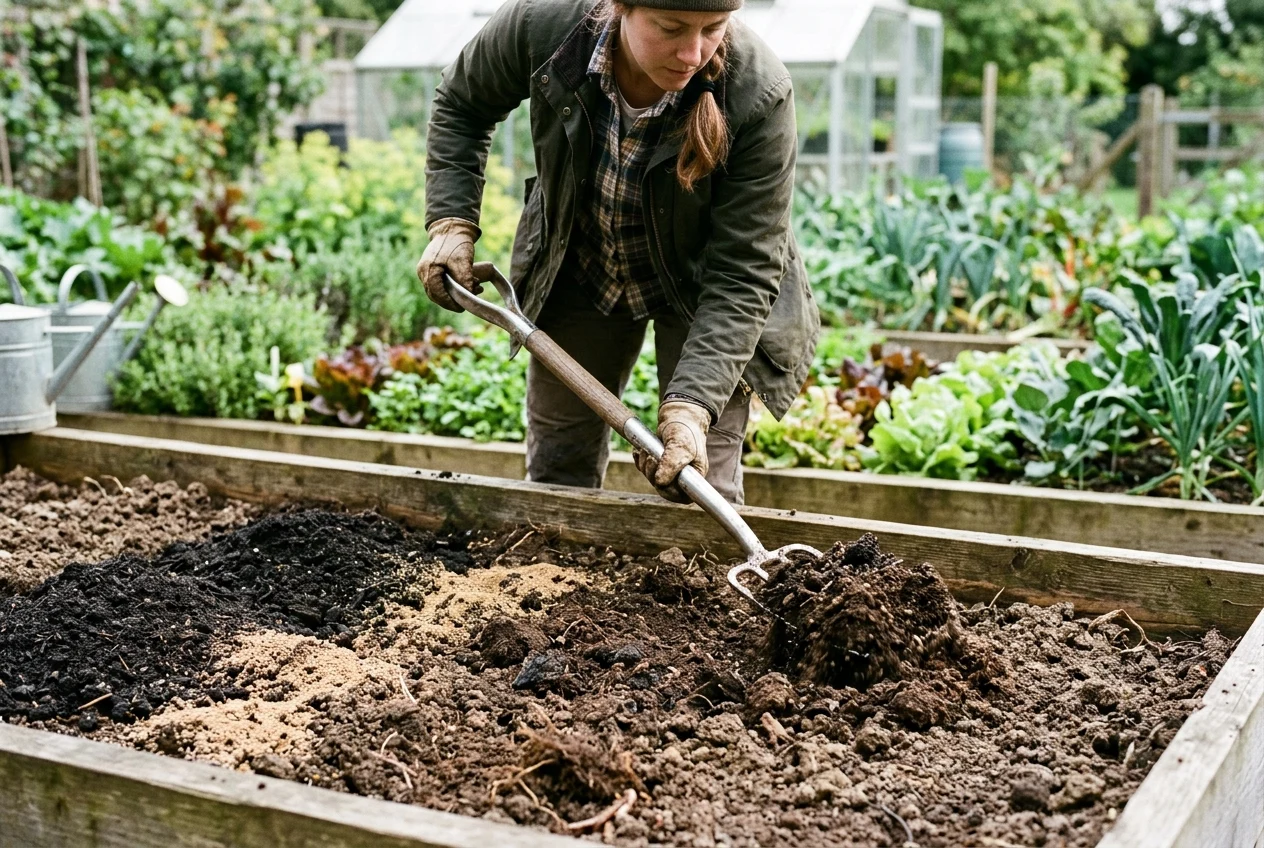
During cucumber seedbed preparation, crop residues and organic matter are incorporated into the top 7–8 inches of soil.
Iowa State University Extension advises spreading organic fertilizer over the garden area and incorporating it into the top 6 to 8 inches of soil with a garden fork, spade, or tiller.
The ideal soil pH for cucumber growth is between 6.0 and 6.8.
For optimal cucumber seed germination, ensure the soil temperature is at least 65°F.
In soils void of organic matter, UGA Extension recommends working in 4–6 in. of finished compost or other humus to a depth of 10 in., with soil pH between 6.0 and 6.5 and soil temperature at least 60 °F before seeding.
University of Minnesota Extension recommends a slightly acidic soil pH between 6.0 and 6.5 for best cucumber yield and quality, and advises adding well-rotted manure or compost in spring or fall while avoiding fresh manure because it may contain harmful bacteria and increase weed problems.
For direct-seeded cucumbers in Minnesota, UMN Extension recommends sowing seeds after the last frost date once soil is at least 70° F at the one-inch depth, sowing seeds about one-half inch deep.
Penn State Extension states that cucumber soils should not be compacted and should have a pH of 5.8–6.6, with a best average growing-season temperature range of 65°F to 95°F; temperatures above 95°F or below 50°F slow cucumber growth and maturity, and soil water depletion causes growth deformity.
Choosing an Organic Fertilizer for Vegetables and Vegetable Garden Soil Tests
In Iowa State University Extension’s soil-test nitrogen table for vegetable gardens, recommended nitrogen application (lbs/100ft2) is 0.20 when soil organic matter is less than 3%, 0.15 when soil organic matter is between 3% and 19%, and 0.10 when soil organic matter is more than 19%.
In Iowa State University Extension’s soil-test phosphorous table for vegetable gardens, recommended phosphate application (lbs/100ft2) is 0.40 at 0-5 ppm Bray-P1 (0-3 ppm Olsen-P), 0.30 at 6-10 ppm Bray-P1 (4-7 ppm Olsen-P), 0.20 at 11-15 ppm Bray-P1 (8-11 ppm Olsen-P), 0.10 at 16-25 ppm Bray-P1 (12-18 ppm Olsen-P), and 0.00 at 25+ ppm Bray-P1 (18+ ppm Olsen-P).
In Iowa State University Extension’s soil-test potassium table for vegetable gardens, recommended potash application (lbs/100ft2) is 0.40 at 0-50 ppm, 0.30 at 51-100 ppm, 0.20 at 101-150 ppm, 0.10 at 151-200 ppm, and 0.00 at 200+ ppm.
In Utah State University Extension Table 1, annual nitrogen recommendations for vegetables are 1 to 2 pounds of nitrogen/1000 sq ft for low-requirement crops (peas, beans), 2 to 3 pounds of nitrogen/1000 sq ft for intermediate-requirement crops (including melon, pepper, tomato, squash, pumpkins), and 4 to 6 pounds of nitrogen/1000 sq ft for high-requirement crops (onion, sweet corn, potato), with a single-application limit of 1 ½ pounds of nitrogen/1000 sq feet to prevent burning.
In Utah State University Extension’s calculation example, supplying 2 pounds of nitrogen per 1000 square feet across a garden area of 1400 square feet using blood meal (12-2-1, Y is 0.12, 12% divided by 100) requires 23 pounds of 12-2-1 fertilizer.
In Iowa State University Extension’s garden rate calculation example, supplying 0.15 lbs of N per 100 ft2 with a 10-2-6 fertilizer requires 0.15 ÷ 0.10 = 1.5 pounds of fertilizer per 100 ft2, or (1.5 × 60) / 100 = 0.9 lbs for a 15 ft × 4 ft (60 ft2) bed; for many granular fertilizers, 1 cup weighs about 0.5 pounds.
To convert phosphate (P2O5) on a fertilizer label to elemental P, multiply the percentage of phosphate by 0.44; to convert potash (K2O) to elemental K, multiply the percentage of potash by 0.83 (for example, supplying 0.10 lbs of K per 100 ft2 with a 0-0-22 fertilizer requires 0.10 ÷ [0.22 × 0.83] = 0.55 pounds over 100 ft2).
Organic Fertilizer Analyses, Microbial Release Speeds, and Application Rates
University of Minnesota Extension lists blood meal (13-2-0), organic tomato fertilizer (3-6-4), and fish fertilizer (5-1-1) as examples of organic fertilizers, alongside inorganic examples all-purpose (10-10-10), tomato fertilizer (17-18-28), and slow-release granular (15-9-12).
In Utah State University Extension Table 2 (%Nitrogen, %Phosphate, %Potash), rapid-availability organic materials include blood meal (12, 1-2, 0-1, rapid, acidic), fish meal (6-12, 3-7, 2-5, rapid, acidic), swine manure (2-3, 0.5-1, 1-2, rapid), poultry manure (3-4, 1-2, 1-2, rapid), seaweed extract (1, 2, 5, rapid, zinc, iron), and wood ashes (0, 1-2, 3-7, rapid).
In Utah State University Extension Table 2 (%Nitrogen, %Phosphate, %Potash), moderate- and slow-availability organic materials include bone meal (1-6, 11-30, 0, moderate, alkaline), cottonseed meal (6, 3, 1, slow, acidic), composts (1-3, 1-2, 1-2, moderate, alkaline), feather meal (12, 0, 0, moderate), hoof/horn meal (12-14, 1.5-2, 0, moderate, alkaline), and kelp (1-1.5, 0.5-1, 5-10, moderate, zinc, iron).
In Iowa State University Extension’s organic amendment table, nitrogen-focused organic amendments and their average NPK analyses include alfalfa meal (5-1-2), ancient bat guano (2-8-0), fresh bat guano (10-3-1), blood meal (10-0-0), coffee grounds (2-0.3-0.2), cottonseed meal (6-2-1), crab meal (4.3-0.5), feathermeals (4-1-1), fish emulsion (4-1-1; 5% sulfur), fish meal (5-3-3), hoof and horn meal (12-2-0), and soybean meal (7-0.5-2.3).
In Iowa State University Extension’s organic amendment table, phosphate, potash, and calcium amendments include steamed bonemeal (1-11-0; 20% total phosphate; 24% calcium), colloidal phosphate (0-2-2), rock phosphate (0-3-0; 32% total phosphate; 32% calcium), granite meal (4% total potash), greensand (7% total potash), kelp meal (1.5-0.5-2.5), Sul-Po-Mag (0-0-22; 11% magnesium; 22% sulfur), leached wood ashes (0-1.2-2), unleached wood ashes (0-1.5-8), gypsum (22% calcium; 17% sulfur; do not apply if pH is below 5.8), and oyster shells (33.5% calcium).
In Iowa State University Extension’s Average Applicable Rate per 100 square feet table (Low Fertility, Medium Fertility, Adequate Fertility), blood meal, steamed bonemeal, feathermeals, fish meal, and hoof and horn meal are each listed at 3 lbs, 2 lbs, and 1 lbs per 100 square feet, while fish emulsion is listed at 0.2 lbs, 0.1 lbs, and 0.1 lbs per 100 square feet.
In Iowa State University Extension’s Average Applicable Rate per 100 square feet table (Low Fertility, Medium Fertility, Adequate Fertility), alfalfa meal is listed at 5 lbs, 3.5 lbs, and 2.5 lbs; cottonseed meal at 3.5 lbs, 2.5 lbs, and 1 lbs; kelp meal and leached wood ashes at 2 lbs, 1 lbs, and 0.5 lbs; soybean meal at 5 lbs, 2.5 lbs, and 1 lbs; dry commercial compost at 20 lbs, 10 lbs, and 5 lbs; and homemade compost at 200 lbs, 100 lbs, and 40 lbs per 100 square feet.
On the Known Source Farms fertilizer-by-crop reference table, fish powder (12 / 0.3 / 1) and kelp powder (1 / 0 / 4) have an immediate to 1 month release time, blood meal (12–14 / 2 / 1), fish meal (10 / 6 / 2), fish emulsion (5 / 2 / 2), cottonseed meal (6 / 0.4–3 / 1.5), alfalfa meal (2 / 1 / 2), steamed bone meal (1–2 / 11–15 / 0), and worm castings (2 / 1.5 / 1.5) have a 1–4 months release time, and feather meal (7–12 / 0 / 0) and high-P bat guano (3 / 10 / 1) have a 4+ months release time.
Root Architecture, Side-Dress Furrow Placement, and Salt-Burn Prevention
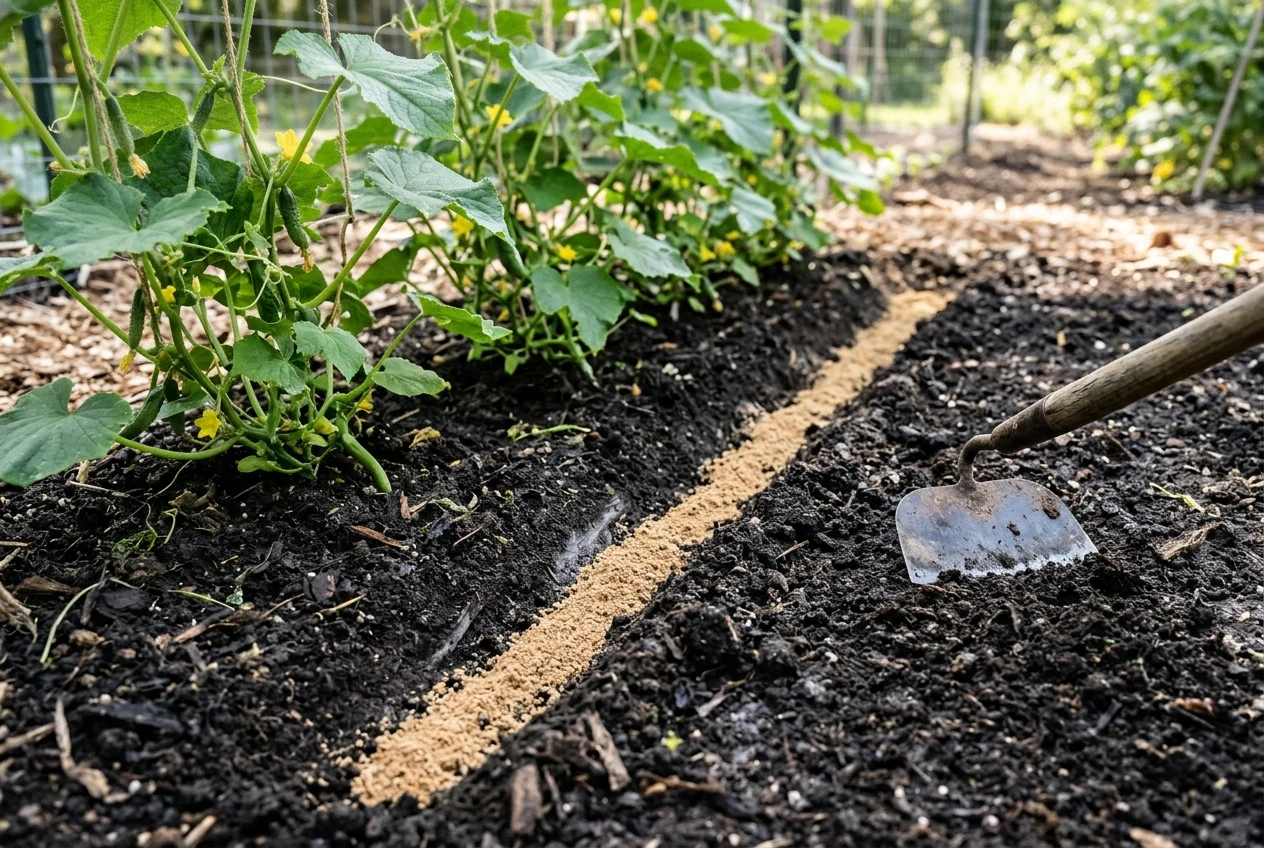
Cucumbers typically have a rooting depth of 36–48 inches and require frequent watering, with soil moisture kept at or above 65% of total water-holding capacity.
Deep cultivation close to cucumber plants can destroy roots and reduce yield and quality; cultivation should penetrate the soil no deeper than 1 inch.
Cucumber plants have both long taproots and branching surface roots close to the soil surface, and vines often send out new roots from joints in the vine, so deep or close cultivation and disturbing the vine can damage roots.
Cucumbers need about one inch of water from rainfall or irrigation each week during the growing season, and organic mulches such as straw or compost should not be applied until the soil is above 75 degrees Fahrenheit because they can slow soil warming.
Utah State University Extension notes that improper organic fertilizer application can contribute to water pollution, may induce a plant nutrient deficiency or toxicity, or cause salt burn because many organic materials contain high levels of salts that burn plants if over-applied.
Utah State University Extension states that liquid and foliar applications can be made with water-soluble organic products like fish emulsion or seaweed extract, but warns that there is a potential for leaf burning with liquid applications.
Diagnosing Poor Fruiting: Excess Nitrogen, Male Blossom Drop, Pollination, and Blossom-End Rot
| Field Observation or Stage | Underlying Cause | Extension Diagnostic Rule |
|---|---|---|
| UGA Extension warns not to over-fertilize cucumbers | because over-fertilizing encourages vine growth | and retards fruiting. |
| Plants lacking nitrogen show yellowing on older, lower leaves, | while too much nitrogen causes excessive leafy growth and delayed fruiting; | late-season excess nitrogen can minimize or delay fruiting. |
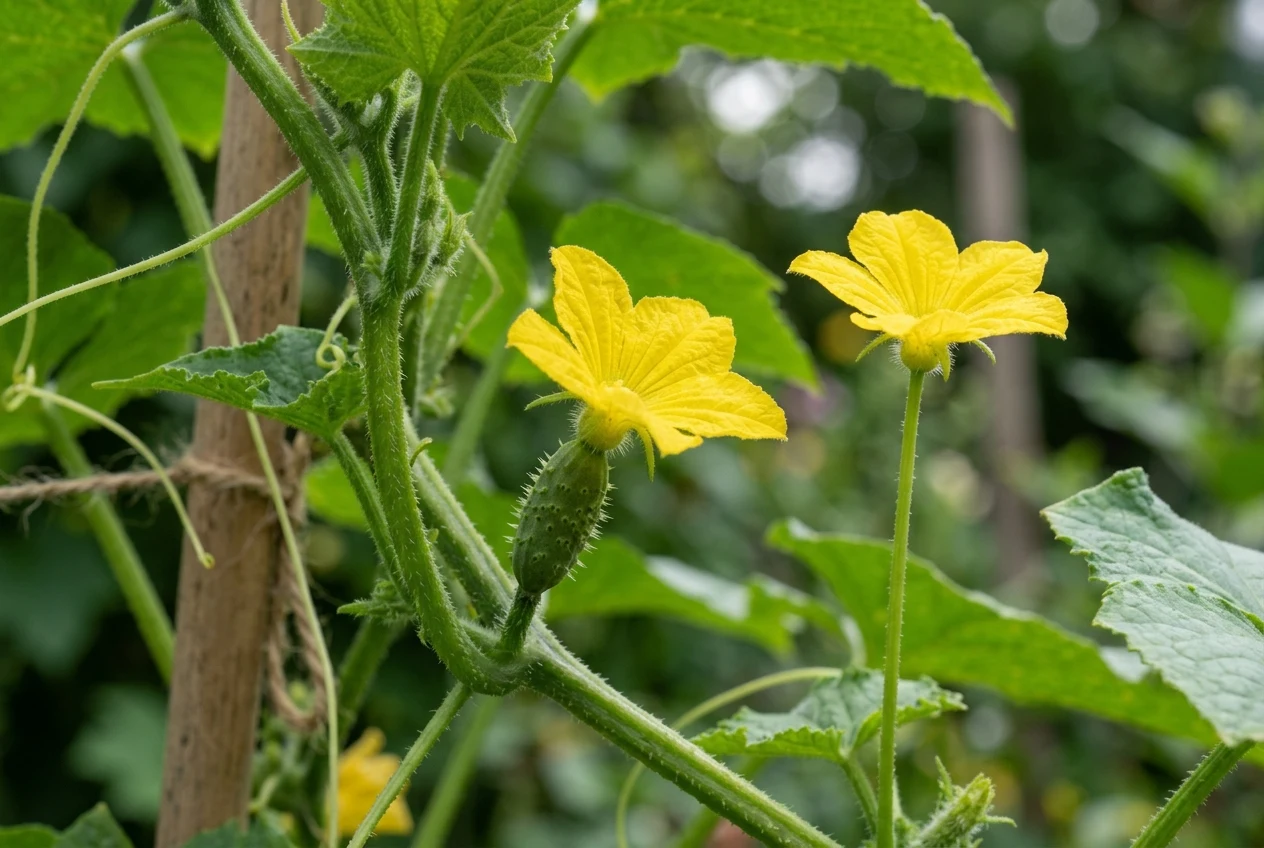
| In standard monoecious cucumbers, | the first 10 to 20 flowers are male, | and 10 to 20 male flowers are produced for every female flower. |
| The first blossoms on cucumber vines often drop naturally | because the first flowers to appear are male; | female flowers open later with a swelling at the base (the ovary) that develops into fruit after bee pollination. |
| University of Maryland Extension reports that a cucumber flower | requires 8 to 12 bee visits per flower | to ensure pollination and fertilization sufficient to form a straight, full-size fruit. |
| Temperatures below 10°C (50°F) | can reduce bee activity | and impact cucumber pollination. |
Iowa State University Extension recommends harvesting cucumbers every 2 to 3 days (2 to 4 inches long for pickling varieties, 6 to 8 inches long and 1 1/2 to 2 inches in diameter for slicing cucumbers) because over-mature cucumbers left on the vine inhibit additional fruit set.
Potassium deficiency causes browning along leaf edges starting on lower, older leaves, while calcium deficiency causes tip burn on younger leaves or blossom end rot in tomatoes or zucchini, usually triggered by uneven watering, excessive soil moisture, or damage to roots rather than low soil calcium.
Bitterness in cucumbers is a temporary issue caused by plant stress such as temperatures below 60°F or above 90°F, drought conditions, or poor nutrition.
Frequently Asked Questions
Why should phosphorus and potassium be incorporated before planting cucumbers?
Phosphorus supports root growth and fruiting while potassium supports disease resistance and plant hardiness; because phosphorus and potassium are not mobile in the soil and need close contact with plant roots, they should be applied and incorporated prior to planting in spring or fall.
How far from the cucumber stem should organic fertilizer be banded?
For in-season banding of organic fertilizers, Utah State University Extension recommends using a rapid-availability organic fertilizer in narrow furrows six to eight inches away from the base of the plants and two to three inches deep, covered with soil.
Why do young cucumbers shrivel and die on the vine after flowering?
In vine crops including cucumbers, when female flowers are not pollinated properly, the small fruits begin to grow and then suddenly shrivel up and die.
How does excessive nitrogen affect blossom-end rot in cucurbits?
In cucurbits and other vine crops, blossom-end rot is caused by a lack of calcium in the developing fruit, and uneven moisture supplies and excessive nitrogen inhibit calcium uptake.
Sources
- Oregon State University Extension Service — Grow Your Own Cucumbers
- University of Georgia Cooperative Extension — Growing Cucumbers in the Home Garden
- University of Maryland Extension — Growing Cucumbers in a Home Garden
- University of Minnesota Extension — Growing Cucumbers in Home Gardens
- University of Minnesota Extension — Quick Guide to Fertilizing Plants
- Iowa State University Extension and Outreach — Growing Cucumbers in the Home Garden
- Iowa State University Extension and Outreach — Reasons for Poor Fruiting of Vine Crops
- Iowa State University Extension and Outreach — Selecting and Using Organic Fertilizers
- Iowa State University Extension and Outreach — Fertilizer Rates and Requirements for the Home Garden
- Iowa State University Extension and Outreach — How to Calculate Fertilizer Rates for the Garden
- Utah State University Extension — Selecting and Using Organic Fertilizers
- Penn State Extension — Cucumber Production
- Known Source Farms — How to Choose an Organic Fertilizer by Crop and Garden Use