Using unmeasured handfuls of worm castings can waste amendment and obscure what seedlings actually receive. For worm castings application rates in seedling mixes and garden planting, start with NC State Extension’s measured vermicompost guidance: blend it into potting medium for seedlings, or use a shallow application around established garden plants.
For plants and seedlings, NC State’s May 2025 revision specifies one part vermicompost to four parts potting medium: 20% of the finished mix by volume. Its garden top-dressing guidance is a ½-inch-deep application around the drip line. These are amendment rates, not a guarantee that the material supplies a crop’s complete fertilizer requirement. Use finished material, measure the intended treatment, and keep any nutrient calculation separate. Source: NC State, accessed October 19, 2026.
How much goes into a seedling mix?
Use equal-volume measures to combine the castings and base medium, rather than weighing the ingredients. A part can be any scoop, provided its volume stays the same throughout the batch. The recommendation applies to vermicompost, which NC State defines as castings mixed with decomposing organic materials; a bag described as pure castings may differ, so check its directions before substituting it.
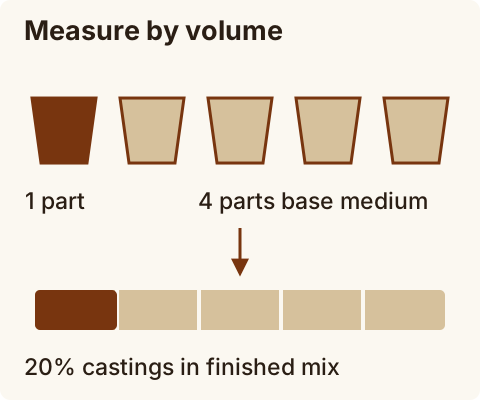
Seedling recipe schematic: the dark scoop is vermicompost; the lighter scoops are base medium. Ratio from NC State LF-007-08, revised May 2025, accessed October 19, 2026.
Recipe threshold: If base-medium volume is less than four times the vermicompost volume when following that seedling recipe, add base medium before filling the tray. This restores the stated amendment fraction and retains the intended share of potting medium. It is a recipe check, not a universal toxicity limit.
Calculate the batch explicitly:
V_castings = V_final × 0.20
V_base = V_final − V_castings
Worked example — assumed batch size, October 19, 2026: For a final 5 L batch using NC State’s 20% by-volume recipe, castings = 5 L × 0.20 = 1 L; base medium = 5 L − 1 L = 4 L. These are derived mixing volumes, not a fertilizer dose. Combining castings with an already filled container of base medium changes the final volume; calculate the finished batch first.
How should castings be used during garden planting?
For a garden plant already in place, use the top-dressing guidance around its drip line rather than transferring the seedling percentage to the whole bed. NC State’s handbook also permits mixing finished vermicompost into garden soil and advises protecting it from direct sunlight by incorporation or mulch. Source: NC State Extension Gardener Handbook, accessed October 19, 2026.
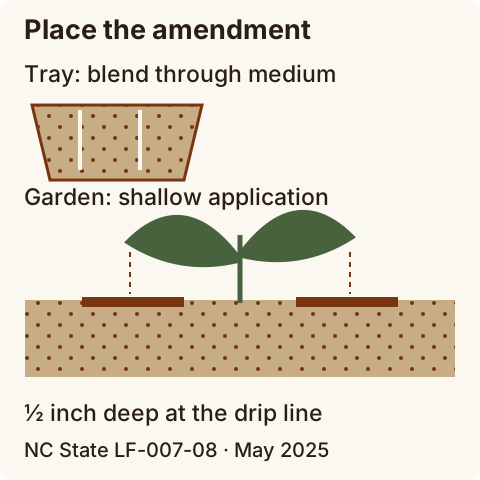
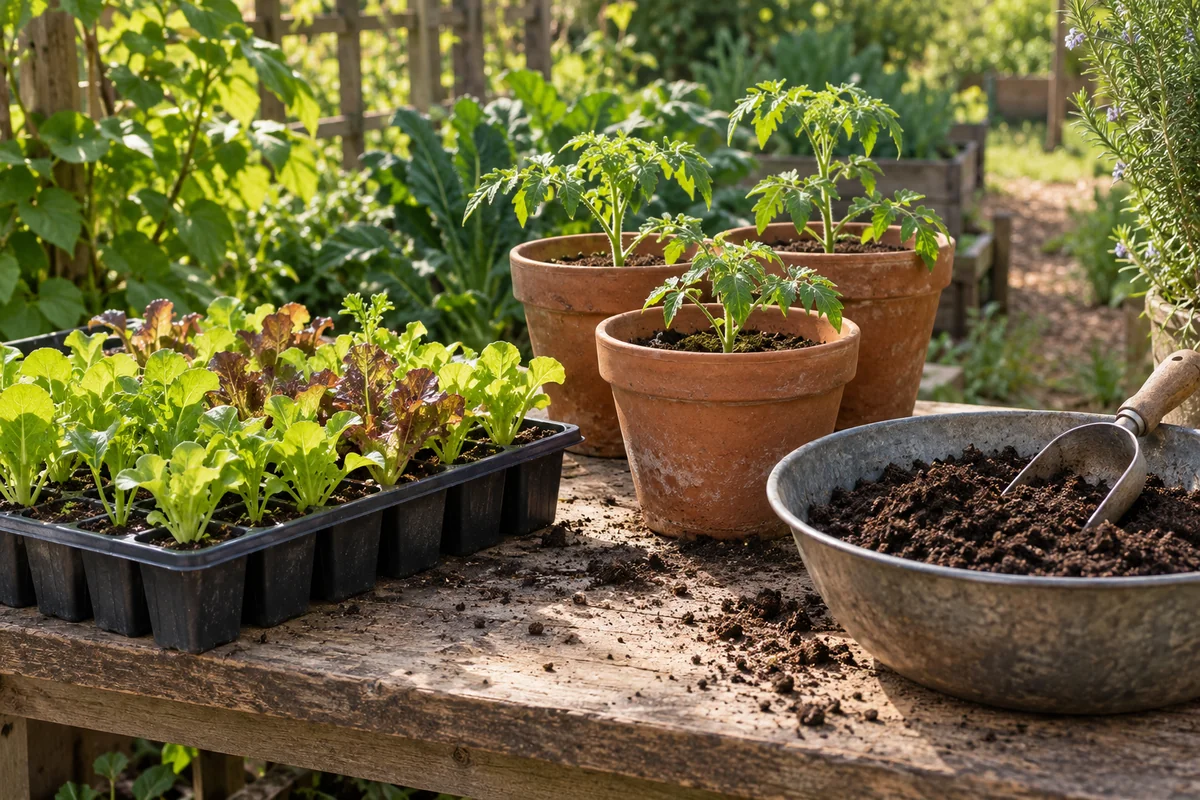
Different treatments: a blended seedling medium and a shallow garden application. The ½-inch garden depth comes from NC State LF-007-08; drawing is schematic.
Do not turn a top-dressing depth into an arbitrary handful per planting hole. They describe different treatment volumes. During transplanting, record which treatment you used and follow product directions for the specific material; these cited recommendations do not establish a universal dose per transplant hole.
| Situation | Appropriate decision | Failure mode and prevention |
|---|---|---|
| Seedling tray | Measure the finished blend by volume | Eyeballing changes the recipe; use the same scoop throughout |
| Garden top dressing | Treat the soil around the drip line | A heap beside the stem does not distribute material over the intended soil area |
| Finished vermicompost left exposed | Incorporate or cover with mulch, as NC State advises | Direct sunlight exposes the amendment; protect it after application |
| Material still containing recognizable fresh food | Finish processing before garden use | Unprocessed bin contents are not the finished amendment described in the guidance |
| Liquid draining from a worm bin | Keep it separate from solid-castings decisions | NC State identifies runoff as leachate and says never to use it on food crops, houseplants or sensitive plants |
The liquid distinction matters: the compost tea guide explains tea, worm tea and leachate, which cannot be dosed using these solid-material rates. The handbook’s leachate warning was checked October 19, 2026.
What do worm castings supply—and what is still missing?
Castings supply organic matter and some nutrients; they do not automatically supply the particular nutrient amounts your crop needs. NC State describes vermicompost as a fine-textured, moisture-holding amendment containing plant-available nutrients. That description gives no batch-specific analysis from which to calculate a complete fertilizer program.
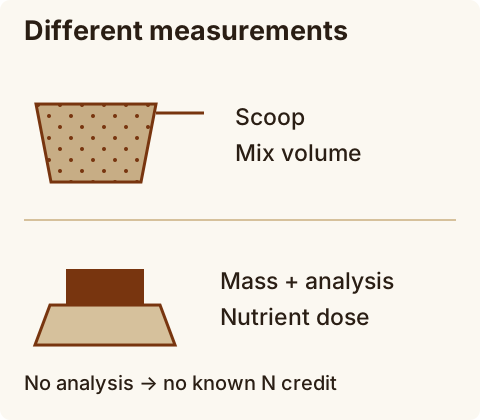
Amendment volume and nutrient mass answer different questions. A scoop measurement alone cannot establish pounds of nitrogen supplied.
Utah State Extension’s December 2011 guide explains that organic materials differ in both nutrient concentration and release speed. Its nutrient-rate calculation requires the area’s recommendation and the material’s nutrient percentage. Accordingly, a castings application without a product analysis or batch test cannot be credited as a known nutrient dose. This is a calculation limit, not a claim that castings contain no nutrients. Source: Utah State Extension, accessed October 19, 2026.
Do not infer a guaranteed microbial count, disease treatment or complete fertility program from a material’s dark color. No microbial-count estimate is needed to apply the measured amendment guidance.
For established turf where the next decision is a known nitrogen application, switch to the lawn fertilizer NPK and timing calculation instead of converting castings volume into an assumed nitrogen dose.
Hidden cost: Repeatedly buying amendment to correct an unidentified nutrient shortage spends money without establishing the dose. Before another bag, use the crop fertilizer guide to match a soil-test recommendation to a nutrient analysis. Keep purchased volume, treated area, date and any labeled analysis in the garden record.
Method and sources
Updated October 19, 2026. This independent growing guide separates NC State’s seedling-mix and garden-placement advice from Utah State’s nutrient-budget method. The batch example is arithmetic using a stated assumed volume. Product composition, starting medium and crop demand remain separate inputs; the recipe is not a promise of improved germination or yield. More growing topics are in the blog index.