Feeding dormant grass wastes product and can encourage growth at the wrong time. Choose organic fertilizer for a lawn by its NPK bag analysis, the turf species and seasonal timing, then calculate the product mass for the measured grass area.
An organic lawn fertilizer’s nitrogen percentage controls the rate calculation; soil testing decides whether phosphate and potash are needed. For warm-season lawns, a spring date alone is insufficient: the grass must be ready for feeding. This guide uses South Carolina bermudagrass and Georgia centipedegrass as separate extension examples, then checks the nitrogen delivered by an actual manufacturer analysis. Their rates and timing should not be transferred to cool-season grass.
Which NPK analysis fits the lawn?
Choose an analysis that supplies the required nitrogen without adding nutrients the soil report does not call for. The organic fertilizer guide by crop explains material selection across garden uses; here the decision is how a lawn product fits the turf’s nutrient budget and season.
NPK on a bag expresses nitrogen, phosphate and potash as percentages of product weight. A zero in an analysis does not by itself make a lawn product incomplete: the soil may already supply that nutrient. Conversely, do not assume a nitrogen-only product corrects a potassium shortage. Utah State advises selecting lower concentrations of nutrients already high in the soil. Source: Utah State Extension, December 2011, accessed October 19, 2026.
| Lawn condition | Selection or timing decision | Failure mode and prevention |
|---|---|---|
| Soil test identifies a nutrient surplus | Avoid unnecessarily supplying that nutrient | Repeated applications can create an imbalance; compare the whole analysis |
| Bermudagrass still emerging from dormancy | Wait for full green-up and the local feeding window | Early nitrogen can stimulate growth vulnerable to late frost |
| Established centipedegrass | Use its species-specific nitrogen plan | Excess nitrogen can contribute to decline; do not borrow a bermudagrass program |
| Streaks after spreading | Check distribution before adding another full dose | Skips and overlaps create unequal application; calibrate the spreader |
The turf risks in the table come from Clemson HGIC 1216 and UGA Circular 1003, reviewed below; all were checked October 19, 2026.
When should organic fertilizer go on warm-season grass?
Apply during the species’ growing season, with timing adjusted to the local climate. Clemson’s South Carolina bermudagrass calendar places feeding after full green-up and warns that early-spring nitrogen followed by a late frost can damage the lawn. Its autumn section advises against nitrogen applications. Source: Clemson, revised November 2018, accessed October 19, 2026.
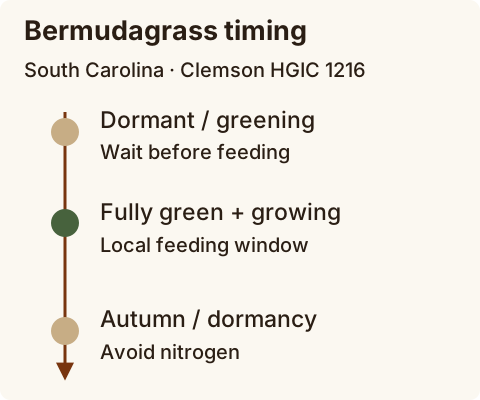
South Carolina bermudagrass timing schematic from Clemson HGIC 1216. Growth stage and local conditions control the decision; this is not a national calendar.
Temperature threshold — Georgia centipedegrass: If spring soil temperature at 4 inches deep is below 65°F, defer the first nitrogen application. UGA says to wait until that depth is consistently 65°F; early fertilization and excess nitrogen are management problems associated with centipedegrass decline. An isolated warm afternoon is not the consistency the guidance requires. Source: UGA Circular 1003, reviewed June 21, 2022, accessed October 19, 2026.
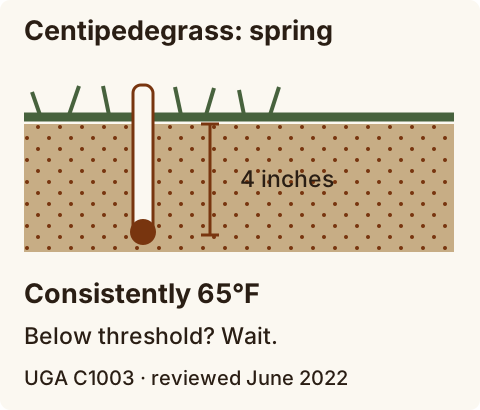
UGA’s centipedegrass threshold measures soil at a specified depth, not air temperature. Schematic, not to scale; source and dates as above.
Slow release does not justify applying a large dose to dormant turf. Nor does the organic designation establish a fixed release schedule. Match the specific product directions to the local grass calendar. For cool-season lawns, obtain the extension schedule for that grass and region instead of using the warm-season rules above.
How much product goes on the measured lawn?
The bag analysis controls the number. Calculate product mass from the nitrogen target and actual turf area, then check it against that bag’s application directions and the local turf recommendation.
Product (lb) = [N target (lb N per 1,000 sq ft) ÷ (label N% ÷ 100)] × [turf area (sq ft) ÷ 1,000 sq ft]
N delivered (lb N) = product mass (lb) × (label N% ÷ 100)
These equations express the label-weight calculation described by Utah State; they calculate total labeled nitrogen, not how much is released immediately.
Worked example — label-rate audit, October 19, 2026: Espoma’s undated All Season Lawn Food 9-0-0 fact sheet states 9% total N and an application of about 6 lb product per 1,000 sq ft when clippings are returned. Assume a measured 2,000 sq ft lawn under that condition. Product = 6 lb × (2,000 ÷ 1,000) = 12 lb; nitrogen delivered = 12 lb × 0.09 = 1.08 lb N, equivalent to 0.54 lb N per 1,000 sq ft. Manufacturer fact sheet, accessed October 19, 2026.
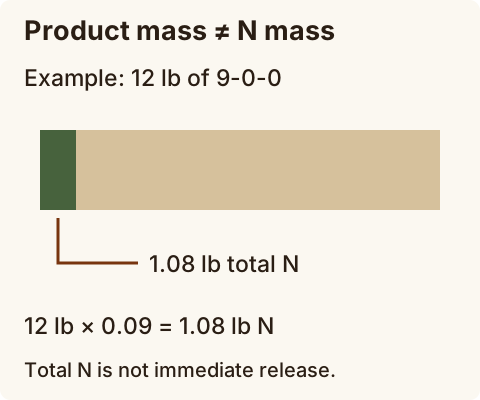
Derived example: product weight and nitrogen weight are different quantities. The nitrogen segment represents 9% of the product mass; example inputs and source appear above.
That audit does not prescribe the product or rate for every grass. In particular, centipedegrass needs its own lower-input program. The archived fact sheet is a worked analysis, not confirmation that every current bag has the same formulation. Read the bag in hand, including its use conditions; its stated analysis controls a fresh calculation.
Measure only grass receiving fertilizer. Divide an irregular lawn into measurable shapes, add their areas, and subtract paths, patios and beds. Keep those measurements with the product weight and date so a future application can be compared with the same area.
What costs are easy to miss?
Account for carrying and spreading product, nutrient oversupply and repeated passes, rather than comparing bags by sticker price alone. Lower nutrient concentration can mean handling more material for a given nutrient target. Hidden cost: feeding for color without first identifying a soil problem can buy unnecessary nutrients and additional mowing. Start with the garden soil-sample lab checklist and identify the sample as lawn turf so the laboratory can interpret it for the right use.
If the intended job is adding solid organic amendment rather than meeting a labeled nitrogen target, use the separate worm castings application-rate guide. Its volume-based mixing and placement decisions answer a different question from the lawn nitrogen calculation.
Method and sources
Updated October 19, 2026. This independent growing guide uses Clemson’s South Carolina bermudagrass calendar, UGA’s Georgia centipedegrass guidance, Utah State’s fertilizer arithmetic and Espoma’s published analysis. The area is an explicit example assumption; the product and nitrogen masses are derived. Local species, soil results, weather and the bag directions determine an actual application. Further growing articles are in the blog index.