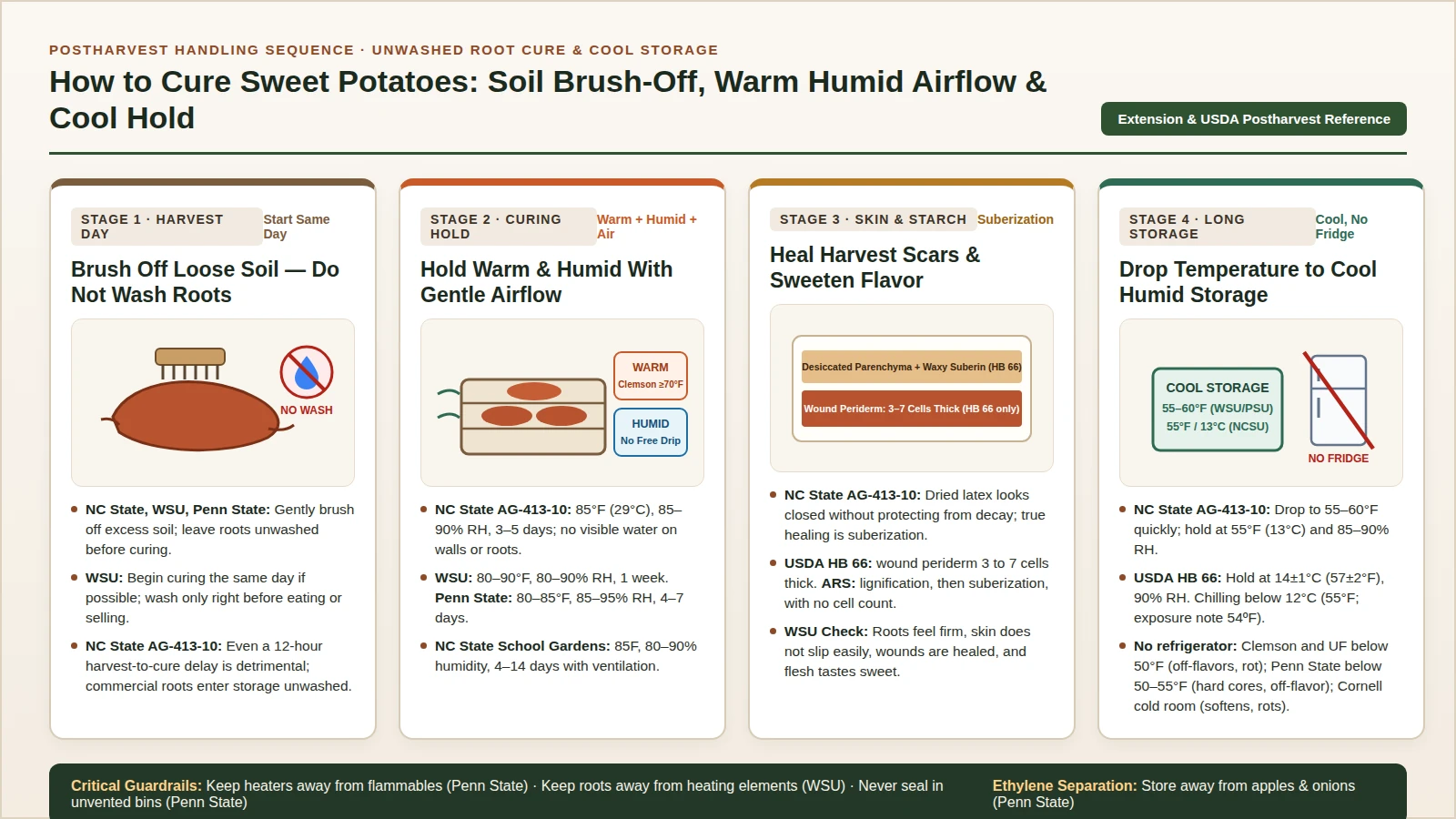
Brush excess soil off freshly dug sweet potatoes without washing them, start the cure on harvest day if possible, and hold the unwashed roots in warm, humid air with gentle ventilation so harvest scars heal and starches convert toward sugar (NC State Plants for Human Health Institute; Washington State University; Penn State Extension). Published extension targets stay distinct by guide: NC State’s school-gardens page gives 85F and 80-90% humidity with good ventilation for 4-14 days, WSU gives 80-90°F and 80-90% relative humidity for 1 week, and NC State Extension publication AG-413-10 gives 85°F (29°C) and 85 to 90 percent relative humidity for three to five days immediately after harvest. Once wounds have healed over, drop the temperature to cool, humid storage and never refrigerate the roots: NC State AG-413-10 reduces temperature to 55 to 60°F (13°C) as quickly as possible and holds near 55°F (13°C) at 85 to 90 percent relative humidity, while WSU holds cured roots at 55-60°F and 80-90% relative humidity (Clemson Cooperative Extension HGIC 1322).
Leaving soil on until the roots are cooked or sold protects delicate skin. WSU notes that washing after harvest can damage the skin and make roots more susceptible to pathogens than unwashed stock, though if a wash is necessary and roots are properly cured afterward, storage life is typically only slightly less than unwashed cured roots. Commercial harvests follow the same sequence: NC State AG-413-10 states that harvested roots go directly into storage without washing, while WSU, Penn State, and University of Minnesota Extension advise washing only right before eating or selling, or drying thoroughly after curing before packing. This postharvest reference sits alongside other home growing guides on the growing blog; bed drainage mixes belong in our raised bed soil mixture guide, and pre-plant or in-season nutrient rates belong in our organic fertilizer by crop guide.
Do You Have to Cure Sweet Potatoes Before Eating Them?
Freshly dug sweet potatoes can go straight to the kitchen without curing, whereas any harvest held for winter storage must be cured first. North Carolina Cooperative Extension in Burke County (Donna Teasley, September 16, 2020) states that sweet potatoes may be dug and eaten immediately and that curing is used when roots must be stored. Writing for Cornell University CALS (May 29, 2020), horticulture professor Steve Reiners gives the same split: sweet potatoes can be eaten fresh, and roots that will be stored must be cured first.
Skipping the cure changes both eating quality and keeping time. NC State AG-413-10 notes that uncured (“green”) sweetpotatoes generally lack the visual appeal, shelf life, and culinary character of cured roots, and Chapter 8 of the North Carolina Organic Commodities Production Guide adds that roots packed and consumed green may not possess the same characteristics and storage ability as cured roots. Without curing, WSU puts postharvest shelf life at only a few weeks, whereas properly cured sweetpotatoes may be stored for 12 months or more. NC State’s school-gardens guide also notes that sweetpotatoes need curing to reach full sweetness. WSU adds one regional boundary: where harvest-period temperatures already sit at 70-85°F, curing may not be needed for flavor enhancement, though wound healing to block pathogen entry and moisture loss remains a primary purpose of curing in the same guide.
True wound healing is a cellular barrier rather than dried sap. NC State AG-413-10 points out that milky latex on a harvest scrape can dry within a few hours and appear to seal the cut while offering little protection against decay organisms or weight loss; the final stage of true wound healing is suberization. WSU explains that curing forms a protective cork layer over the root surface and deposits suberin, a waxy material that acts with the cork layer as a barrier to microorganisms and excessive moisture loss. In USDA Agriculture Handbook Number 66 (revised February 2016, edited by Gross, Wang, and Saltveit; sweetpotato summary by Stanley J. Kays, University of Georgia), the outermost parenchyma cells at the wound site desiccate first, subtending parenchyma cells suberize, and a ligninlike wound periderm forms underneath, with roots adequately healed once that wound periderm reaches 3 to 7 cells thick. The USDA-ARS sweetpotato chapter by Truong, Avula, Pecota, and Yencho (with Horticultural Science affiliation at North Carolina State University) describes this sequence as lignification beneath damaged cells followed by wound periderm formation called suberization.
Sweetening spans curing, storage, and cooking through distinct steps. After harvest, NC State AG-413-10 says sweetpotatoes stay metabolically active and respire, converting starch to sugars, WSU says curing improves flavor as starch is converted to sugar, and the USDA-ARS chapter places that starch-to-sugar respiration during storage; in WSU’s Mount Vernon trial table, Bayou Belle soluble solids read 6.6 and 9.1. Handbook 66 adds that curing facilitates the synthesis of enzymes that operate in flavor development during cooking, and the USDA-ARS chapter specifies that during cooking itself, amylases act on gelatinized starch to form maltose in cooked sweetpotatoes.
How Long Does It Take to Cure Sweet Potatoes?
Published curing times run from three to five days in heated commercial rooms up to 14 days (or 2 to 3 weeks) in cooler household spaces, so each duration belongs beside the temperature and humidity of the publication that printed it. Promptness matters before counting days: NC State AG-413-10 (published August 1, 2008 and reviewed April 23, 2025, by Edmunds, Boyette, Clark, Ferrin, Smith, and Holmes, reviewed by Jonathan Schultheis and revised from the 1997 publication AG-413-10-B) and the joint LSU AgCenter PDF of that same bulletin report that a delay of as few as 12 hours between harvest and curing has been shown to be detrimental, and that a larger gap between root pulp temperature and 85°F (29°C) lengthens the cure.
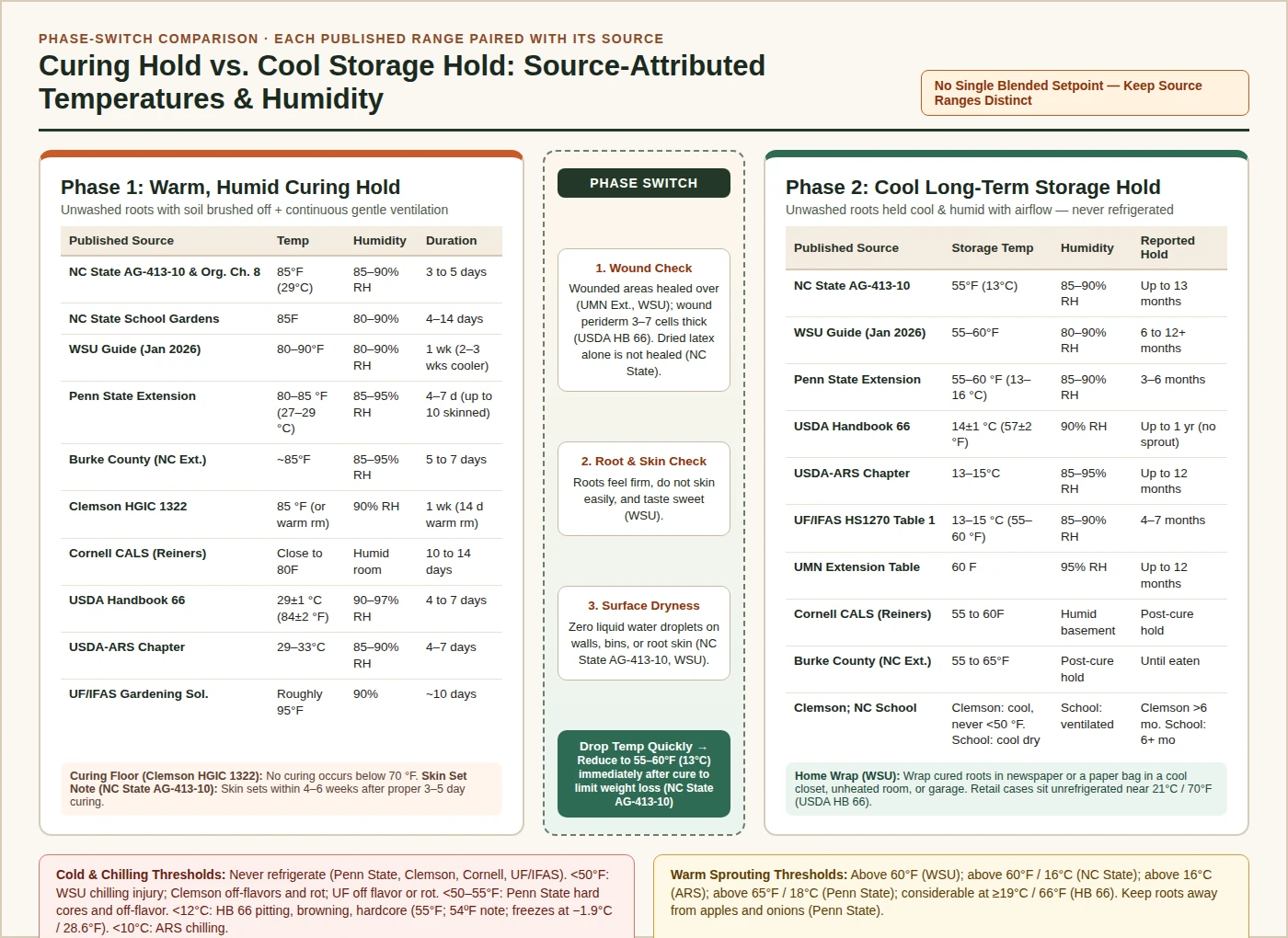
| Publication | Curing Temperature | Relative Humidity | Curing Duration and Airflow Note |
|---|---|---|---|
| NC State Extension AG-413-10 (and NC Organic Commodities Chapter 8; joint LSU AgCenter PDF) | 85°F (29°C) | 85 to 90% RH | 3 to 5 days immediately after harvest with proper ventilation |
| NC State Plants for Human Health Institute (School Gardens) | 85F | 80-90% humidity | 4-14 days with good ventilation |
| Washington State University (January 2026) | 80-90°F (or lower temperatures) | 80-90% RH | 1 week at 80-90°F; 2 to 3 weeks at lower temperatures |
| Penn State Extension | 80-85 °F (27-29 °C) | 85-95% RH | 4-7 days (up to 10 days if heavily skinned) with gentle, continuous airflow |
| North Carolina Cooperative Extension, Burke County (Sept. 16, 2020) | About 85 degrees | 85 to 95% RH | 5 to 7 days to tighten skin, heal abrasions, and turn starches to sugar |
| Clemson HGIC 1322 (updated Apr 13, 2022) | 85 °F (or warmest room, usually kitchen) | 90% humidity | 1 week at 85 °F; 14 days in the warmest room when 85 °F / 90% RH is unavailable |
| Cornell CALS (Steve Reiners, May 29, 2020) | Close to 80F | Humid room | 10 to 14 days before moving to cool storage |
| USDA Agriculture Handbook 66 (revised Feb. 2016) | 29±1 °C (84±2 °F) | 90 to 97% RH | 4 to 7 days immediately after harvest, ventilated to remove CO2 and replenish O2 |
| USDA-ARS Sweetpotato Chapter (Truong et al.) | 29-33°C | 85-90% RH | 4-7 days with proper ventilation |
| UF/IFAS Gardening Solutions | Roughly 95°F (dark, warm room) | 90% humidity | Approximately 10 days before eating |
Keep two separate timelines clear when reading extension bulletins. In NC State AG-413-10, curing itself lasts three to five days, whereas full skin set develops within four to six weeks after proper curing; that bulletin also notes that some cultivars may be washed and graded without serious injury if carefully done within 24 to 48 hours of harvest. Separately, UF/IFAS Gardening Solutions mentions an in-ground option for some drier, purple-fleshed, or white-fleshed varieties: cutting the vines at the crown and letting the tubers sit in the soil for 10 days prior to harvest.
Check the roots rather than relying on the calendar alone. WSU states that properly cured sweetpotatoes feel firm, do not skin easily, have healed-over wounds, and taste sweet. University of Minnesota Extension (Cindy Tong, Natalie Hoidal, Annalisa Hultberg, and Annie Klodd, reviewed in 2026) likewise states that potatoes and sweet potatoes are done curing when wounded areas are healed, while USDA Handbook 66 defines adequate healing microscopically as a wound periderm 3 to 7 cells thick.
How Can You Cure Sweet Potatoes at Home Without a Curing Room?
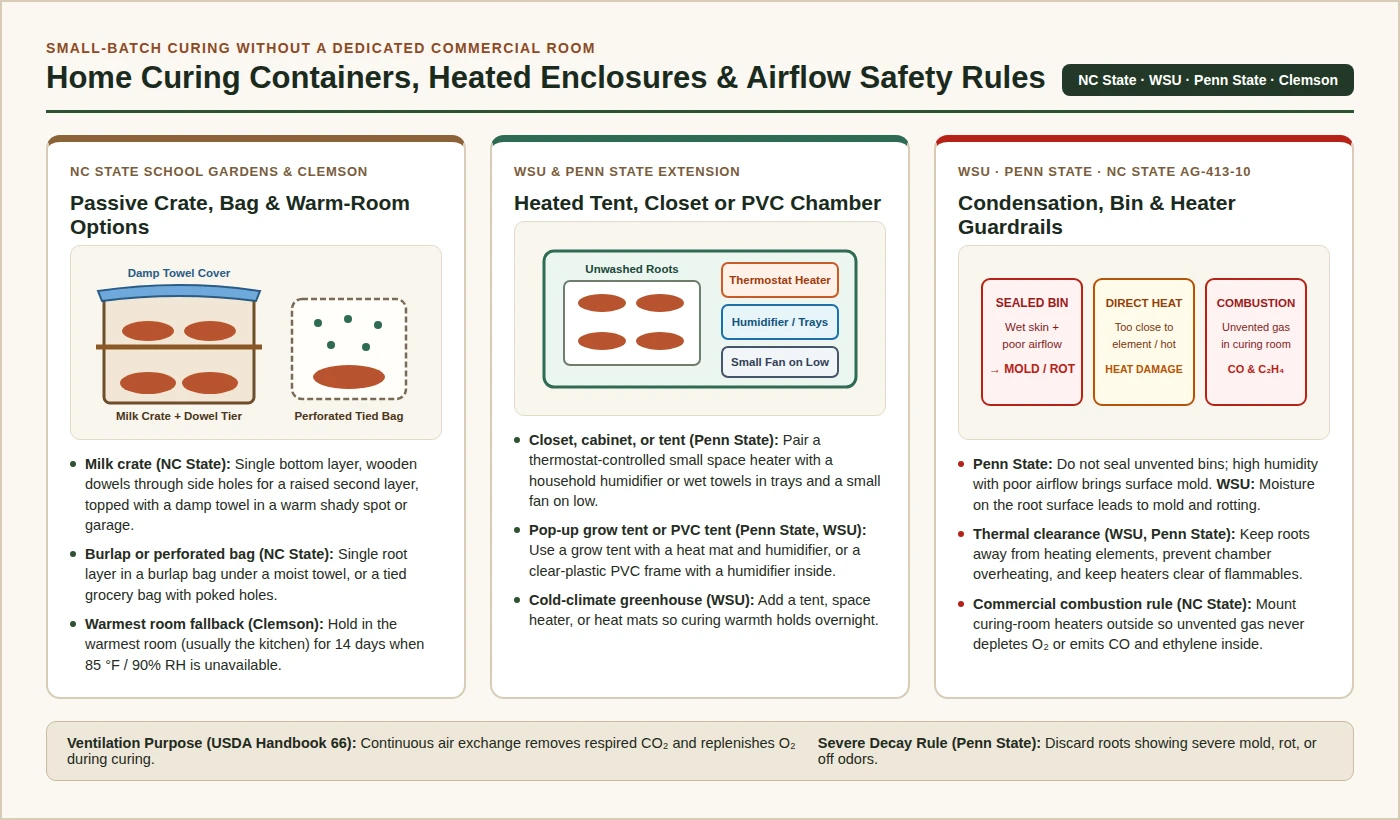
Small rooms, closets, tents, crates, and perforated bags can substitute for a commercial curing room when they supply warmth, moisture, and air exchange without wetting the root skin. NC State’s school-gardens guide notes that 85F and 80-90% humidity are easily achieved in a greenhouse and can be harder at home or school, then outlines three passive container setups for small harvests:
- Stack a single bottom layer of sweetpotatoes in a milk crate, push wooden dowels or sticks through the side holes to hold a second layer a few inches above the first, drape a damp towel on top, and place the crate in a warm, dry, shady spot or garage so air moves through the moist, warm space (NC State school gardens).
- Lay a single layer of sweetpotatoes inside a burlap bag, set a moist towel on top of the bag, and hold it in a warm, dry, shady place outdoors (NC State school gardens).
- Poke several holes in a plastic grocery bag, place a single layer of roots inside, tie the bag shut, and set it in a sunny window or a warm, dry, shady outdoor spot (NC State school gardens).
When a house cannot maintain 85 °F and 90-percent humidity, Clemson HGIC 1322 advises placing the sweetpotatoes in the warmest room in the house, usually the kitchen, for 14 days.
For tighter control over heat and humidity, WSU and Penn State Extension pair enclosed domestic spaces with small appliances. WSU notes that roots can cure in a small room with a space heater and humidifier, drawing heat from a built-in room heater, a space heater, a greenhouse, or a naturally warm area of the home, and humidity from a small humidifier or trays of water. Where no spare room exists, WSU suggests loosely draped plastic or a small chamber framed from PVC pipe, covered in clear plastic, with a humidifier inside.
How Do You Set Up a Small Sweet Potato Curing Box?
A small curing box or cabinet needs four parts working together: an enclosure, regulated warmth, evaporated moisture, and gentle air circulation. Penn State Extension recommends converting a closet, tent, or insulated cabinet with a small space heater on a thermostat controller, a household humidifier or wet towels in trays, and a small fan set on low for continuous gentle airflow. For micro-operations, Penn State notes that a pop-up grow tent equipped with a humidifier and a heat mat works well.
Airflow and heater spacing prevent surface mold and heat damage inside small chambers. Penn State warns not to seal sweetpotatoes in unvented bins and pairs surface mold with high humidity plus poor airflow, while WSU explains that ventilation keeps liquid moisture from accumulating on root surfaces where it leads to mold and rotting. Keep roots clear of heating elements so the chamber does not get too hot (WSU), and keep space heaters away from flammables (Penn State). Save newspaper or paper-bag wrapping for after the cure: WSU uses newspaper or a paper bag in a cool closet, unheated storage room, or garage as the home storage step, not as the curing container.
How Do You Cure Sweet Potatoes in a Cold Climate?
Dig sweet potatoes before the first fall frost (Cornell CALS) and move them straight into a heated indoor enclosure, because Clemson HGIC 1322 states that no curing occurs below 70 °F. Northern extension guides address both overnight heat loss during curing and cold storage rooms afterward.
WSU wrote its sweetpotato curing and storage guide for environmental conditions in northwestern Washington and notes that if roots are cured in an unheated greenhouse, growers should add a tent, a space heater, or heat mats so adequate temperature holds overnight. In New York, Cornell’s Steve Reiners cures freshly dug roots in a warm, humid room close to 80F for 10 to 14 days and then shifts them to a relatively cool (55 to 60F), humid basement, warning not to place roots in a refrigerator or a cold room where they will soften and rot.
University of Minnesota Extension lists sweet potatoes among crops that require curing before storage. Its general field-curing paragraph (7 to 10 days on the soil until wounds scab over) applies only when warm (about 80 to 90 degrees Fahrenheit), rainless days are forecast at harvest; whenever autumn weather will not support field curing, the same guide recommends curing indoors in a covered facility such as a barn or high tunnel with outside air circulated past the crop. Do not place freshly harvested roots in a refrigerator while waiting to cure them (Penn State).
Can You Cure Sweet Potatoes in an Oven?
None of the extension guides or USDA postharvest references cited on this page evaluate a kitchen oven for curing sweet potatoes or publish an oven setpoint. Published curing temperatures stay with each guide: NC State school gardens at 85F, NC State AG-413-10 at 85°F (29°C), WSU at 80-90°F, Penn State at 80-85 °F, Clemson at 85 °F, Cornell close to 80F, USDA Handbook 66 at 29±1 °C (84±2 °F), the USDA-ARS chapter at 29-33°C, and UF/IFAS Gardening Solutions at roughly 95°F.
Extension heater warnings explain why enclosed heat sources require clearance and ventilation. WSU states that sweetpotatoes will be damaged if placed too close to a heating element or if the curing chamber or room gets too hot, and Penn State advises keeping heaters away from flammables. For commercial curing rooms, NC State AG-413-10 warns that heater combustion air must not come from inside the room: unvented gas heaters can rapidly deplete room oxygen, generate carbon monoxide, and emit ethylene as a combustion by-product that harms sweetpotato quality, which is why commercial heaters should always be mounted outside the curing room.
How Do Commercial Growers Cure Sweet Potatoes?
Some commercial sweetpotatoes are shipped “green,” meaning they are washed, graded, and packed within hours or days of harvest without curing, though NC State AG-413-10 notes those uncured roots generally lack the visual appeal, shelf life, and culinary character of cured stock. For standard cured storage, NC State AG-413-10 moves unwashed roots immediately after harvest into a room held at 85°F (29°C) and 85 to 90 percent relative humidity with proper ventilation for three to five days.
Commercial rooms balance high humidity against condensation and respired gas buildup. NC State AG-413-10 states that curing humidity should be 85 to 90 percent without reaching the point where liquid water appears on walls, floors, bins, or the sweetpotatoes. Outside air exchange in that bulletin can be as little as one-half cubic foot per bushel per day for sound harvests, while roots injured by rough handling, exposed to chilling, or dug from waterlogged soil may require 5 to 10 cubic feet of outside air per bushel per day. Penn State Extension pairs a heated, humidified commercial room with gentle air circulation and vented crates stacked with 6-12 inches of clearance around stacks. USDA Handbook 66 specifies curing immediately after harvest at 29±1 °C (84±2 °F) and 90 to 97% RH for 4 to 7 days with ventilation to remove CO2 and replenish O2, and the USDA-ARS chapter gives 29-33°C and 85-90% RH with ventilation for 4-7 days.
Switching from Curing to Long-Term Cool Storage
Once wounds heal, drop the temperature promptly into the cool storage range while keeping relative humidity high and refrigeration off the table. NC State AG-413-10 advises not exceeding its three to five days of curing to limit weight loss from overcuring, reduces temperature to 55 to 60°F (13°C) as quickly as possible, and notes that normal weight loss should not exceed 5 to 8 percent of freshly harvested weight.
| Publication | Storage Temperature | Storage Relative Humidity | Reported Hold and Temperature Boundaries |
|---|---|---|---|
| NC State Extension AG-413-10 | 55°F (13°C) after dropping to 55-60°F | 85 to 90% RH, ventilated | Marketable as long as 13 months; sprouts above 60°F (16°C) |
| Washington State University (Jan. 2026) | 55-60°F | 80-90% RH | 6 to 12 months or more; chilling below 50°F, sprouting above 60°F |
| Penn State Extension | 55-60 °F (13-16 °C) | 85-90% RH | 3-6 months; avoid below 50-55 °F (10-13 °C) and above 65 °F (18 °C) |
| USDA Agriculture Handbook 66 | 14±1 °C (57±2 °F) | 90% RH | Up to 1 year without sprouting (sensory quality declines); chilling below 12 °C (55 °F susceptibility; 54 ºF exposure note), sprouting at 19 °C (66 °F) or above |
| USDA-ARS Sweetpotato Chapter | 13-15°C | 85-95% RH | Marketable up to 12 months; chilling below 10°C, sprouting above 16°C |
| UF/IFAS HS1270 Table 1 (adapted from Kitinoja and Kader, 2003) | 13-15 °C (55-60 °F) | 85-90% RH | 4-7 months storage row |
| University of Minnesota Extension Table | 60 F | 95% RH | Up to 12 months; wash after curing when ready to sell |
| Cornell CALS (Steve Reiners) | 55 to 60F | Humid environment (basement) | Do not refrigerate or place in a cold room (softens and rots) |
| North Carolina Cooperative Extension, Burke County | 55 to 65 degrees | Cool post-cure hold | Hold until eaten; store-bought roots keep about two weeks in a cool dry place without refrigeration |
| Clemson HGIC 1322; NC State School Gardens; UF/IFAS Gardening Solutions | Clemson: cool location, never below 50 °F; school gardens: cool dry place; UF/IFAS: cool, dry pantry | School gardens: good ventilation | Over 6 months (Clemson) and 6 months or more (school gardens); below 50 °F brings off-flavors and possibly rot (Clemson) or an off flavor or rot (UF/IFAS); never refrigerate (Clemson and UF/IFAS) |
Home storage habits also differ from retail display conditions. At home, WSU recommends wrapping cured sweetpotatoes in newspaper or a paper bag and keeping them in a cool closet or an unheated storage room or garage, while Penn State warns against storing roots near apples or onions because ethylene accelerates sprouting. UF/IFAS publication HS1270 prints its 13-15 °C (55-60 °F) and 85-90% RH row as a postharvest storage entry rather than a curing setpoint, and USDA Handbook 66 notes that grocery stores typically display sweetpotatoes loose in unrefrigerated cases near 21°C (70 °F) rather than at long-term storage temperatures. Notice also in Burke County’s guidance that the two-week pantry rule applies to purchased sweet potatoes (which turn bitter if refrigerated), whereas home-cured roots are held at 55 to 65 degrees until eaten.
Chilling damage can develop inside raw roots before cooking reveals it. USDA Handbook 66 places the freezing point of sweetpotato roots at -1.9 °C (28.6 °F) and notes that chilling-injury severity below 12 °C (printed as 55 °F in the chilling threshold and 54 ºF in the exposure note) depends on both how cold the room gets and how long roots stay there. NC State AG-413-10 lists surface pitting, greatly accelerated respiratory activity (dry matter loss), and higher decay susceptibility as the most common chilling symptoms. Handbook 66 adds root shriveling, abnormal wound periderm, fungal decay, internal tissue browning, and hardcore: a disorder invisible in raw roots that stays firm after cooking or processing and affects noncured roots more readily than cured roots.
Postharvest Curing and Storage Phase-Switch Record
Use this log on harvest day and on the day the roots move out of the warm hold so each batch shifts to cool storage based on skin and wound condition.
| Record Field | Batch Entry to Write Down | Published Check Before Moving On |
|---|---|---|
| Harvest date and cure-start time | Dig date, pre-frost check, and hour placed into the warm hold | Harvest before first fall frost (Cornell); start curing the same day if possible (WSU), as even a 12-hour delay is detrimental (NC State AG-413-10) |
| Soil brush-off and unwashed check | Confirmation that loose soil was brushed off and roots stayed dry and unwashed | Brush off soil and do not wash before curing (NC State, WSU, Penn State); commercial roots also enter storage unwashed (NC State AG-413-10) |
| Curing temperature and relative humidity | Measured air temperature and relative humidity next to the crates or tent | Hold at least at or above the 70 °F floor (Clemson) and match the target range of the guide followed, such as 80-90°F and 80-90% RH (WSU) or 85°F and 85-90% RH (NC State AG-413-10) |
| Airflow and condensation check | Fan, vent, or crate-spacing note plus daily check for wet walls, bins, or root skin | Keep gentle continuous airflow (Penn State) with zero visible water droplets on walls, bins, or roots (NC State AG-413-10, WSU) and no surface mold (Penn State) |
| Curing day count | Number of days elapsed since cure start | Compare elapsed days against chamber warmth: 3 to 5 days at 85°F (NC State AG-413-10), 4-7 days (Penn State, Agriculture Handbook Number 66), 1 week (WSU, Clemson), or 10-14 days near 80F or in a warm room (Cornell, Clemson) |
| Skin-slip and wound-healing check | Thumb check for firm skin that does not slip and dry, healed harvest scars | Roots feel firm, skin does not slip easily, and wounds are healed over rather than merely coated in dried latex (WSU, UMN Extension, NC State AG-413-10) |
| Storage phase-switch temperature | Date moved, new room temperature, relative humidity, and ethylene check | Drop quickly to 55-60°F / 13°C (NC State AG-413-10, WSU, Penn State), keep above 50°F without refrigeration (Clemson, Cornell, UF/IFAS), and store away from apples and onions (Penn State) |