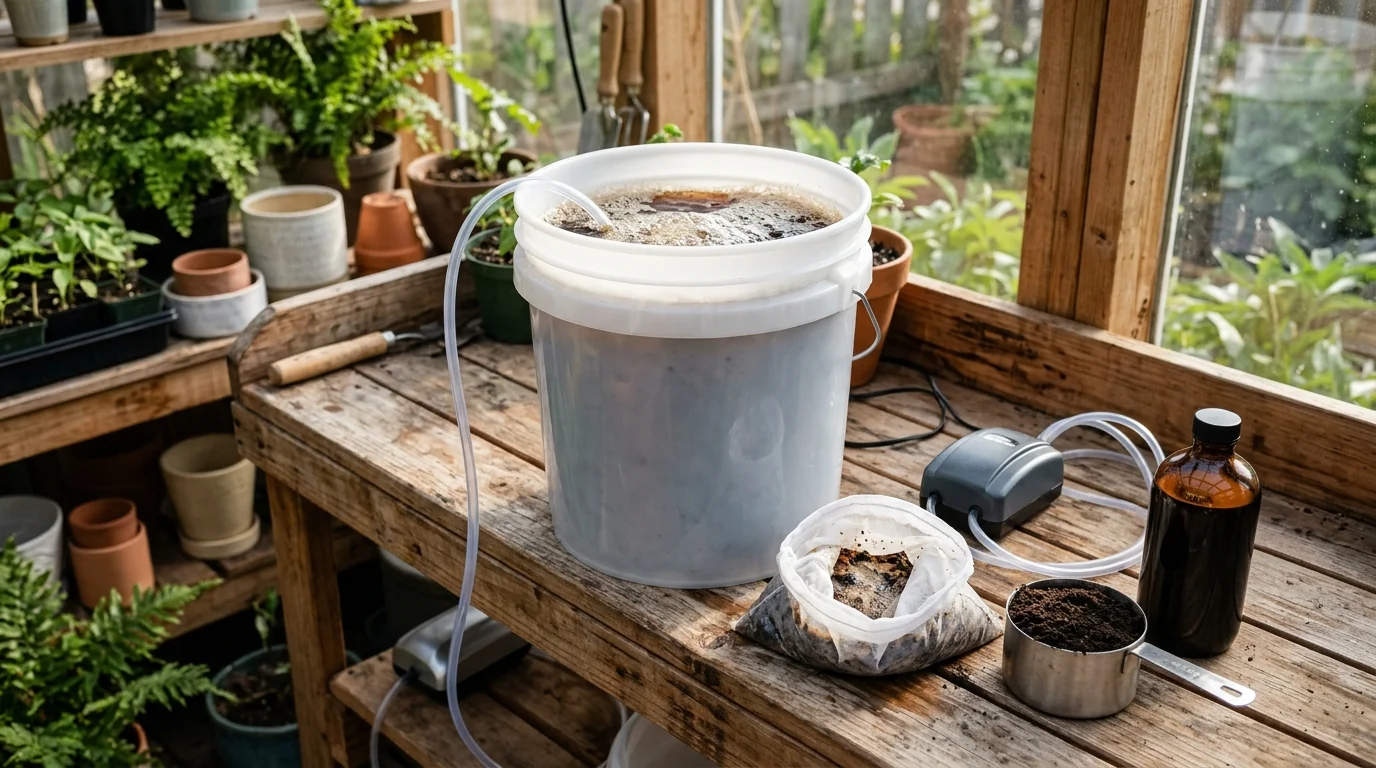
NC State Plants for Human Health Institute specifies a 5-gallon bucket aerated compost tea setup using a small aquarium pump with tubing and air stone (costing less than $10), a fine mesh bag (such as knee-high nylon hose), and about 2 cups of compost.
NC State Extension Gardener Handbook warns that liquid runoff leaking from the bottom of a worm bin is leachate—liquid that has passed through unprocessed organic material—which may contain pathogens, phytotoxins, and anaerobic microorganisms harmful to plants; never use leachate on food crops, houseplants, or sensitive plants, and use only finished vermicompost to make vermicompost tea.
University of Hawaii research (Pant, 2011) tested vermicompost tea with vermicompost to water ratios of 1:10 to 1:100 (by volume) and observed the best plant growth response with ratios of 1:20 and 1:10, indicating that the optimal ratio of vermicompost to water ranges between 1:10 and 1:20.
In greenhouse trials on pak choi, applying vermicompost tea at compost to water ratios of 1:10 to 1:100 (v:v) increased yield, total carotenoids, total glucosinolates, and N content linearly, with the best plant growth response at 1:20 and 1:10 (optimal range 1:10 to 1:20).
Core Compost Tea Recipe Ratios by Batch Volume
| Recipe Source and System | Compost to Water Ratio Specification | Brewing Notes and Target Outcome |
|---|---|---|
| In the NC State Extension Gardener Handbook, a compost tea brewer can be made from a clean 5-gallon bucket, fine mesh fabric, and two sticks | using 1 part compost to 10 parts water— | for example, for 1 gallon of water (128 ounces), use 13 ounces of compost. |
| UC ANR / El Dorado County Master Gardeners | states that a ratio of one pound of compost to 5 gallons of water | produces a concentrated tea that can be diluted before application, with a normal brewing period of 24 hours. |
| UVM Extension reports a 2-year study by the Rodale Institute and Pennsylvania State University | that prepared aerated compost tea by combining compost and water at a ratio of 9:1 | and adding kelp, humic acid, and fish hydrolysate. |
| In the Western SARE North Valley Organics process specifications for a 10-gallon batch in a Growing Solutions brewer with an Ecoplus model 728455 pump rated at 2.3 cfm at 0 PSI | and a #18 mesh (1000 microns) nylon basket, | the amount of compost per 10-gallon batch is 10 cups with low compaction in the basket. |
| UH CTAHR / SARE (Brew Master 2, Island Harvest Organics) | reports brewing 2 lbs of vermicompost to 50 gal of water for 24 hours, | applying 50 gallons per 7000 sq ft greenhouse once per week, trying to use up the brew within 4 hours, and warning to be careful with foliar spraying of seedling starts because they may get burned. |
One gallon of vermicompost weighs around 4-5 pounds, though measuring by volume is preferred because compost weight varies by moisture content.
Standard metric conversions for compost tea recipes are 1 gallon = 3.8 liters and 1 pound = 0.45 kilograms.
Weltzien (1990) used a 1:3 to 1:10 (vol:vol) compost to water ratio and found no difference in Phytophthora infestans suppression between 1:3 and 1:10, whereas suppression was lower at a 1:50 compost to water ratio.
In the UH CTAHR / USDA SARE Compost Tea Manual literature review, most disease-suppression studies followed Weltzien (1990) using a 1:3 to 1:10 (vol:vol) compost-to-water ratio, while Welke (2005) observed higher strawberry yield and lower disease incidence and another study (2006) reported a non-significant difference in tomato seedling growth response across vermicompost teas brewed at 1:25, 1:12, and 1:10 ratios.
How to Make Compost Tea in a Five-Gallon Bucket
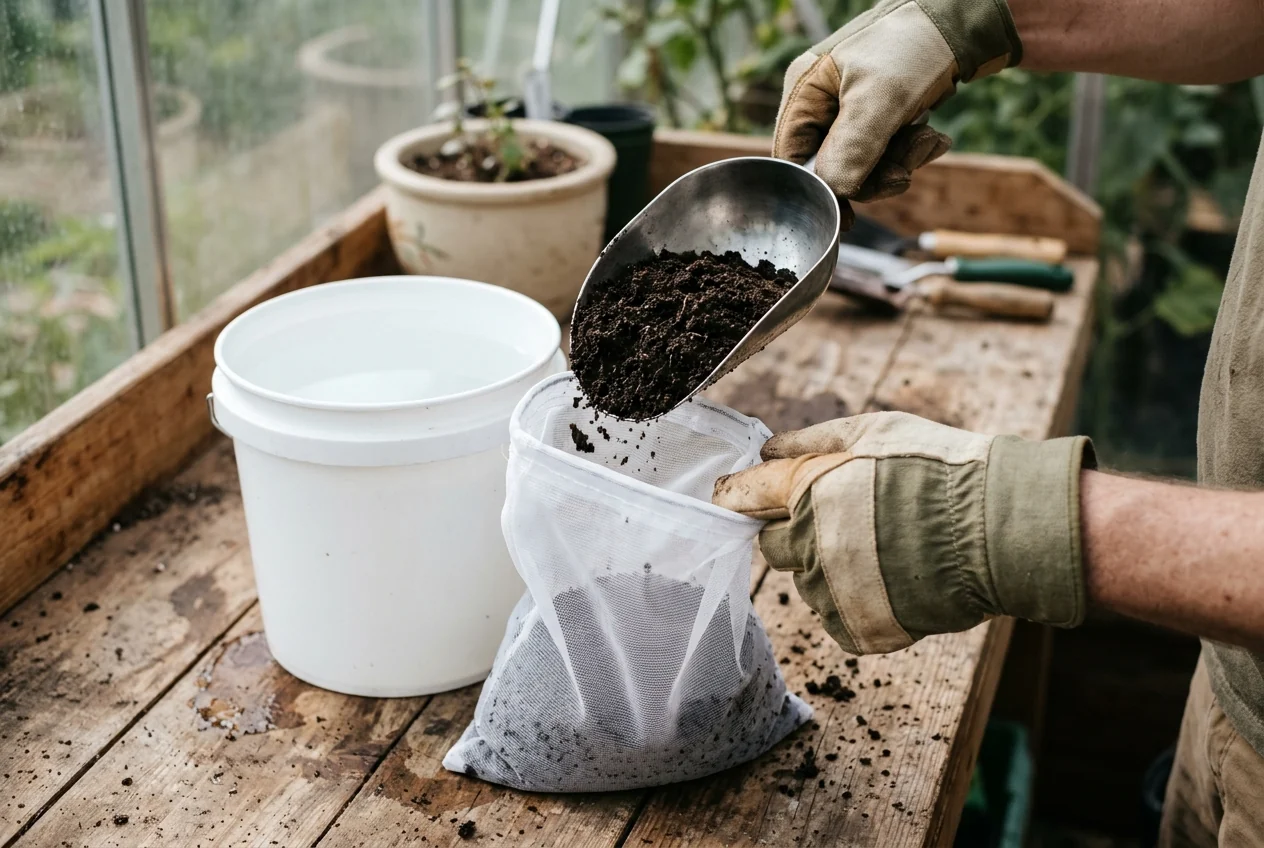
UH CTAHR / SARE states that chlorinated water can be degassed by allowing the water to sit overnight or letting the aerator run for several hours, whereas chloramine is chlorinated ammonia used as an alternative to chlorine in some situations and is much more difficult to remove.
In the Western SARE on-farm aerated compost tea trials, well water emerging from the ground at 55 degrees F and 4 mg/L dissolved oxygen is left to sit at least 8 hours to reach a brewer room temperature of approximately 70 degrees F and pre-aerated for 2 hours to bring dissolved oxygen from 4 mg/L up to 10-12 mg/L; if using municipal water, aeration also dissipates chlorine.
In the NC State Plants for Human Health Institute 5-gallon bucket recipe, 1 tablespoon of unsulfured blackstrap molasses is added to the bucket because bacteria require simple sugars to reproduce and sulfur can kill beneficial bacteria.
In the Western SARE North Valley Organics process specifications for a 24-48 hour brew cycle, food additives are added after 15 minutes of brewing at a rate of 1/2 cup of humic acid/seaweed extract per 10 gallons and 1/2 cup of unsulfured organic molasses per 10 gallons.
NC State PHHI specifies letting aerated compost tea brew for 24-36 hours.
NC State Extension Gardener Handbook directs placing the brewing bucket out of direct sunlight where temperatures remain 60 to 80°F (16 to 27°C), stirring 12 times over 48 hours or running an aquarium pump during that time, and using the strained yellow-brown tea immediately or within 4 hours after brewing.
Non-Aerated vs Aerated Compost Tea Brewing Times
MOFGA (citing Diver 2002) describes non-aerated compost teas (NCT) made by covering compost with tap water at a ratio between 1:5 to 1:8 (volume/volume), stirred once and fermented outdoors between 15° and 20° C (59-68° F) for 2 to 21 days (mostly 3 to 7 days), then strained through cheesecloth.
UVM Extension states that for compost tea effectiveness, compost should not be more than 9 to 12 months old, non-aerated compost tea may need at least five to eight days fermentation time, for aerated compost tea 24 to 48 hours of fermentation is considered sufficient, and brewed tea should be applied promptly because available oxygen is used up and the tea turns anaerobic, killing beneficial bacteria.
In the Western SARE aerated compost tea guidelines, brewing at 70-80 degrees F can shorten brew time to 12-24 hours when food and oxygen are maintained, whereas brewing at colder ambient temperatures can extend brew time to 48-72 hours, with dissolved oxygen as the critical measurement.
In the UH CTAHR / USDA SARE Compost Tea Manual, Weltzien (1991) reported that usually a 5 to 8 day period and up to a 16 day brewing time is needed for non-aerated compost tea (NCT), Ketterer et al. (1992) observed maximum Botrytis suppression on grape leaves with 7-day brewed NCT (testing 1, 3, 7, and 14-day teas), and Ingham (2005) suggests an optimum brewing time for aerated compost tea (ACT) often 12-24 hours with commercial aerobic compost tea makers to coincide with maximum active microbial population.
UH CTAHR / SARE states that the convention is to use finished compost tea within 4 hours after brewing, although research at Ohio State University showed that refrigeration can extend efficacy for up to 14 days.
In the Western SARE rules for brewing pathogen-free compost tea, operators must clean equipment immediately after brewing to prevent biofilm buildup, assure dissolved oxygen in all parts of the brewer never falls below 6 mg/L, and apply the tea within 1 hour after completion of brewing.
In the Western SARE step-by-step aerated compost tea protocol, brewing lasts 24-48 hours based on ambient temperature (24 hours at 80 degrees F in summer, or 36-48 hours at 60 degrees F in fall or early spring), surface foam after 24 hours indicates good microbe growth, and dissolved oxygen is checked during brewing to verify it never falls below 6 mg/L.
Molasses Additives, Pathogen Safety, and Preharvest Rules
In the Western SARE aerated compost tea report, many tea brewers have moved away from simple sugars such as molasses due to a concern that the rate of bacterial reproduction with this readily available sugar can outstrip the aerating pump’s ability to supply adequate oxygen.
In USDA ARS trials on dairy and chicken manure compost teas, Salmonella and E. coli O157:H7 regrowth was positively correlated with molasses concentration: with 1% molasses, Salmonella grew from 1 to >1000 CFU/ml in dairy tea and >350,000 CFU/ml in chicken tea by 72 h, and E. coli grew to ~1000 CFU/ml, whereas pathogen regrowth did not occur when molasses was eliminated or kept to 0.2%.
USDA ARS (September 21, 2006) reported that when compost containing fewer than two cells per milliliter of Salmonella and Escherichia coli was brewed into compost tea, the pathogens multiplied when additives (soluble kelp, fish hydrolysates, humic acid, rock dust, and proprietary nutrient solutions) were included in the initial water mixture, but remained undetectable in all teas made without commercial additives.
University of Vermont Extension reports that recommendations of the National Organic Standards include that compost tea made with additives either be pre-tested to meet EPA recreational water quality guidelines or follow the raw manure 90-120 day pre-harvest rule.
Under the National Organic Standards Board (NOSB) recommendations cited in the UH CTAHR / USDA SARE Compost Tea Manual, compost teas used in contact with crops less than 120 days before harvest must be made from high quality compost as defined in section 205.203(c)(2) and must not be prepared with supplemental nutrients such as sugars, molasses, or other soluble carbon sources unless the production system has been pre-tested to meet EPA recreational water quality guidelines (US EPA, 2000).
Under 7 CFR § 205.203(c)(1)-(2), raw animal manure must be composted unless applied to crops not for human consumption, incorporated into the soil not less than 120 days prior to harvest when the edible portion has direct contact with the soil surface or particles, or not less than 90 days prior to harvest when the edible portion does not have direct contact; composted plant and animal materials must establish an initial C:N ratio between 25:1 and 40:1 and maintain 131 °F to 170 °F for 3 days in an in-vessel or static aerated pile system or 15 days (turned a minimum of five times) in a windrow system.
Under USDA NOP guidance for vermicompost production, pathogenic organisms are eliminated in 7-60 days, thin organic matter layers are added at 1-3 day intervals to keep temperatures below 35 degrees C (95 degrees F), moisture is maintained at 70-90% at 18-30 degrees C (65-86 degrees F), and management lasts 6-12 months for outdoor windrows, 2-4 months for angled wedge or indoor container systems, and 30-60 days for continuous flow reactors.
In the Western SARE summary of FDA Produce Safety Rule microbial standards for biological soil amendments of animal origin (Proposed sections 112.54 and 112.55), acceptable treatment limits are Listeria monocytogenes not detected in 1 CFU per 5 gram portion, Salmonella species less than 3 MPN per 4 grams of total solids, E. coli O157:H7 less than 0.3 MPN per 1 gram portion, and fecal coliforms less than 1,000 MPN per gram of total solids.
In the Western SARE aerated compost tea guide, simple sugars such as molasses and protein sources such as kelp and fish hydrolysate favor bacterial growth (traditionally used for annual plants), whereas soybean, garbanzo bean, and oats favor fungal growth (traditionally used for perennial plants and trees), while recent practice favors a balanced tea with high counts of both bacteria and fungi.
Aerobic Smell Check, Dissolved Oxygen, and Compost Maturity
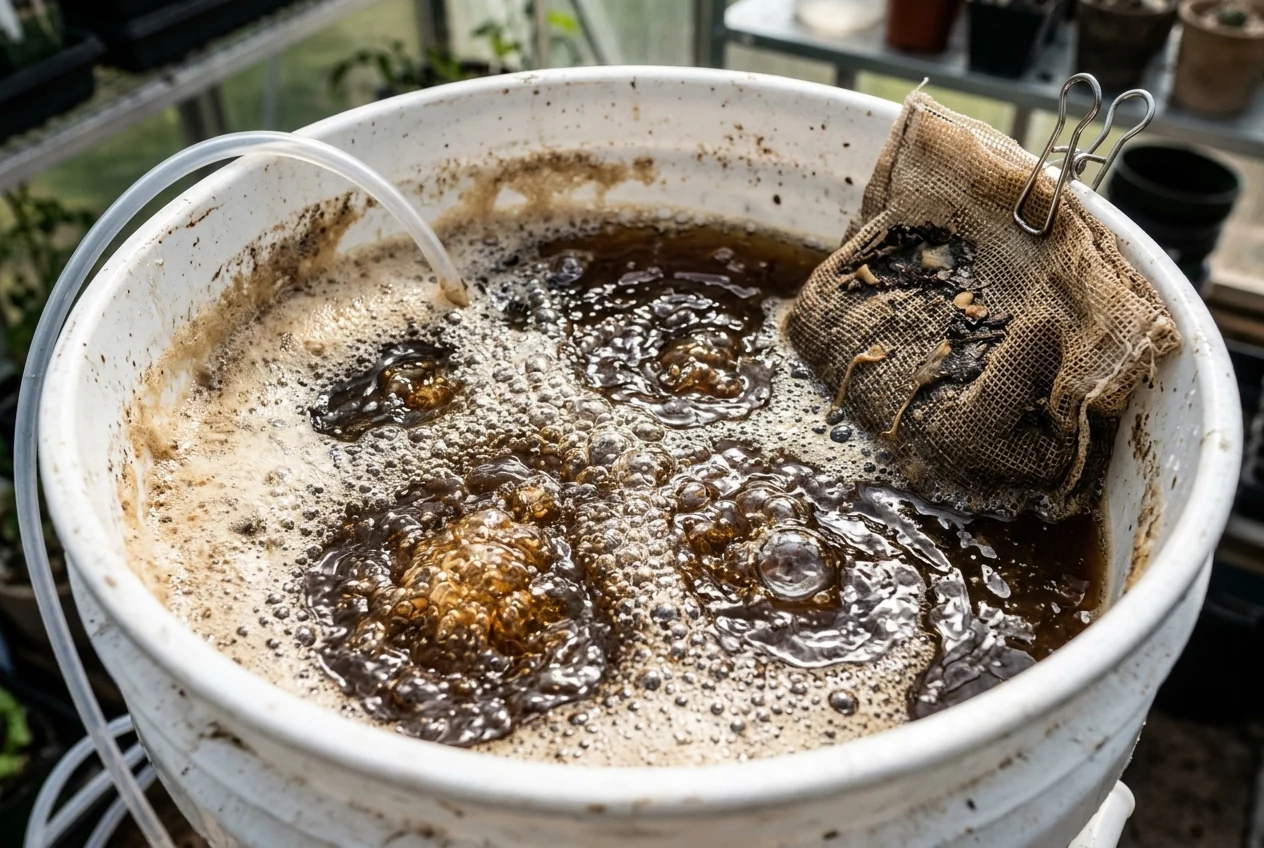
In the Western SARE aerated compost tea report, dissolved oxygen in compost tea should never fall below 6 mg/L and should preferably remain at 8 mg/L or higher.
In the Western SARE Step 7 validation guidelines, testing dissolved oxygen (DO) in the brew is critical: dissolved oxygen meters cost from $400 and up, whereas DO test strips with range indicators from 0 mg/L through 12 mg/L cost as little as $15.
In the Western SARE aerated compost tea guide, probiotic bacteria thrive in an oxygen-rich (aerobic) environment whereas pathogenic bacteria such as E. coli 0157:H7 thrive in an oxygen-poor (anaerobic) environment; a simple smell test distinguishes them because a rich earthy smell indicates probiotic microbes while a rotting putrid smell indicates pathogens.
According to UC ANR Master Gardeners, if compost tea smells bad or rotten, it contains anaerobic bacteria that can be harmful to plants and humans and should not be used.
NC State Extension Gardener Handbook states that a properly managed aerobic compost pile has a pleasant earthy smell, whereas anaerobic decomposition in the absence of oxygen can produce a strong foul odor of rancid butter or rotten eggs.
According to NC State Extension, under anaerobic conditions, anaerobes produce noxious odors that have been compared to the rotten-egg smell of hydrogen sulfide gas and organic acids that can inhibit plant growth.
| Maturity or Quality Source | Indicator and Threshold Range | Stability and Plant Safety Outcome |
|---|---|---|
| In the UH CTAHR / USDA SARE Compost Tea Manual, | mature compost suitable for promoting plant growth is dark brown, earthy smelling, moist, and finely divided, | and lacks sour or ammonia off-odors (Kuo et al. 2004; Sullivan and Miller, 2001). |
| USDA AMS / NCAT ATTRA Tipsheet | states that compost that is 5° to 10° above ambient temperature cannot be counted as finished | and can be detrimental to plants because bacteria and fungi are still sequestering nutrients rapidly enough that plants can be harmed or die. |
| In the UH CTAHR / USDA SARE Compost Tea Manual, | objective maturity indicators for compost used in compost tea include an optimal C:N ratio of 10-20:1 | (composts above 25:1 are unacceptable for cropping systems) and a self-heating stability test over a 5-10 day period where a temperature rise above 20 C in 10 days indicates unstable compost (Briton, 2000). |
| In the UH CTAHR / USDA SARE Compost Tea Manual, | quantitative maturity thresholds for compost used in compost tea include ammonium below 1000 ppm, | an ammonium-to-nitrate ratio below 1:1, electrical conductivity (EC) below 2.0 mmo, and pH between 6.0 and 7.5. |
Applying and Diluting Compost Tea for Plants
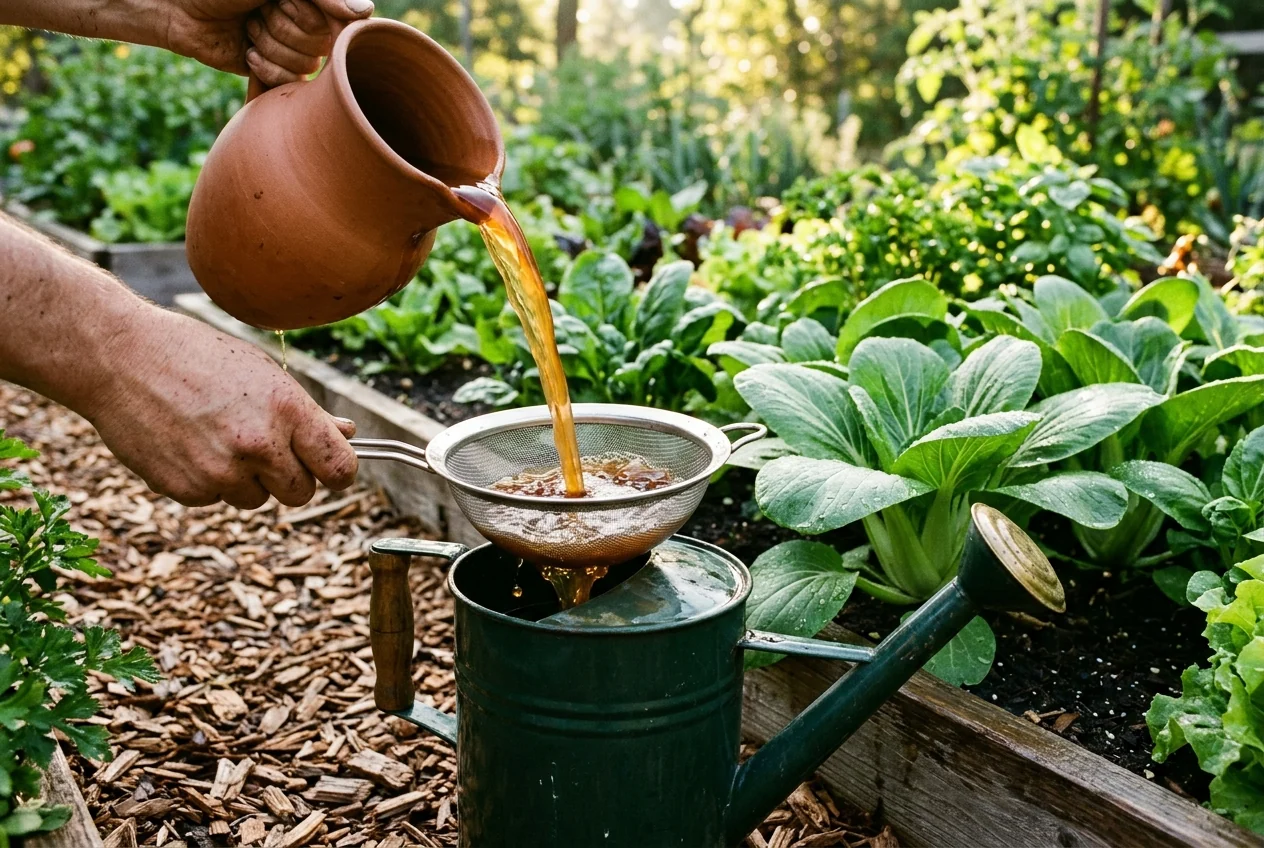
UH CTAHR / SARE reports that optimal vegetable crop growth in University of Hawaii research was seen at a compost tea application rate of 7-14 gal per 1000 sq ft (300-600 gal per acre), applied weekly for at least 4 weeks.
In the Western SARE North Valley Organics application specifications, aerated compost tea is diluted 2:1 for foliar feed, 4:1 for side dress and soil drench, and 1:1 for starts drench, and sprayed during low UV using a boom sprayer with red T-Jet AIXR #04 nozzles (600-micron opening, nozzle filter removed) at a maximum pressure of 15 psi.
Known Source Farms’ existing worm castings guide (citing NC State LF-007-08, revised May 2025) specifies blending 1 part vermicompost to 4 parts potting medium (20% of the finished mix by volume: V(castings) = V(final) × 0.20, so a 5 L batch uses 1 L castings and 4 L base medium) for seedlings, and applying a ½-inch-deep top-dressing around the drip line for garden plants.
Frequently Asked Questions
What is the simplest compost to water ratio for a home compost tea recipe?
To prepare a 1:10 compost-to-water ratio by volume, add a little over 1 1/2 cups of compost for every gallon of water.
How do you know how to make compost tea when tap water contains chlorine?
NC State Extension Gardener Handbook instructs that if brewing water has chlorine in it, you must first let the chlorine evaporate out by filling the bucket with water and letting it sit for at least 24 hours before submerging the mesh bag of compost.
What brewing condition prevents pathogen growth in commercial compost tea equipment?
In a USDA ARS study of aerated compost tea production in 18.9 L containers with dechlorinated tap water, commercial additives such as unsulphured molasses, soluble kelp, humic materials, and proprietary nutrient solutions promoted growth of inoculated Salmonella and E. coli O157:H7, whereas pathogens did not grow in the absence of additives.
How does compost leachate differ from brewed compost tea?
According to MOFGA, compost leachate is the dark solution that leaches from the bottom of the compost pile and is not compost tea, which is prepared from well-made finished compost.
How do you dilute finished compost tea for plants as a foliar spray?
NC State PHHI specifies that finished compost tea can be applied directly to soil or diluted for use as a foliar spray on plant leaves at a ratio of 4 cups of tea per 1 gallon of water (using water that sat for 24 hours to allow chlorine to evaporate).
Sources
- University of Hawaii College of Tropical Agriculture and Human Resources and Sustainable Agriculture Research and Education Compost Tea Manual (2011)
- North Carolina State Extension Gardener Handbook and Plants for Human Health Institute Composting and Compost Tea Guides (2022)
- University of California Agriculture and Natural Resources Master Gardeners Compost Tea Publication
- Maine Organic Farmers and Gardeners Association (Sideman, Spring 2004) citing NCAT/ATTRA Diver (2002)
- University of Vermont Extension Compost Tea to Suppress Plant Disease Factsheet (June 2005)
- Western SARE Aerated Compost Tea Field Guide (Morgan / North Valley Organics, February 2017)
- Agricultural Research Service and National Organic Standards Board Compost Tea Task Force Reports (2006)