Confusing a soil measurement with a fertilizer recommendation can lead you to add the wrong amount. To interpret soil test results, confirm the sample and crop, read each result with its laboratory method and units, then scale the lab’s application recommendation to the area of your bed.
Keep the measured soil value separate from the amount the laboratory recommends applying. The worksheet below records both, with blank spaces for anything your report does not explain. It is for an existing laboratory report on garden soil; use the garden soil-sample checklist if you have not collected a sample yet.
| Check before calculating | Copy from your report or records | Why it matters |
|---|---|---|
| Sample and crop | Bed ID, date, intended vegetables or crop code | A recommendation for another area or crop needs clarification |
| Analytical result | Nutrient name, method, value, units and lab rating | A soil concentration describes the sample |
| Application recommendation | Nutrient or product name, amount, area basis and timing | This is the instruction you may need to scale |
| Actual bed area | Measured length and width, in matching units | Converts an area-based rate to your bed |
| Fertilizer label | Nutrient analysis and application instructions | Converts nutrient mass into product mass |
Start with the right sample and crop
Find the sample ID on the report and match it to the bed you sampled. Check the collection date and the crop listed in the recommendation section. A correct laboratory result can still be paired with a crop you did not intend to select; ask the lab to clarify that before using its rates.
Iowa State’s interpretation guide explains that reports commonly include recommendations for the area being tested, such as a vegetable garden or lawn. Keep those recommendations with their crop and any attached notes. If a report lists several crops, choose the applicable row rather than combining their rates.
Our suggested record-keeping rule is simple: make one worksheet for each sampled bed. If you cannot identify the bed or crop confidently, put the calculation on hold and resolve that first.

Read the results and recommendations as separate sections
Begin by marking which part of the report contains measurements and which contains application instructions. A phosphorus result in parts per million (ppm) is not a number of pounds of fertilizer to spread. Likewise, a soil-test value reported in lb/acre is still a test result unless the report identifies it as an application recommendation.
Use this field guide to decide what to copy and what to ask about:
| Report field | What it describes | What to do with it |
|---|---|---|
| Soil pH | Acidity or alkalinity | Record it beside the crop-specific interpretation; it is not an amendment weight |
| Buffer pH | A separate test used to help determine lime requirement | Keep it distinct from soil pH and use the lab’s liming instructions |
| Phosphorus or potassium result | A measured value interpreted using the lab’s method | Copy the method, units and rating together |
| Nitrogen recommendation | May be based on crop needs and organic matter rather than a routine N measurement | Copy the recommendation and timing even if the result column is blank |
| Organic matter and CEC | Organic matter content and the soil’s capacity to retain positively charged nutrient ions | Keep them as context; neither is a fertilizer application rate |
| Fertilizer or lime recommendation | Amount to apply for the specified crop, area and schedule | Establish whether the amount means nutrient mass or product mass before calculating |
The distinction between phosphorus methods matters. Iowa State describes Bray-P1 and Olsen-P tests with different interpretation ranges. Keep the method and the lab’s rating instead of taking a ppm threshold from another laboratory’s chart. If the method is missing, leave that cell blank and ask for it before comparing reports.
Nitrogen needs a similar check. Iowa State explains that nitrate levels change readily, and some reports distinguish nitrate from nitrate-nitrogen. An absent nitrogen test is not a zero result. Copy any crop-based nitrogen recommendation separately; do not invent a missing measurement or subtract a nitrate result from a fertilizer rate.
For pH, Maryland Extension distinguishes soil pH from buffer pH, which helps determine liming requirements. A pH reading alone does not tell you how many pounds of lime to buy. If there is no clear crop-specific amendment instruction, ask the lab rather than filling in a rate from a generic chart.
Copy the blank soil-report worksheet
Use the tables here, or download the blank garden soil-report worksheet as a CSV. The CSV opens in a spreadsheet and provides fields for the sample context, analytical results, recommendations and calculations. It is a manual-entry record; it contains no automatic formulas or preset application rates.
| Context field | Your entry |
|---|---|
| Laboratory; report date; report reference | ____________________ |
| Sample ID; bed location; collection date | ____________________ |
| Intended crop; crop or use code on report | ____________________ |
| Soil or growing medium described on submission | ____________________ |
| Recent amendments and dates, from your records | ____________________ |
| Planted length × width; actual area and units | ____________________ |
| Recommendation notes and timing, copied exactly | ____________________ |
Then make a separate entry for each item you need to interpret:
| Report or calculation field | Your entry |
|---|---|
| Item or nutrient, spelled as the report gives it | ____________________ |
| Test method; measured value; units; lab rating | ____________________ |
| Recommended amount and nutrient or product name | ____________________ |
| Area basis, such as per 100 or per 1,000 sq ft | ____________________ |
| Nutrient amount for your bed, if applicable | ____________________ |
| Product analysis and nutrient percentage | ____________________ |
| Product amount for your bed; weight units | ____________________ |
| Application timing, splits and label restrictions | ____________________ |
| Decision: follow recommendation / no addition / ask lab | ____________________ |
| Unresolved question and laboratory response | ____________________ |
Keep blank and zero distinct. A blank recommendation needs clarification; a stated zero is an instruction you can record. If the report already gives an amount of a named fertilizer product, record it as product mass. Do not divide it by the nutrient percentage again.
Scale an application recommendation to the planted area
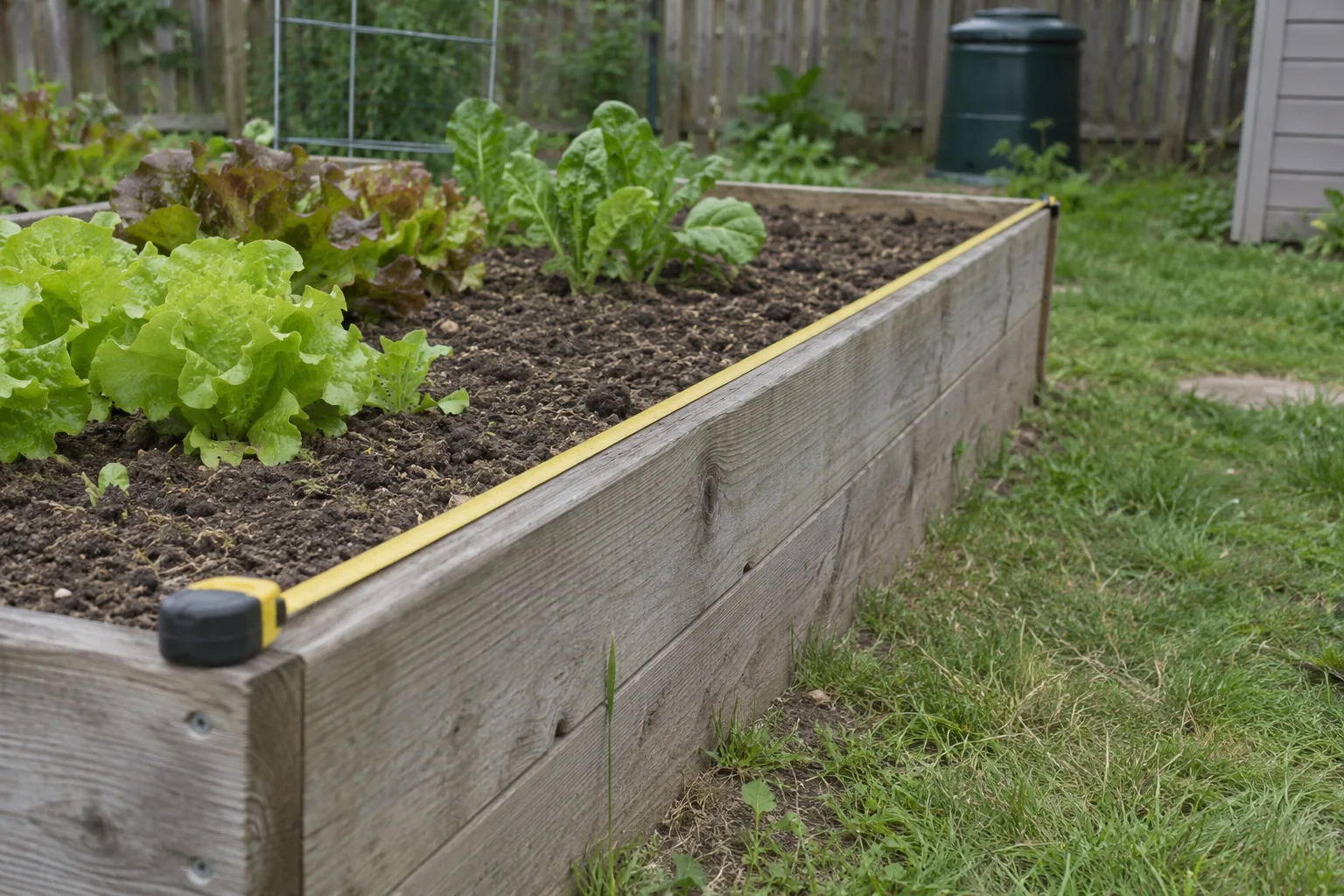
Measure the area that the recommendation will cover. For a rectangular bed, multiply its planted length by its planted width using the same length unit. Record the bed dimensions before entering a rate; paths and adjacent beds belong outside that area unless they are part of the intended treatment.
Use this relationship only after confirming that the number is an application recommendation:
Amount for your bed = recommended amount × (your bed area ÷ recommendation area).
Check that the denominator really is an area. Arkansas Extension’s report guide notes that some crop recommendations are given per 100 feet of row. A row-length rate needs the matching treated row length; do not put square feet into that calculation. Ask the lab if the basis is unclear.
Keep both areas in the same units. A rate per 100 square feet and a rate per 1,000 square feet have different denominators. If a report uses an acre, Maryland Extension gives 43,560 square feet per acre: divide a lb/acre application rate by 43.56 to express it as lb per 1,000 square feet. This changes the area basis; it does not turn a measured soil concentration into a fertilizer prescription.
Worked example with assumed inputs
These are hypothetical teaching inputs, not a soil-test result or a recommended rate for your garden. Assume a 4 ft × 10 ft planted bed and a lab instruction to supply 1 lb of nitrogen per 1,000 sq ft, with no phosphate or potash addition.
| Calculation | Result under these assumptions |
|---|---|
| Bed area: 4 ft × 10 ft | 40 sq ft |
| Area factor: 40 ÷ 1,000 | 0.04 |
| Nitrogen for bed: 1 lb × 0.04 | 0.04 lb N |
Stop here if you have not chosen a suitable product. 0.04 lb N is nutrient mass, not the weight of fertilizer to spread. Preserve the report’s application schedule; calculating a total does not mean applying it all at once.
Convert nutrient mass to fertilizer-product mass
Check the nutrient’s full name before using a label percentage. Maryland’s Garden Fertilizer Basics explains that the three label numbers are percentages by weight of nitrogen (N), phosphate (P₂O₅) and potash (K₂O). Elemental P and K are different from those oxide forms. If the recommendation’s wording is unclear, ask which form its rate uses.
For matching nutrient forms, use:
Product mass = required nutrient mass ÷ (label percentage ÷ 100).
Continuing the assumed example, imagine a suitable product labeled 10-0-0. Its nitrogen fraction is 10 ÷ 100 = 0.10. The calculation is 0.04 lb N ÷ 0.10 = 0.4 lb product, or 6.4 ounces by weight using 16 ounces per pound. This demonstrates the arithmetic only; use your actual recommendation, label and timing instructions.
A product containing other nutrients requires another check: product mass multiplied by each nutrient fraction gives the additional nutrient mass supplied. In this example, choosing 10-10-10 to meet the nitrogen target would also add phosphate and potash even though their assumed targets are zero. Reconsider the product before applying it.
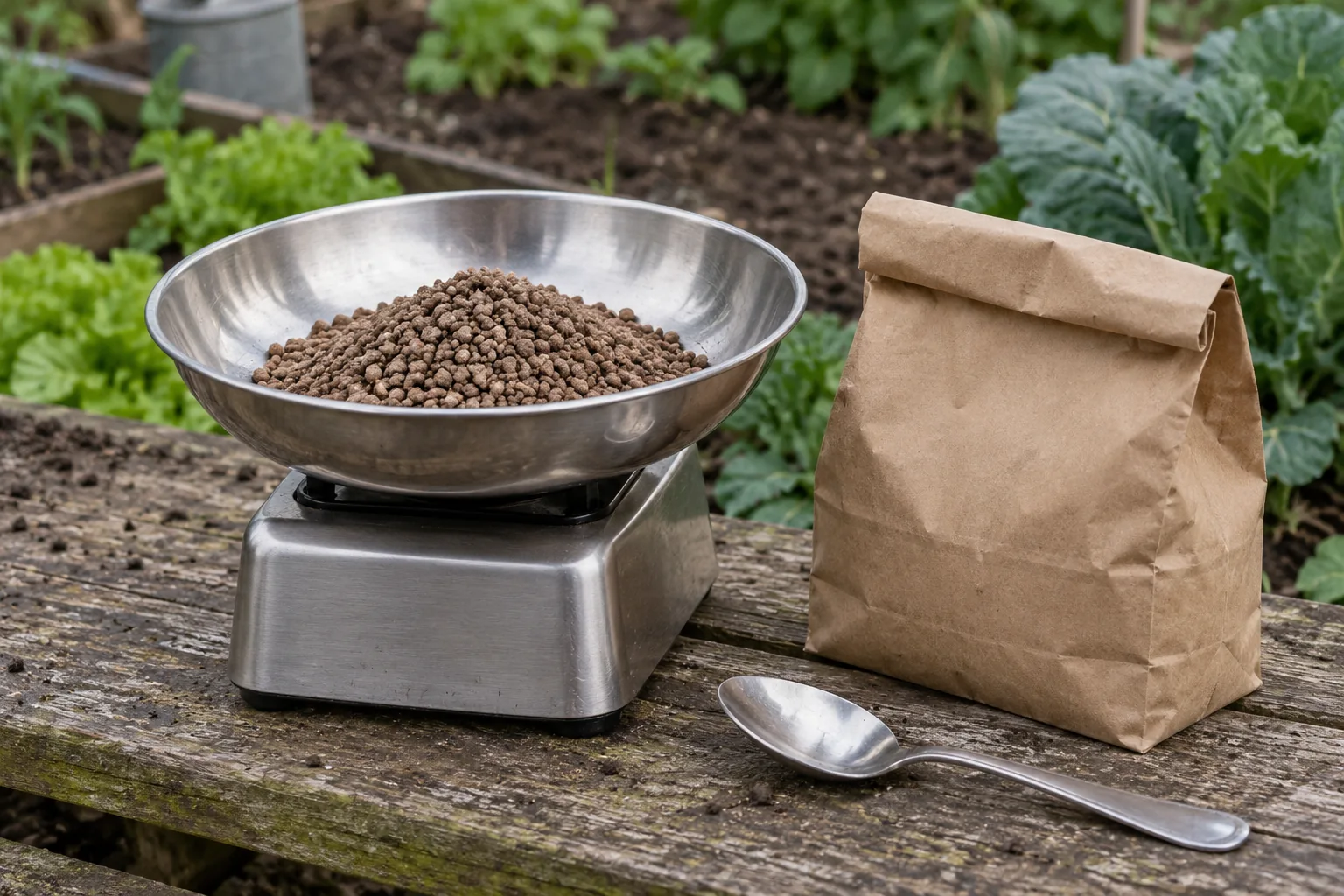
A spoonful is a volume, so it does not establish the calculated weight. Keep the weighing unit on the worksheet. For choosing among materials and release timings after resolving the report, use the organic fertilizer guide.
Finish with a no-addition or ask-the-lab decision
Do not treat every reported nutrient as a shopping-list item. Maryland Extension explains that adding a nutrient already at an adequate or very high level does not improve growth. Still, read the crop-specific recommendation: if its rate seems to conflict with the rating, ask the lab to explain it rather than replacing it with your own rule.
Use the last worksheet field to write a specific unresolved question:
- “Does this rate mean pounds of nutrient or pounds of the named product?”
- “Is this phosphate expressed as P₂O₅, or elemental phosphorus?”
- “The crop code is for a lawn; can you interpret this sample for my vegetables?”
- “Is this amount a seasonal total, and how should the applications be divided?”
- “Which test method and interpretation apply to this result?”
Keep the lab’s answer with the report and revise the calculation only after the units and instructions agree. This worksheet addresses fertility interpretation for garden soil. Container media, commercial crop plans and contamination concerns need their own appropriate testing and advice. Iowa State notes that heavy metals are not typically included in a standard fertility test; a fertility report alone does not settle that question.
Method and sources
Prepared on 16 October 2026 from the University of Maryland Extension’s soil-report guide and fertilizer basics, Iowa State University Extension and Outreach’s soil-test interpretation guide, and Arkansas Extension’s FSA2118 report guide, accessed that day. The linked references explain the underlying fields and calculations; the worksheet organization is our editorial aid. All worked-example inputs are assumed, and no laboratory report, product trial or garden outcome is presented as measured evidence.
Keep the original report, your completed worksheet and any lab clarification together for the next review. More related guides are in the home-growing section.