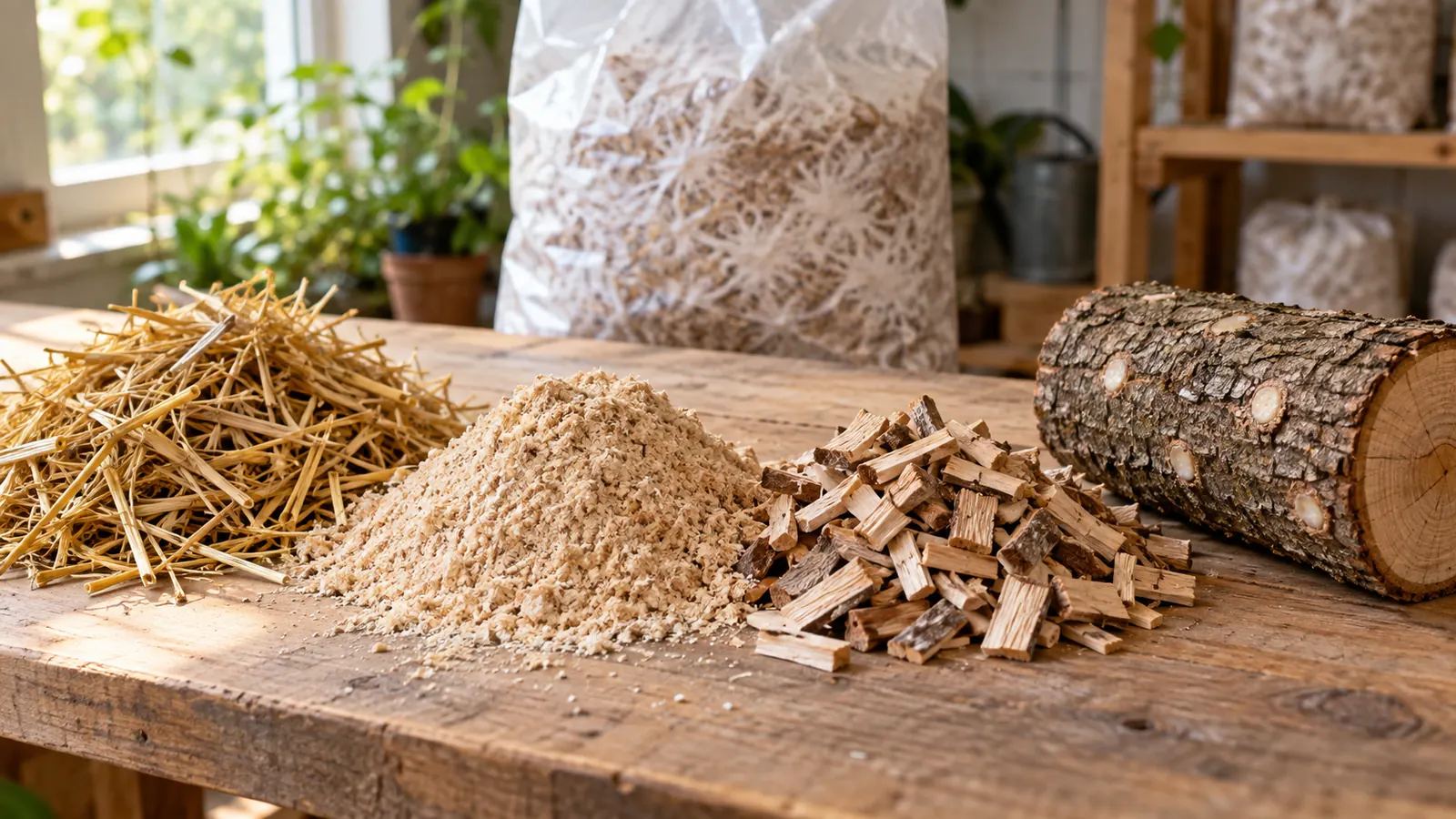
The wrong substrate can leave spawn sitting for weeks without colonizing, or let mold take over before the mushrooms do. Choose the substrate by species first: oyster mushrooms grow on straw, cottonseed hulls or other crop wastes; shiitake on hardwood logs (the only route these sources describe); lion’s mane on hardwood logs or supplemented indoor media; wine cap in wood-chip beds; and button mushrooms on composted substrate with a peat casing.
Mushroom substrate is the material that feeds the mycelium and holds it while it grows. Cornell Small Farms puts colonization at as little as 3 to 4 weeks on straw or sawdust, 2 to 6 months on wood chips and 6 to 18 months on logs. Indoor substrates usually need to be cleaned first: straw is pasteurized (NAMA gives 160–170°F for one hour at home), while supplemented sawdust is sterilized or pasteurized in its bag, according to University of Kentucky Extension. This guide compares the common substrates for five cultivated species grown from purchased spawn; it does not cover wild mushrooms.
This page is compiled from extension and mycological association publications by Known Source Farms, an independent information site; we have not run growing trials. It opens our mushrooms section.
| Input or item | Typical value or source | Why it matters |
|---|---|---|
| Species | Oyster, shiitake, lion’s mane, wine cap, button | Some species accept many materials, others need hardwood |
| Indoors or outdoors | Bags and bottles indoors; logs and chip beds outdoors | Indoor substrates usually need heat treatment |
| Treatment you can manage | Hot-water pasteurization of straw at 160–170°F for 1 hour (NAMA); supplemented mixes treated in the bag (Kentucky) | Decides which indoor substrates you can use |
| Colonization time | As little as 3–4 weeks for straw or sawdust; 2–6 months chips; 6–18 months logs (Cornell) | Sets how long before the substrate is ready to fruit; fruiting conditions then decide the harvest |
| Productive life | 4–8 weeks straw or sawdust; 3+ years logs (Cornell) | Decides how often you rebuild the substrate |
| Moisture | 67–69% for Penn State’s commercial oyster mix | Too dry slows colonization; too wet invites contamination |
What is mushroom substrate?
Mushroom substrate is any material that serves as both food and growing medium for mushroom mycelium. Cornell Small Farms lists logs, stumps, wood chips, straw, sawdust, coffee grounds, grain hulls and other carbon-rich materials. Some species are particular about which ones they use; others are flexible.
Substrate is not the same as spawn. Spawn is cultivated mycelium of a known species, grown in a clean lab, usually on sterilized grain (Penn State), and bought from a supplier much as a vegetable grower buys seed. You mix spawn into the substrate or insert it into a log, and the mycelium then grows through the substrate until it is ready to fruit.
Button mushrooms add a third layer. Penn State Extension describes a composted substrate made from wheat straw and hay, prepared in two composting phases and pasteurized, with a casing of peat moss and ground limestone spread on top to support the crop. That “mushroom compost” is a purpose-made growing medium, not the same thing as garden compost; for the garden kind and the liquids made from it, see how compost, compost tea and leachate differ.
Takeaway: Buy spawn for the species you want, then choose the substrate it will feed on.
Which substrate suits which mushroom?
Oyster mushrooms are the most flexible; shiitake wants hardwood logs in these sources; lion’s mane takes logs or supplemented indoor media; wine cap wants wood chips outdoors; button mushrooms want compost. The table summarizes what the extension sources describe for each species grown from purchased spawn.
| Species | Substrates described | Indoor or outdoor | Notes from the sources |
|---|---|---|---|
| Oyster | Straw (the commonest, per NAMA), cottonseed hulls, or a mix (Penn State); other crop wastes such as corn stalks (NAMA) | Both | Penn State’s commercial mix (about 2003 guide): 75% cottonseed hulls, 24% wheat straw, 1% ground limestone, at 67–69% moisture |
| Shiitake | Hardwood logs | Outdoor in these sources | Logs 3–8 in across, 3–4 ft long, from live, decay-free trees with intact bark; oaks seem preferred (Kentucky). Indoor blocks are not covered by these sources |
| Lion’s mane | Hardwood logs, like shiitake; indoor bags of sawdust, chips or straw with supplements such as bran | Both | Fruits in 5–6 weeks under controlled conditions versus about 18 months on logs (Kentucky) |
| Wine cap (King Stropharia) | Wood chips or sawdust in an outdoor bed | Outdoor | Indoor production is not considered economically viable (Kentucky) |
| Button (Agaricus) | Composted wheat straw and hay, with a peat and limestone casing | Indoor | Two composting phases plus a casing layer (Penn State) |
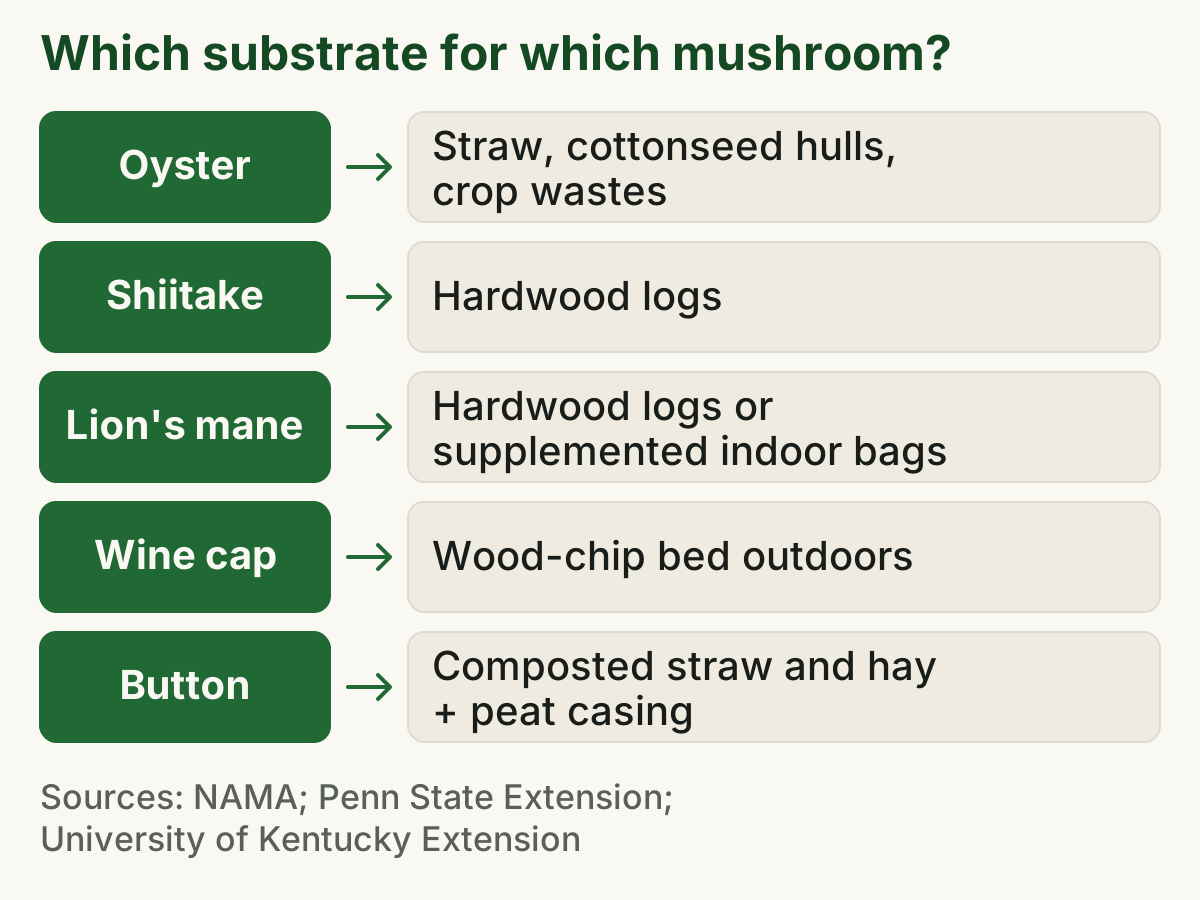
Figure 1. Substrates described for each species in the extension sources. Kentucky’s guide covers lion’s mane and wine cap; Penn State covers oyster and button.
Common mistake: Putting shiitake spawn on straw because straw works for oyster. The sources we used describe shiitake only on hardwood logs.
Takeaway: If you are flexible on species, oyster on straw is the widest choice; if you want shiitake, plan for hardwood logs, and check your spawn supplier’s guidance for any indoor route.
The 3-question substrate choice
Three questions narrow the choice: which species you are growing, whether you are growing indoors or outdoors, and what treatment you can carry out. Each answer removes options, and the last question usually decides between straw and supplemented sawdust.
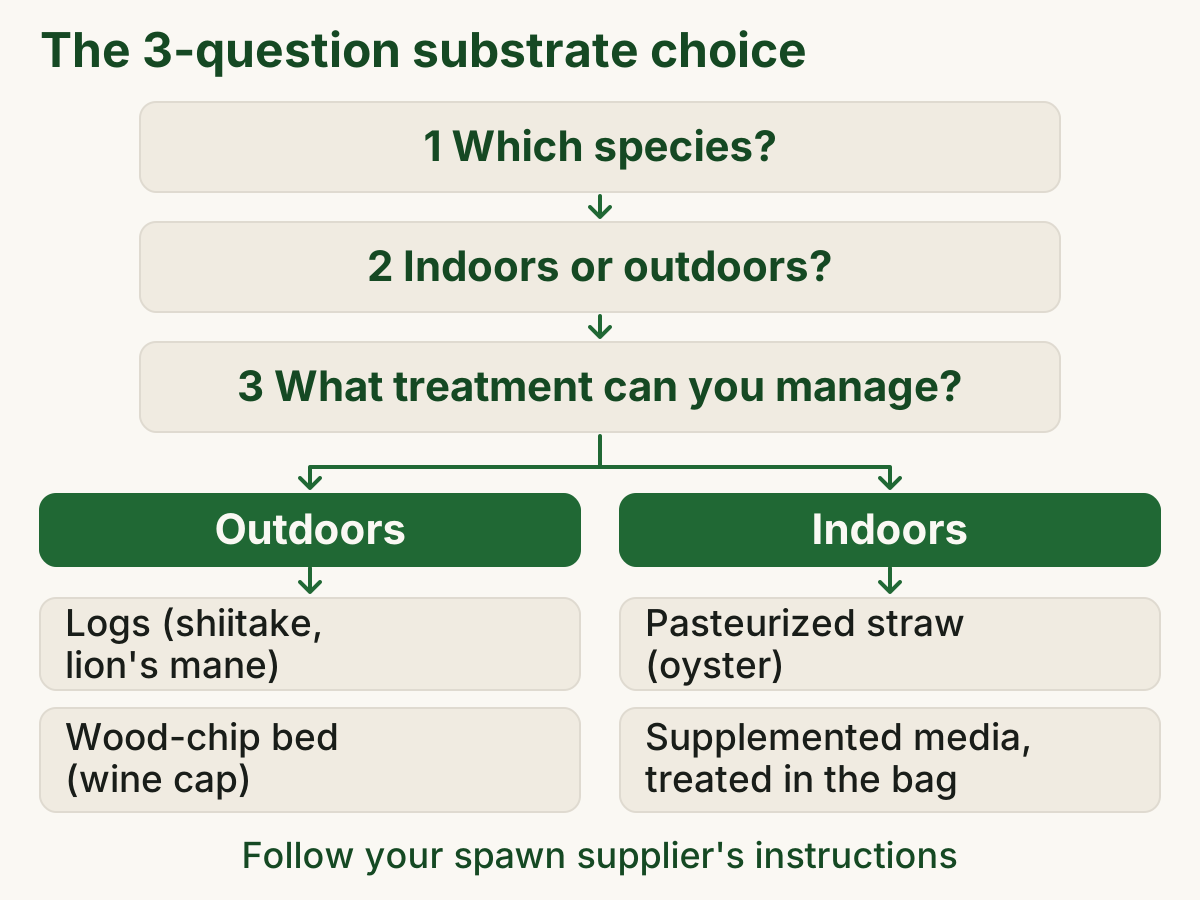
Figure 2. The three questions in order. Species sets the material; site and equipment set the method.
Takeaway: Answer the three questions in order before buying spawn or substrate.
Question 1 — Which species are you growing?
The species fixes the material, as the table above shows, so this question is really about pairing a species with a material you can get reliably. If you have not chosen a species yet, let the substrate you can get easily decide it.
Cornell Small Farms advises looking at what materials are available and affordable locally before settling on a system. NAMA notes that besides straw, other agricultural wastes such as corn stalks can be used for oyster mushrooms. The University of Kentucky guide points out that spent shiitake or oyster logs can be ground up and reused as wine cap substrate, provided the chips are sterilized first when they come from previously colonized logs.
Takeaway: Match the species to a material you can get reliably, not just once.
Question 2 — Indoors or outdoors?
Outdoor substrates (logs, stumps and wood-chip beds) need little cleaning, because contamination is a minor issue outside, according to Cornell. Indoor substrates in bags, buckets or bottles almost always need cleaning with heat or another method and inoculation in a clean space, otherwise molds can take over.
Outdoors, Kentucky’s guide describes two systems:
- Logs for shiitake, lion’s mane and similar species: freshly cut hardwood logs inoculated with dowel or sawdust spawn, sealed with hot cheese wax and stacked in a moist, shady spot. Lion’s mane logs are often buried upright to a third of their length. Well-maintained logs can produce for at least three to five years.
- Wood-chip beds for wine cap: a cleared area of about 4 by 8 feet, a 2-inch layer of chips, spawn broadcast on top, then another 2 to 3 inches of chips. Keep it heavily watered for the first four days and watered regularly for the next three to four months; then stir the bed again, and in Kentucky’s description mushrooms should follow within a couple of weeks. The same guide warns that wine cap fruiting is highly variable, typically between two months and a year. Adding chips each year keeps the bed producing for three to four seasons.
Indoors, Kentucky describes growing media of sawdust, wood chips or straw with supplements such as bran, mixed with water, treated in the bag or bottle, cooled and inoculated. Cornell adds that indoor incubation usually needs a steady 65–70°F and checks for mold.
Takeaway: Outdoors trades speed for simplicity; indoors trades simplicity for faster, more controllable crops.
Question 3 — What treatment can you manage?
Plain straw can be pasteurized on a stove; supplemented mixes are sterilized or pasteurized in the bag, as the spawn supplier specifies; fresh logs and new wood chips outdoors need no heat treatment. The treatment you can actually carry out often decides between straw and sawdust for indoor growing.
| Treatment | Used for | How the sources describe it |
|---|---|---|
| Hot-water pasteurization | Straw for oyster | Straw cut to 3–4 inches, submerged in a bag in water at 160–170°F for 1 hour, then drained until a squeezed handful gives only a few drops (NAMA) |
| Steam pasteurization | Commercial oyster mixes; button compost | Aerated steam at 65°C (149°F) for 1 hour for Penn State’s oyster mix; pasteurization in Phase II of button composting |
| Sterilization or pasteurization | Grain spawn; supplemented sawdust, chips or straw in bags | Spawn grain is sterilized (Penn State); supplemented mixes are sterilized or pasteurized in their containers (Kentucky), as the recipe specifies |
| Lime bath, peroxide or cold fermentation | Straw, as alternatives to heat | Listed by NAMA as alternative treatments for straw |
| None | Fresh logs, stumps, new wood-chip beds | Inoculated directly; outdoor contamination is a minor issue (Cornell). Exception: chips ground from previously colonized logs are sterilized first (Kentucky) |
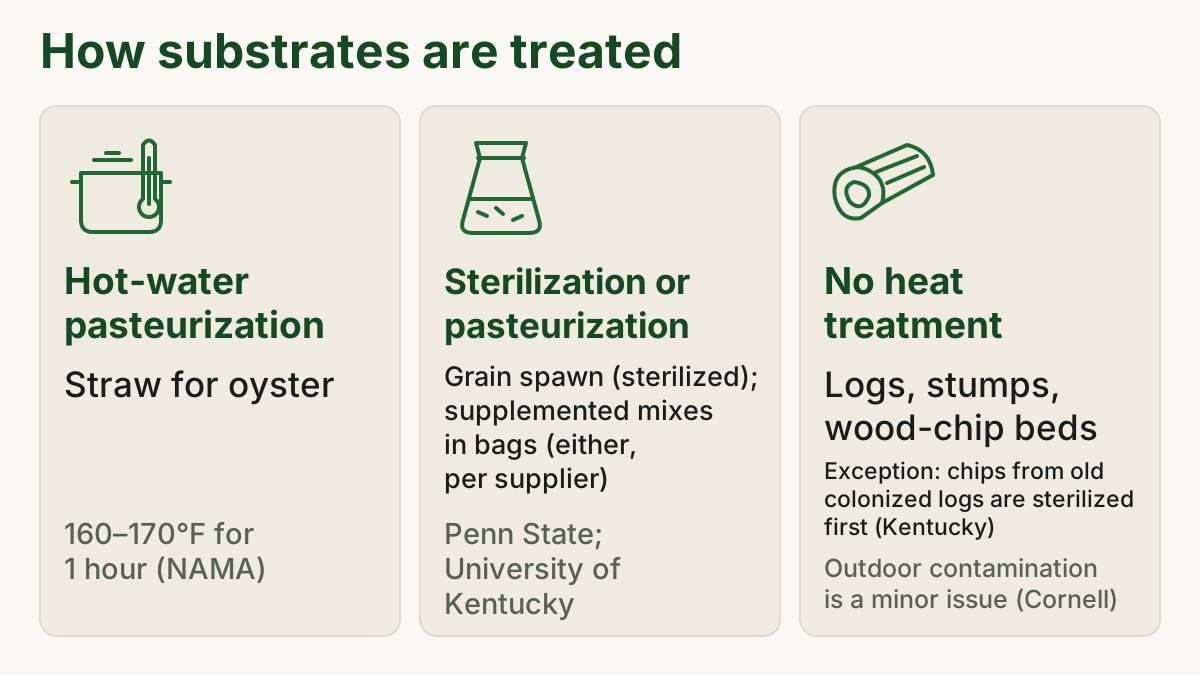
Figure 3. Treatment options by substrate, compiled from NAMA, Penn State and University of Kentucky guidance.
The two heat treatments differ in strength. Penn State describes pasteurization of mushroom compost as removing harmful microbes while keeping beneficial ones; sterilization, used for spawn grain, is the stronger treatment. Kentucky lists both for supplemented mixes without saying which suits which recipe, so take the method, and the equipment it needs, from your spawn supplier’s instructions before choosing a supplemented route. Garden compost has its own heat rule for certified organic farms, covered in our note on compost and compost tea safety practices.
Our reading: for a first indoor grow, pasteurized straw for oyster mushrooms is the combination the sources describe as both common and manageable on a stove top. If your spawn supplier gives a different preparation for its mix, follow the supplier.
Common mistake: Treating spawn as the substrate. Spawn is the ready-colonized starter you buy; the substrate is the bulk material it grows through, and it is the part you prepare and treat.
Takeaway: Choose the substrate whose treatment you can carry out every time, not just the first time.
How long does colonization take?
Finer substrates colonize faster but run out sooner. Cornell Small Farms gives as little as 3 to 4 weeks for straw and sawdust, 2 to 6 months for wood chips and 6 to 18 months for logs and stumps, with oyster much faster than shiitake.
| Substrate | Colonization (Cornell) | Productive life |
|---|---|---|
| Straw or sawdust | As little as 3–4 weeks | 4–8 weeks (Cornell) |
| Wood chips | 2–6 months | Three to four seasons with added chips (Kentucky, wine cap) |
| Logs and stumps | 6–18 months | 3+ years (Cornell); at least 3–5 years if well maintained (Kentucky) |
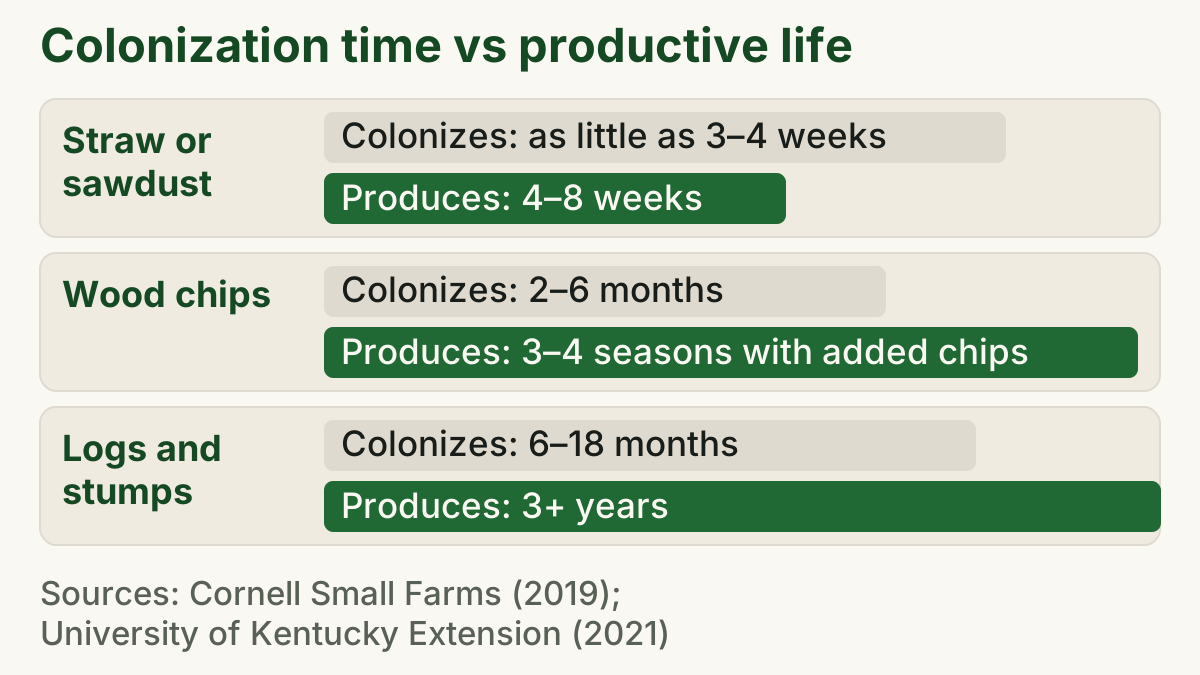
Figure 4. Colonization time against productive life, from Cornell Small Farms and University of Kentucky Extension.
Shiitake logs have one advantage for planning: Cornell notes they can be forced to fruit by soaking them in water for 12 to 24 hours, while other outdoor species fruit on their own schedule.
Takeaway: Straw or sawdust colonize fastest but are spent within weeks; logs take months to colonize but can keep producing for years.
What happens to substrate after harvest?
Spent substrate stops being worth fruiting long before it stops being useful. Penn State describes spent mushroom substrate as a soil-like material high in organic matter that improves soil structure and supplies a few nutrients, making it useful as a soil amendment or on newly seeded lawns.
Penn State adds one caution: fresh spent substrate can be high in salt, so avoid it around salt-sensitive plants and vegetables, and use material weathered for six months or more in gardens. Its figures describe commercial button mushroom substrate; home-grown straw or sawdust will differ. Because it adds organic matter rather than a measured dose of nutrients, treat it like compost when you pick the nutrient your soil is actually short of.
Extracts of spent mushroom compost have also been tested against apple scab, with success in the lab and mixed results in the field, according to a Washington State University review; our explainer covers what the evidence says about compost teas and extracts.
What you harvest needs handling too. The University of Kentucky guide advises refrigerating freshly picked mushrooms straight away in vented cardboard containers, and notes that some are sold fresh under clear, breathable wrap or in plastic clamshells; IFPA’s packaging white paper adds that macroperforated film has historically been the choice for mushroom packs. Our comparison of produce pack formats explains how perforated, sealed and clamshell packs differ.
Takeaway: For spent commercial mushroom compost, follow Penn State’s advice to weather it first; check what any other spent material is made of before using it.
When this does not apply
This guide covers cultivated culinary species grown from purchased spawn. It does not apply to:
- Wild mushrooms: identifying or eating wild fungi is outside this guide and carries a real poisoning risk.
- Making your own spawn, which needs sterile lab technique.
- Commercial button mushroom composting, where the Penn State process is far more involved than described here.
- Food safety and selling rules, which depend on your state and local authority.
- Packing fresh mushrooms for sale, beyond the note above; how perforated, sealed and clamshell retail packs differ is covered in our comparison of produce pack formats.
Takeaway: For anything beyond purchased spawn and the five species here, ask your extension service.
Method and sources
Compiled on 7 October 2026 from Cornell Small Farms (2019), University of Kentucky Extension’s gourmet and medicinal mushroom profile (March 2021), Penn State Extension’s substrate and production pages and its spent-substrate article (updated 23 December 2025), an older Penn State oyster mushroom guide (about 2003) and the North American Mycological Association’s preparation notes. We have not run growing trials and do not sell spawn or substrate; Known Source Farms is an independent information site. More mushroom guides will appear in our mushrooms section.
Related reading:
- How to choose an organic fertilizer by crop — Decide when compost-like material such as spent substrate is enough and when a fertilizer is needed.
- What is compost tea? — Separate garden compost, compost tea and leachate, and see what the evidence says.
- Cucumber packaging options compared — See how perforated, sealed and clamshell produce packs differ before packing a harvest for sale.
Takeaway: Use these figures to plan; your spawn supplier’s instructions decide the details.