Mixing a mushroom substrate recipe with the wrong water ratio or overheating the pasteurization bath causes anaerobic bag-bottom pooling, killed beneficial microbes, and rapid green mold failure before mycelium can colonize. To make mushroom substrate that colonizes cleanly indoors, hydrate dry ingredients to 60% to 69% moisture (verified when a hard fist squeeze releases no more than one to a few drops of water), match the heat treatment to the recipe’s nitrogen content, and calculate your 5% to 10% spawn dose from the drained wet weight rather than the initial dry weight.
Most first-batch failures happen when growers treat all indoor recipes alike—either under-dosing spawn because they weighed dry straw before soaking, or adding loose wheat bran to an open hot-water bath that only reaches pasteurization temperatures. Low-nitrogen lignocellulosic materials such as chopped wheat straw can be pasteurized in a 160–170°F (71–77°C, target 165°F / 73.9°C) water bath for 40 to 120 minutes (UF/IFAS Extension SS662; Field & Forest Products) or with aerated steam at 60–65°C (140–149°F) for 1 to 2 hours (Penn State Plant Pathology), whereas hardwood sawdust supplemented with 10% to 40% dry-weight bran or grain requires full sterilization at 121°C (250°F) for 1 to 2 hours in sealed polypropylene filter bags or bottles.
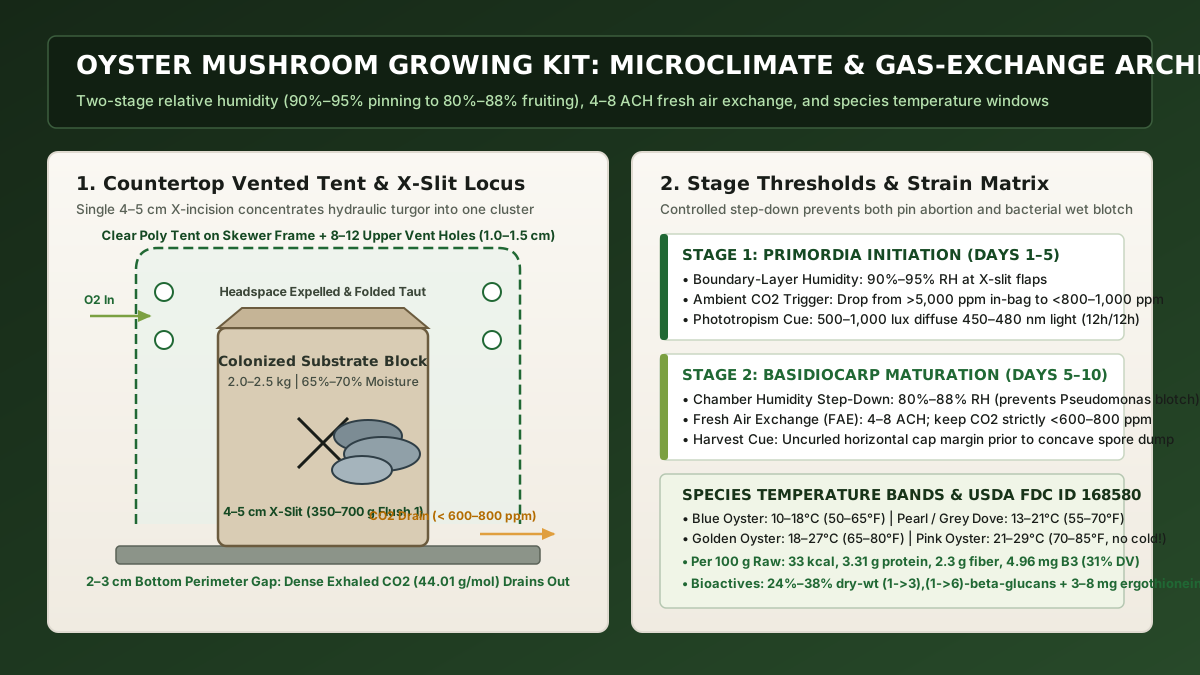
This calculation and preparation guide is compiled by Known Source Farms, an independent agricultural information site in our mushrooms section and across our cultivation guides on the blog. If you are still choosing between outdoor logs, wood-chip beds, straw, and compost by mushroom species, start with our mushroom substrate selection guide. Once your pasteurized bags are fully colonized with white mycelium, follow our oyster mushroom growing kit humidity and fresh air guide to fold the bag headspace and cut a fruiting slit, and use our oyster mushroom second-flush care guide after the first harvest.
| Substrate Recipe & Target Species | Dry Ingredient Formula | Target Moisture & Wet-Weight Math | Required Heat / Chemical Treatment | Spawn Rate (by Drained Wet Weight) | Dominant Failure Mode & Prevention |
|---|---|---|---|---|---|
| Recipe A: Chopped Wheat or Oat Straw (Temperate, Blue, Golden, or Pink Oyster) | 100% wheat or oat straw chopped to 3–5 in (7.5–12.5 cm) (UF/IFAS; Field & Forest) or milled to 2–6 cm (Penn State) | ~65% moisture after draining 1 to several hours (1 kg dry straw → ~2.86 kg drained wet weight; hand squeeze yields ≤ 1 to a few drops) |
Hot-water bath at 160–170°F (target 165°F) for 40–50 min (Field & Forest) to 1–2 hr (UF/IFAS SS662); OR cold hydrated-lime soak (12 g / 1/8 cup per gal water at pH ~12 for 18–20 hr) |
5%–10% wet weight (20 lb / 9.07 kg wet straw takes 1 lb spawn at 5% or 2 lb at 10% beginner rate) |
Under-spawning from dry weight or bag-bottom pooling: always weigh straw after draining and cool below 75°F (23.9°C) before spawning |
| Recipe B: Boiling-Water DIY Pellet Block (Oyster single-bag low-tech block, Field & Forest method) | 2.5 cups hardwood fuel pellets + 1.5 cups cottonseed hull pellets + 1 cup soy hull pellets (5 cups dry pellets total in one 0.2 micron filter bag) |
Add 5.5 cups boiling water directly into the bag; pellets expand and absorb free water with zero draining required | In-bag steam semi-pasteurization from boiling water; fold bag shut immediately and optionally hold in an insulated cooler/tub for 2 hours | 1.5 cups grain spawn per block after cooling 8–12 hours in a clean, low-traffic area | Premature opening or warm inoculation: keep folded bag sealed during the 8–12 hr cool-down so airborne mold spores cannot land on uncolonized soy/cottonseed hulls |
| Recipe C1: Cottonseed Hull & Straw Mix (Commercial / small-farm Pleurotus, Penn State MRC formula) | 75% cottonseed hulls + 24% chopped wheat straw + 1% ground limestone (CaCO3 adjusts pH to ≥ 7.5) |
67%–69% moisture (1 kg dry mix at 68% moisture → 3.13 kg wet weight using 2.13 kg / L water) |
Aerated steam pasteurization at 60–65°C (140–149°F) for 1–2 hours in perforated boxes/tunnels, followed by 1.5 hr HEPA-filtered air cooling (Penn State) | 5% wet weight (raising spawn rate from 1.25% to 5% wet wt increased yield by nearly 50% and cut cycle time by > 7 days in Penn State trials) |
Delayed-release supplement overheating: adding 3%–10% dry-weight supplement at spawning raises metabolic heat; keep core bag temperature < 90°F (32.2°C) |
| Recipe C2: Supplemented Hardwood Sawdust Block (Shiitake, Lion’s Mane, Maitake, Enoki, King Oyster, Wood Ear) | 78%–80% hardwood sawdust + 20% wheat or rice bran (4:1 ratio) + 1% CaCO3 + 1% sucrose; OR 70% oak sawdust + 10% bran + 10% millet + 10% rye (Penn State) |
~60% moisture (1.0 kg dry mix + 1.5 L water = 2.5 kg wet weight per microfiltered polypropylene bag) |
Autoclave / pressure sterilization at 121°C (250°F) for 60–120 minutes, then cool 16–20 hours prior to aseptic inoculation | Aseptic grain or sawdust spawn mixed and shaken inside heat-sealed microfiltered polypropylene bags or bottles | Attempting to pasteurize loose bran: unsterilized starch/bran at 160°F triggers rapid green mold (Trichoderma); never add loose bran to open hot-water baths |
1. Match Your Mushroom Substrate Recipe to Your Heat Treatment (Pasteurization vs. Sterilization)
Before weighing ingredients on a scale, match the nitrogen and starch profile of your mushroom substrate recipe to the thermal equipment you actually have. In indoor mushroom cultivation, heat treatment is not one-size-fits-all: Penn State Extension and University of Kentucky Cooperative Extension (CCD-CP-079) distinguish between pasteurization (selective heating at 60–77°C / 140–170°F) and sterilization (complete microbial eradication under pressurized steam at 121°C / 250°F).
Why Loose Bran Forces a Switch From Pasteurization to Sterilization
Plain wheat straw and un-supplemented hardwood consist primarily of complex structural polymers—cellulose, hemicellulose, and lignin—with very low free nitrogen and almost no simple sugars. Aggressive saprophytic fungi such as Pleurotus ostreatus (oyster mushrooms) secrete extracellular ligninolytic and cellulolytic enzymes that break down those tough plant cell walls, whereas common airborne mold spores struggle to germinate rapidly on low-nitrogen straw once competitors are knocked back by a 160–170°F water bath (UF/IFAS Extension SS662).
As soon as you add 10% to 40% dry weight of starch- and nitrogen-rich supplements—such as wheat bran, rice bran, millet, rye, or corn meal (Penn State Department of Plant Pathology)—you flood the substrate with readily available carbohydrates and soluble proteins. Fast-growing contaminant molds such as Trichoderma (green mold), Penicillium, and Aspergillus germinate and multiply on free starch far faster than mushroom mycelium. Consequently, supplemented sawdust recipes must be packed into heat-resistant polypropylene filter bags or bottles and sterilized at 121°C (250°F) for 60 to 120 minutes, then cooled and inoculated under clean conditions.
Engineering Rules-of-Thumb for Recipe Selection
- Rule 1 (Open Hot-Water Bath or Cold Lime Soak → Zero Loose Bran): If your heat source is a stovetop stockpot, 55-gallon drum bath at 160–170°F, or a cold hydrated-lime soak (pH ~12), use 100% chopped wheat or oat straw (or un-supplemented cottonseed hulls). Never mix loose wheat bran or cereal flour into an open hot-water straw bath.
- Rule 2 (No Autoclave, Higher Nutrition Desired → Sealed Boiling-Water Pellet Mix): If you want a denser block than plain straw without owning a 121°C pressure sterilizer, use Field & Forest Products’ low-tech pellet method: combine compressed hardwood fuel pellets, cottonseed hull pellets, and soy hull pellets inside a 0.2-micron filter-patch bag and hydrate with boiling water. Because wood and hull pellets are already heat-extruded during manufacturing and the boiling water steams inside a closed filter bag, the block can be cooled for 8–12 hours and spawned with vigorous oyster grain spawn.
- Rule 3 (10%–40% Loose Bran/Grain Supplement → Mandatory 121°C Sterilization): If your recipe includes loose wheat bran, rice bran, millet, or rye—required for indoor synthetic logs of shiitake (Lentinula edodes), maitake (Grifola frondosa), enokitake (Flammulina velutipes), wood ear (Auricularia spp.), King Oyster (Pleurotus eryngii), or Black Pearl Oyster—sterilize the bagged substrate at 121°C (250°F) for 1 to 2 hours (Penn State; Field & Forest Products).
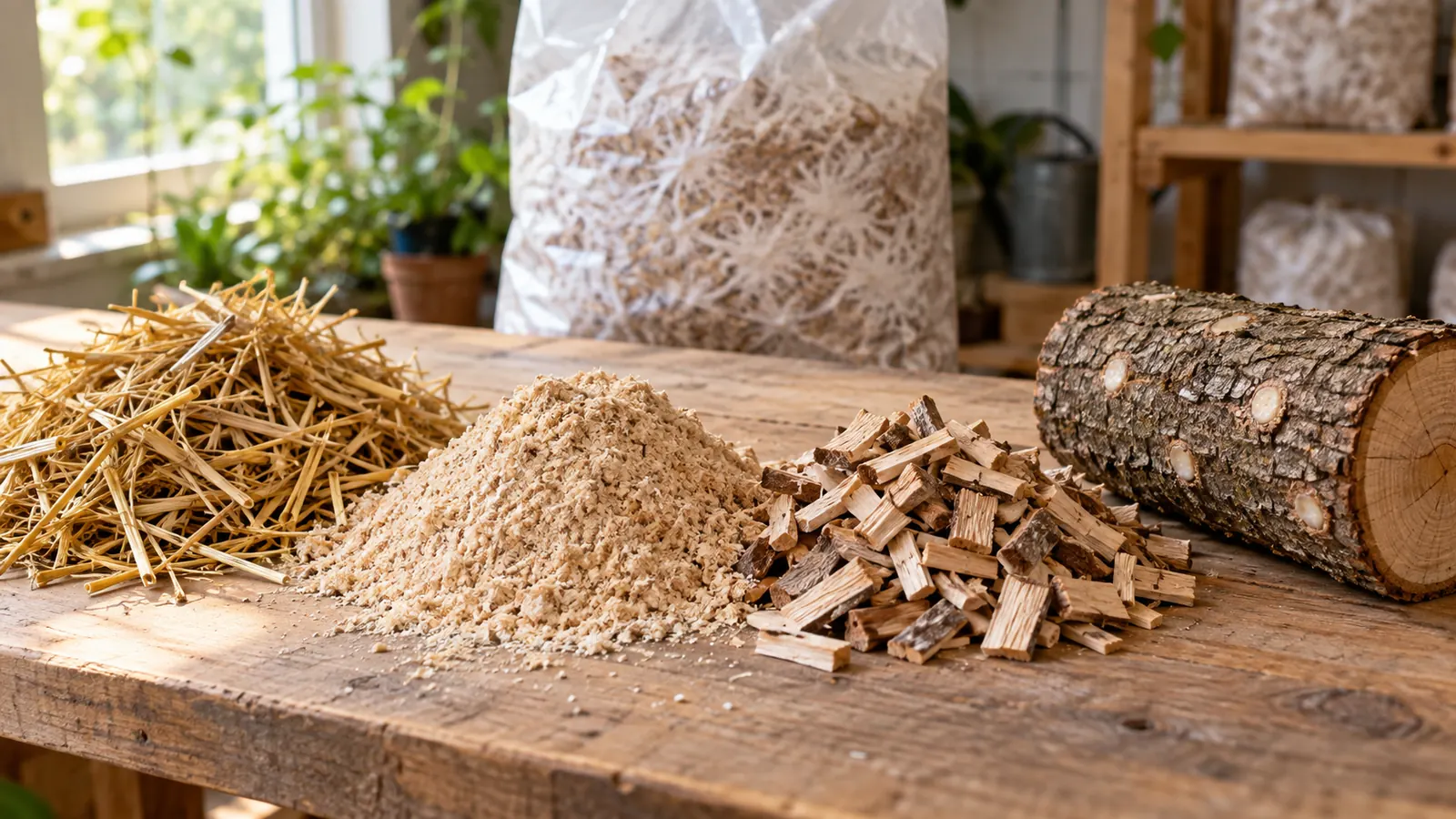
- Rule 4 (Respect Strain-to-Substrate Restrictions): Even within the oyster mushroom genus (Pleurotus), not every strain grows on pasteurized straw. Field & Forest Products notes that King Oyster and Black Pearl Oyster are only suitable for production on sterilized sawdust substrate, while log-specific strains such as Blue Dolphin and Polar White are bred for hardwood logs rather than bagged substrates. For a full breakdown of species and outdoor vs. indoor options, see our mushroom substrate selection guide.
Takeaway: Pasteurize plain chopped straw or buffered cottonseed hulls at 140–170°F, use sealed boiling-water hydration only for pre-pelletized oyster mixes in 0.2-micron bags, and reserve loose bran or grain supplements for bags sterilized at 121°C (250°F).
2. Three Proven Mushroom Substrate Recipes and Dry-to-Wet Weight Math (60%–69% Moisture)
When scaling any mushroom substrate recipe, professional growers and university extension researchers express moisture as gravimetric wet-basis moisture content—the mass of water divided by the total wet mass of the hydrated substrate, not simply water as a percentage of dry weight.
Explicit Wet-Weight and Water-Balance Equations
To convert a dry ingredient weight (W_dry) into a target hydrated wet weight (W_wet) at a desired moisture fraction (M_target, such as 0.60 for 60% moisture or 0.68 for 68% moisture):
Moisture_% = [(W_wet - W_dry) ÷ W_wet] × 100
W_wet = W_dry ÷ (1 - M_target)
Water_Added = W_wet - W_dry
Where:
W_dry= Initial dry mass of substrate ingredients (inkgorlb; if air-dry sawdust or pellets carry an initial ambient moisture fractionM_init, such as0.08for 8% moisture, true oven-dry solids equalW_air_dry × (1 - M_init))M_target= Target wet-basis moisture fraction (0.60to0.69across Penn State and extension recipes)W_wet= Final hydrated substrate wet weight (kgorlb)Water_Added= Mass of water absorbed (1 kgof water =1.0 L=2.205 lb=0.264 US gal)
Recipe A: Home Chopped Wheat or Oat Straw (~65% Target Moisture)
Cereal straw (wheat or oat) is the standard North American home substrate for Pearl, Blue, Golden, and Pink oyster mushrooms (UF/IFAS Extension SS662; Field & Forest Products).
- Chopping length: Cut dry straw into 3 to 5 inch (7.5 to 12.5 cm) pieces using a chopper, lawn mower, or string trimmer inside a clean garbage can (UF/IFAS specifies 4–5 in; Field & Forest specifies 3–5 in; commercial mills chop to 2–6 cm per Penn State). Unchopped long straw leaves hollow air pockets that dry out mycelium and reduce bag density.
- Worked Wet-Weight Calculation (20 lb / 9.07 kg Drained Wet Bag):
Suppose you want to fill one large polyethylene sleeve to a drained wet weight of
W_wet = 20.0 lb (9.07 kg)at Field & Forest Products’ target of65% moisture(M_target = 0.65):- Required dry straw solids:
W_dry = 20.0 lb × (1 - 0.65) = 7.0 lb (3.18 kg)of dry straw (equivalent to roughly7.6 to 7.8 lbof air-dry bale straw at 8%–10% ambient moisture). - Absorbed water retained after draining:
Water_Retained = 20.0 lb - 7.0 lb = 13.0 lb (5.90 L)of bound water. - Because chopped straw absorbs nearly 2.5 to 3 times its air-dry weight after soaking and draining, a
7 lbbundle of dry straw becomes a~20 lbwet bag once drained to field capacity.
- Required dry straw solids:
Recipe B: Boiling-Water DIY Pellet Grow Block (Single Filter-Patch Bag, Field & Forest Method)
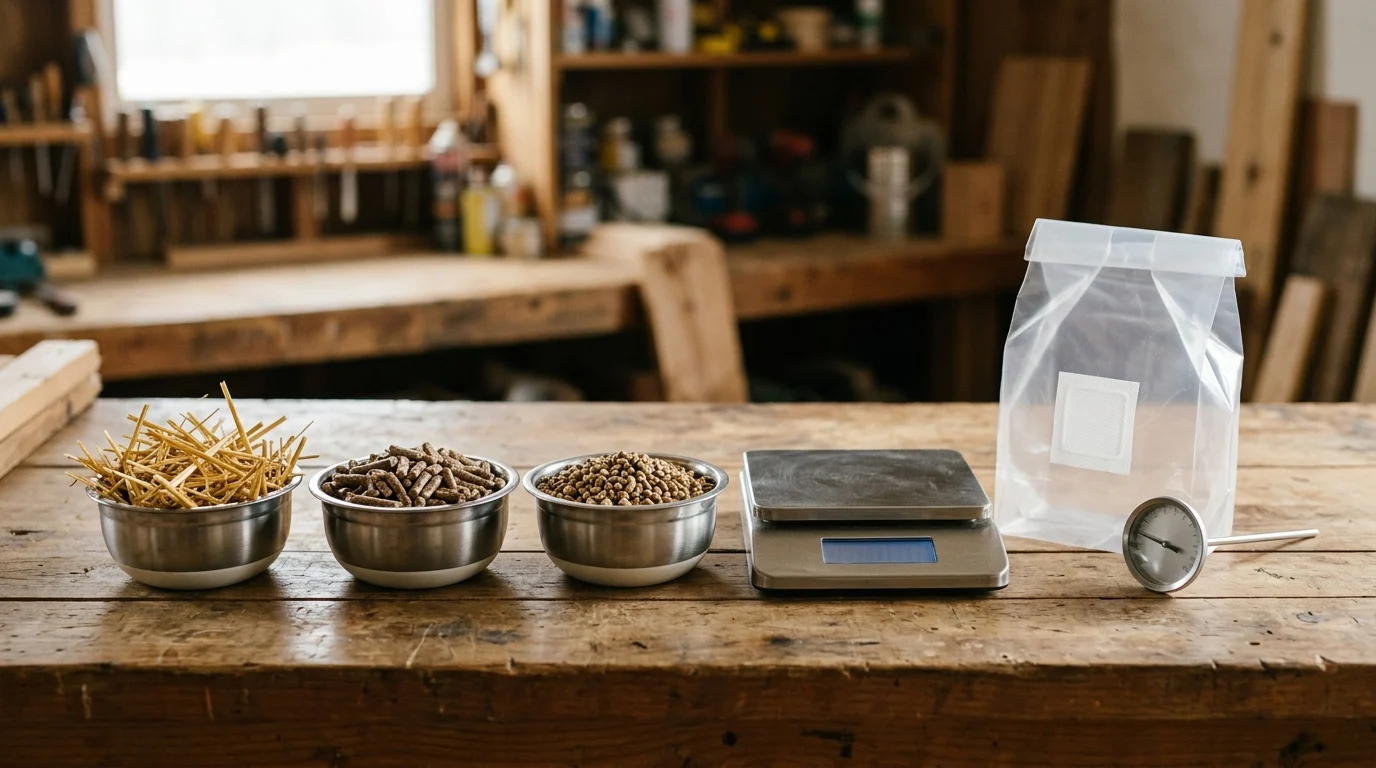
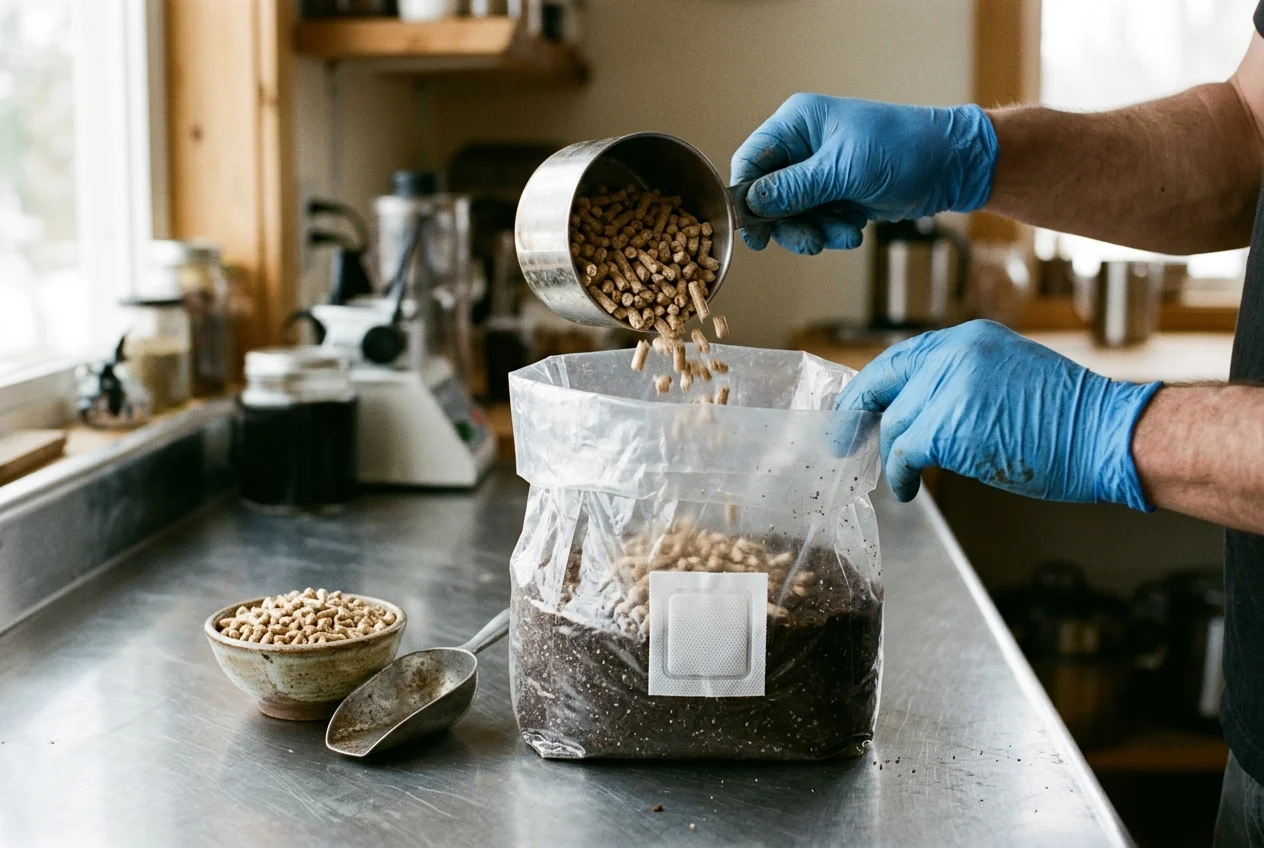
For home growers who want tidy, compact oyster mushroom grow blocks without wrestling wet straw baths or buying an autoclave, Field & Forest Products publishes a single-block volumetric recipe inside a standard 0.2-micron filter-patch bag:
- Dry pellet blend (per 1 block):
- 2.5 cups hardwood fuel pellets (50% by volume)
- 1.5 cups cottonseed hull pellets (30% by volume)
- 1.0 cup soy hull pellets (20% by volume)
- Total dry volume: 5.0 cups dry pellets placed directly into one
0.2 micronfilter-patch bag.
- Hydration & steam treatment: Boil 5.5 cups of water and pour it directly onto the 5 cups of pellets inside the bag. Immediately seal or fold the bag top tightly shut. As the compressed pellets absorb the boiling water and expand, the trapped steam semi-pasteurizes the interior. For a longer thermal hold, pack the folded bags tightly into an insulated beverage cooler or closed storage tub for 2 hours.
- Cool & inoculate: Let the sealed bag cool in a clean, low-traffic room for 8 to 12 hours until completely cool to the touch, then open briefly on a sanitized counter, pour in 1.5 cups of oyster grain spawn, fold and secure with a tight rubber band (keeping the
0.2 micronfilter patch unobstructed), and shake to distribute the spawn. Incubate undisturbed at 62–65°F (16.7–18.3°C) for about 20 days (2 to 3 weeks) before opening to fruit.
Recipe C: Penn State Commercial Cottonseed-Straw (67%–69% Moisture) and Sterilized Sawdust-Bran Blocks (60% Moisture)
Penn State’s Department of Plant Pathology and Penn State’s Cultivation of Oyster Mushrooms guide (Daniel J. Royse) document four benchmark formulations used across specialty mushroom facilities:
| Penn State Formulation | Dry Weight Composition (%) | Target Moisture (%) | Worked Batch Math (Dry + Water = Wet Weight) |
Heat Treatment & Incubation |
|---|---|---|---|---|
| MRC Commercial Oyster Mix (Pleurotus spp.) | 75% cottonseed hulls + 24% milled wheat straw (2–6 cm) + 1% ground limestone (pH >= 7.5) |
67%–69% (target 68%) |
4.0 kg dry mix (3.0 kg hulls + 0.96 kg straw + 40 g limestone) ÷ (1 - 0.68) = 12.5 kg (27.6 lb) wet bag using 8.5 L water |
Aerated steam 65°C (149°F) for 1 hr (or 60°C for 1–2 hr); fill 25–30 lb (12–15 kg) perforated poly bags; incubate at 23–25°C for 12–14 days |
| Standard 4:1 Sawdust-Bran Block (Shiitake, Enoki, Lion’s Mane) | 80% hardwood sawdust + 20% rice or wheat bran (4:1 dry ratio; or 78% sawdust + 20% bran + 1% CaCO3 + 1% sucrose) |
~60% | 1.0 kg dry mix (800 g sawdust + 200 g bran) ÷ (1 - 0.60) = 2.5 kg (5.5 lb) wet bag using 1.50 L water |
Sterilize in polypropylene filter bag at 121°C (250°F) for 60–120 min (2 hr for shiitake synthetic logs); cool 16–20 hr |
| Direct Cottonseed-Bran Block (Auricularia / Wood Ear) | 93% cottonseed hulls + 5% wheat bran + 1% sucrose + 1% calcium carbonate (CaCO3) |
~60% | 1.0 kg dry mix (930 g hulls + 50 g bran + 10 g sucrose + 10 g CaCO3) + 1.50 L water = 2.5 kg wet bag |
Sterilize in polypropylene bag at 121°C (250°F) for 60 min; incubate at 25°C ± 2°C for 28–30 days (< 500 lux light) |
| Shen & Royse Multi-Grain Maitake Formula (Grifola frondosa) | 70% oak sawdust + 10% wheat bran + 10% millet + 10% rye (30% total grain/bran supplement) | ~60% | 1.0 kg dry mix (700 g oak sawdust + 100 g bran + 100 g millet + 100 g rye) + 1.50 L water = 2.5 kg wet bag |
Sterilize in microfiltered polypropylene bag; cool 16–20 hr; shake-inoculate; 30–60 day spawn run (12-week total crop cycle) |
Takeaway: Use W_wet = W_dry ÷ (1 - M_target) to hit 60% moisture on sterilized sawdust-bran blocks (1.0 kg dry + 1.5 L water = 2.5 kg wet block) and 65% to 69% moisture on pasteurized straw or cottonseed hull recipes.
3. Verify Field Capacity With the Hand Squeeze Test and Prevent Bag-Bottom Pooling
When preparing chopped straw in a hot-water bath or cold hydrated-lime soak, you cannot simply measure the water poured into the tub because the straw is submerged in excess bath water. Instead, moisture control depends on thorough gravity draining followed by the hand squeeze test.
How to Drain and Run the Field-Capacity Squeeze Test
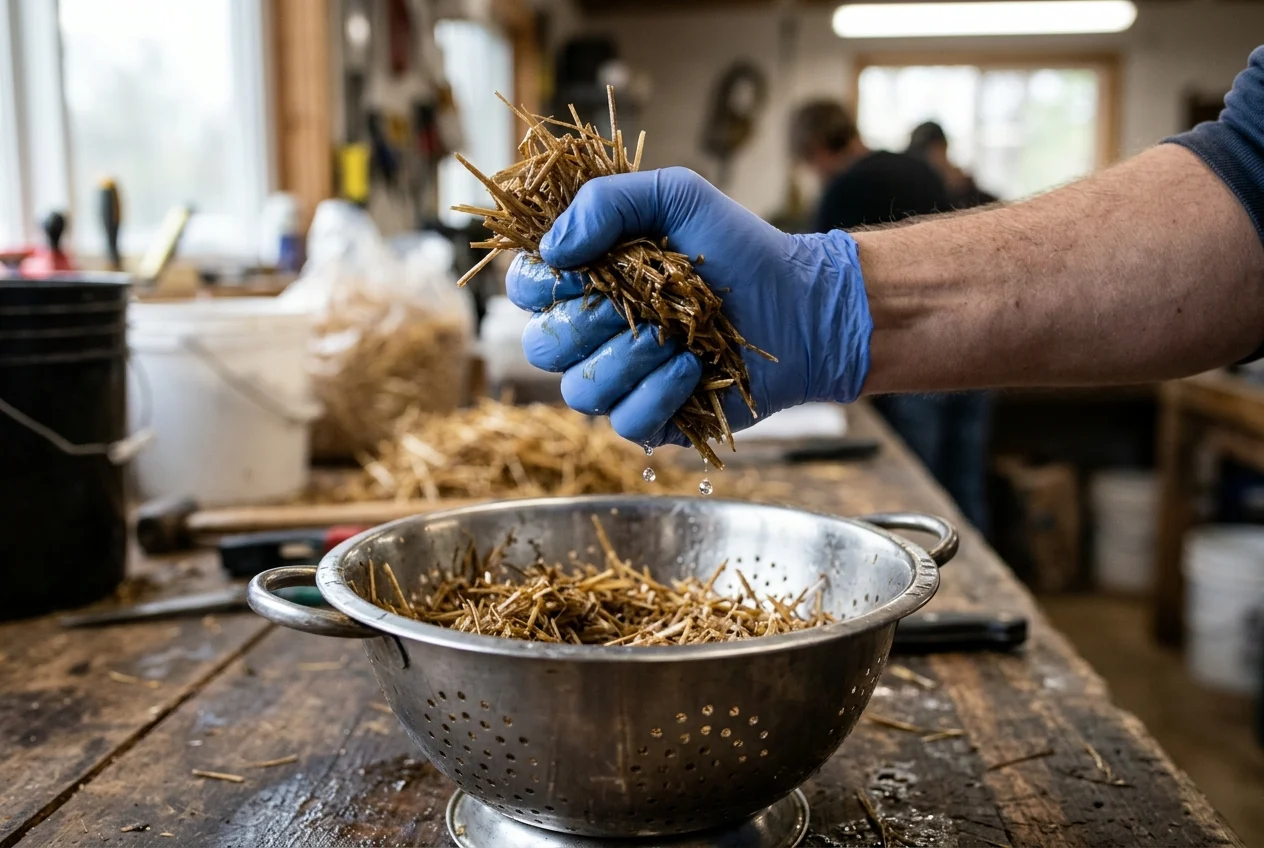
- Drain excess bath water for 1 to several hours: After pulling submerged mesh sacks or pillowcases out of a 165°F water bath, UF/IFAS Extension SS662 instructs draining excess water for at least 1 hour, while Field & Forest Products recommends draining hot-water straw for up to 20 hours during cool-down (or draining cold lime-soaked straw for several hours) until internal moisture settles around 65%.
- Sample from the bottom third of the draining sack: Gravity pulls free water downward. A handful taken from the top of a hanging sack can feel dry while the bottom third is still waterlogged.
- Squeeze as hard as you can: Grab a full handful of cooled straw and clench your fist with maximum pressure. According to Field & Forest Products, no more than one drop of water should come out (similarly, the North American Mycological Association standard cited in our mushroom substrate selection guide specifies only a few drops). When you open your hand, the straw should feel damp and springy without dripping.
Why Undrained Free Water Triggers Anaerobic Souring and Green Mold
Mushroom mycelium is strictly aerobic: as hyphae digest lignocellulose, they consume oxygen (O2) and respire carbon dioxide (CO2) through the microscopic air channels between straw strands or sawdust particles (Penn State Extension; Penn State Plant Pathology).
When straw is bagged above 70%–72% moisture, gravity pulls unbound free water to the bottom 5 to 10 cm of the polyethylene bag or bucket. That standing liquid displaces air pore spaces and cuts off oxygen diffusion. As Penn State Extension’s microbial activity guide explains, wet and dense substrate without aeration rapidly turns anaerobic. Anaerobic bacteria ferment soluble carbohydrates into organic acids, dropping substrate pH and leaving unconsumed sugars that favor Trichoderma green mold and foul-smelling bacterial rot while drowning mushroom hyphae.
Takeaway: Never bag dripping straw; drain until a maximum-force fist squeeze produces at most one to a few drops of water, and pack bags to the firmness of a tight pillow (UF/IFAS SS662) without crushing air spaces into waterlogged paste.
4. Calculate Grain or Sawdust Spawn Rate From Drained Wet Weight (1.25% vs. 5%–10%)
The single most expensive calculation mistake in home mushroom cultivation is multiplying a 5% to 10% spawn rate by the dry weight of the straw or pellets instead of the drained wet weight.
The Wet-Weight Spawn Equation and Worked Comparison
Both Penn State and Field & Forest Products define spawn rate as a percentage of substrate wet weight (W_wet):
Spawn_Weight = W_wet × (Spawn_Rate_% ÷ 100)
Worked Example (5.0 lb Dry Straw Batch Hydrated to 65% Moisture):
Suppose you start with 5.0 lb (2.27 kg) of dry chopped wheat straw. After hot-water pasteurization and draining to 65% moisture (M_target = 0.65), your drained wet weight is:
W_wet = 5.0 lb ÷ (1 - 0.65) = 14.29 lb (6.48 kg)of drained wet straw (or up to15–20 lbif starting with a slightly larger air-dry bundle).- Wrong calculation (using dry weight):
5.0 lb dry × 5% = 0.25 lb (113 g)of grain spawn. In a14.29 lbwet bag,0.25 lbof spawn is an effective wet-weight spawn rate of only1.75%—leaving wide gaps between grain kernels where competitor molds can establish. - Correct 5% wet-weight calculation:
14.29 lb wet × 5% = 0.71 lb (324 g)of grain spawn (for a standard20 lb / 9.07 kgwet straw bag,20 lb × 5% =1.0 lb / 0.45 kgof grain spawn). - Correct 10% beginner wet-weight calculation: Field & Forest Products recommends starting with a 10% minimum spawn rate when learning straw cultivation (
20 lb wet × 10% =2.0 lb / 0.91 kgof grain spawn, or1.43 lbfor a14.29 lbwet batch). At a 5% rate, a standard 4 lb (1.81 kg) bag of grain spawn inoculates roughly80 lbof wet straw—about two-thirds of a small square straw bale, filling three to four18 × 36 inchoyster bags.
Penn State Yield and Colonization Speed Data (1.25% vs. 5% Wet Weight)
Why does the jump from < 2% to 5%–10% wet-weight spawn matter so much? In controlled trials reported by Penn State Department of Plant Pathology and Penn State’s Cultivation of Oyster Mushrooms (Pleurotus cornucopiae across 1.25%, 2.5%, 3.75%, and 5.0% wet-weight spawn rates):
- Nearly 50% higher mushroom yield: Raising the spawn rate from 1.25% to 5.0% of substrate wet weight increased mushroom yield by nearly 50%. The cereal grain carrier in the spawn supplies direct nutrient energy to the developing mycelium while multiplying the number of active inoculation points throughout the bag.
- More than 7 days faster to harvest: Using a 5.0% wet-weight spawn rate reduced total time to production by more than 7 days compared with a 1.25% spawn rate.
- Shorter contamination and pest window: Every day that uncolonized wet straw sits warm in a bag is an opportunity for weed molds, bacteria, and sciarid fungus gnats (Lycoriella mali, which complete an egg-to-adult life cycle in 25 days at 21°C / 70°F and 35–38 days at 18°C / 64°F according to Penn State) to infest the crop. Rapid mycelial closure locks competitors out before they can sporulate.
Takeaway: Weigh your straw after pasteurizing and draining, then add 5% to 10% grain or sawdust spawn by wet weight (1 to 2 lb of spawn per 20 lb wet bag)—never calculate spawn from dry bale weight.
5. Hold the Pasteurization Temperature-Time Window (And Why Overheating Invites Green Mold)
Home growers often assume that if holding straw at 165°F (73.9°C) is good, boiling it at 212°F (100°C) in an open pot must be even safer. In practice, overheating an open or semi-sealed substrate bath destroys its biological defenses and invites catastrophic green mold (Trichoderma) contamination.
The Microbiology of Selective Heat: Thermophiles vs. Override Kill
As Penn State Extension plant pathologist Dr. David M. Beyer explains, pasteurization is not sterilization: its goal is to selectively kill harmful nematodes, insects, pest bacteria, and competing fungi while minimizing the loss of beneficial thermophilic (heat-loving) microbes.
In Penn State’s microbial activity research on mushroom substrate:
- Beneficial thermophilic actinomycetes (“fire fang”) and thermophilic fungi grow best between 115°F and 140°F (46°C and 60°C). These beneficial microbes consume soluble nitrogen, ammonia, and simple carbohydrates—converting them into microbial cell protein that mushroom mycelium readily digests while leaving no free sugars for weed molds.
- During a normal compost pasteurization held at 140°F (60°C), roughly 30% to 50% of beneficial thermophiles survive (
~300,000 to 500,000per million initial microbes) and rapidly repopulate the substrate afterward. - However, when substrate temperature suffers a high “override” to 160°F (71°C) or above in a microbe-dependent system, roughly 90% of beneficial microbes are killed or inactivated (leaving only
~100,000per million). When you boil or overheat straw in an open pot above 170°F (77°C) and then lift it into non-sterile room air to drain, you wipe out the protective thermophilic bacteria on the straw surface while hydrolyzing plant starches—handing a biological vacuum to airborne Trichoderma green mold spores.
Published Pasteurization, Sterilization, and Alkaline Soak Windows Compared
| Treatment Method | Target Temperature & pH | Hold Duration | Primary Source & Application | Critical Boundary Control |
|---|---|---|---|---|
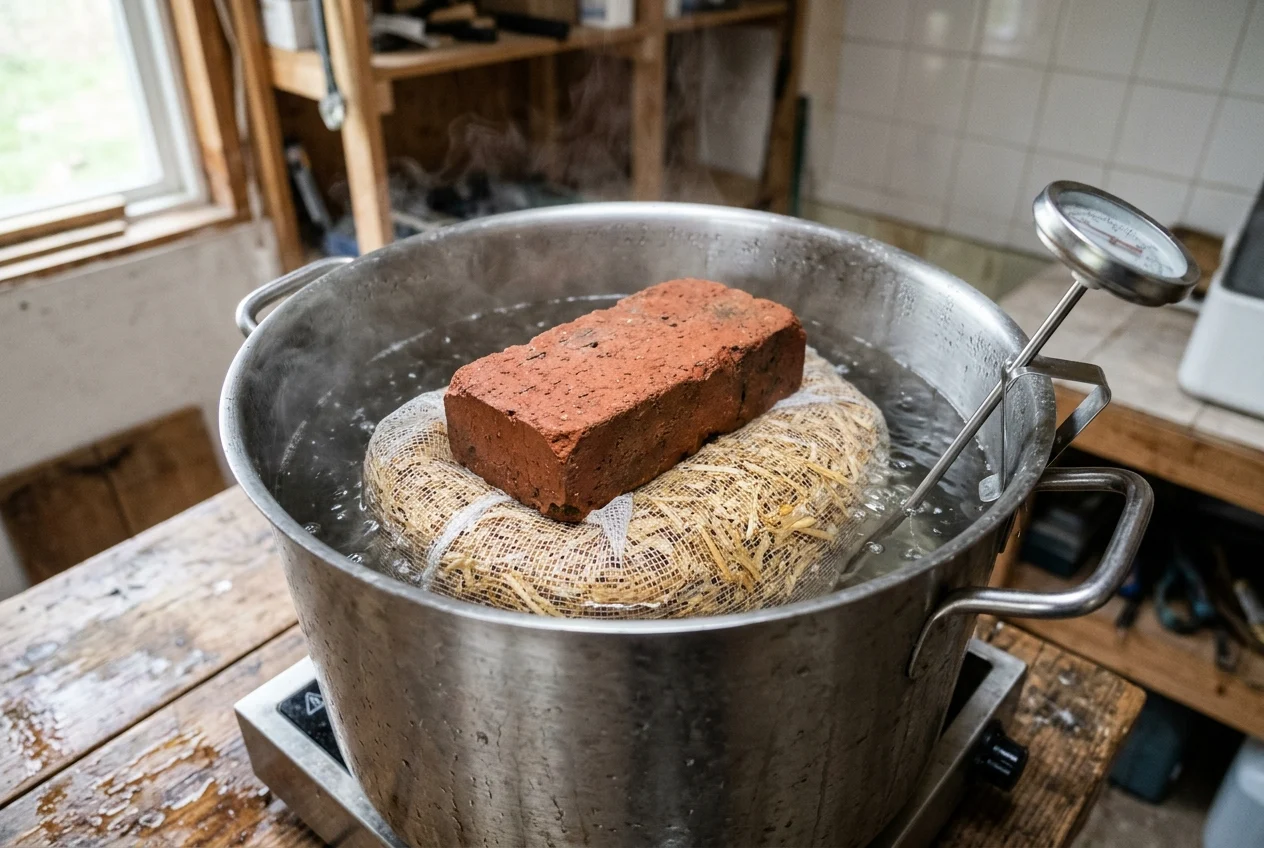
| Home Hot-Water Straw Bath | Heat water to 160°F (71°C); hold submerged straw at 165°F ± 5°F (160–170°F / 71–77°C) | 40–50 minutes (Field & Forest) to 1–2 hours (UF/IFAS SS662) | Home chopped wheat or oat straw (3–5 in) in water-permeating mesh sacks or pillowcases weighted below waterline with bricks |
Monitor core with a long-stem compost/probe thermometer; do not boil (> 170°F) in open pots |
| Commercial Aerated Steam (Straw / Cottonseed Hulls) | 60°C (140°F) or 65°C (149°F) air-steam mixture passed top-to-bottom | 1 hour at 65°C (Penn State) or 1–2 hours at 60°C (Penn State) | Penn State MRC cottonseed hull + wheat straw + 1% ground limestone (pH >= 7.5) in perforated metal boxes |
Cool immediately after hold for ~1.5 hours using 99.9% HEPA-filtered air before spawning |
| Phase II Compost Pasteurization & Conditioning | 140°F (60°C) pasteurization (>= 2 hr air/substrate crossover), then 115–140°F (46–60°C) conditioning |
4 hours at 140°F, followed by ~4+ days conditioning (<= 5°F drop per 24 hr) |
Commercial Agaricus button mushroom compost (Penn State Extension); illustrates thermophile survival curve | Avoid 160°F override in Phase II compost, which kills ~90% of ammonia-converting actinomycetes |
| Cold Hydrated-Lime Soak (Zero-Heat Alternative) | Cold tap water adjusted to pH ~12 using 1/8 cup (12 g) horticultural hydrated lime per gallon of water | 18–20 hours submerged soak, then drain several hours to ~65% moisture | Field & Forest Products cold-soak straw protocol for oyster mushrooms | Verify pH ~12 with litmus/pH paper strips; use horticultural hydrated lime (Ca(OH)2), not agricultural limestone (CaCO3) |
| Buffered Limestone Addition (Heat-Pasteurized Mixes) | 1% ground limestone (CaCO3) by dry weight to raise substrate pH to ≥ 7.5 |
Mixed dry prior to 60–65°C steam pasteurization | Penn State Specialty Mushroom Production Technology (citing Stolzer & Grabbe 1991) | Alkaline pH (>= 7.5) suppresses Trichoderma green mold germination during oyster spawn run |
| Autoclave / Pressure Sterilization | 121°C (250°F) (or 4 hr at 95°C + 1 hr at 120°C for enoki bottles) |
60–120 minutes (60 min Wood Ear; 120 min Shiitake 2.5 kg synthetic logs) |
Penn State & UKY Extension supplemented sawdust (10%–40% bran/grain) |
Mandatory whenever loose bran, millet, rye, or sucrose supplements are mixed into sawdust or hulls |
Takeaway: Keep hot-water straw baths strictly between 160°F and 170°F (target 165°F) for 40 to 120 minutes (or use 12 g per gallon hydrated lime at pH ~12 for an 18–20 hour cold soak) so you eliminate pests without stripping the straw’s natural biological selectivity.
6. Cool Below 75°F Before Spawning and Track Internal Bag Temperature (<90°F): Batch Checklist
Even a perfectly pasteurized and drained substrate batch will fail if you mix grain spawn into warm straw or let metabolic heat cook the mycelium during the first week of incubation.
Two Thermal Cutoffs Every Grower Must Measure
- Pre-Spawning Cooling Cutoff (
< 75°F / 23.9°C): After draining hot-water pasteurized straw, let the straw cool in a clean space for about 20 hours until the internal temperature is below 75°F (23.9°C) before mixing in spawn (Field & Forest Products; UF/IFAS Extension SS662). For sealed boiling-water pellet bags, cool undisturbed for 8 to 12 hours in a low-traffic room. Pitching cool grain spawn into 95–105°F substrate shocks the fragile hyphal tips and encourages thermophilic bacteria and molds to outrun the stalled mushroom culture. - Day 3 to Day 5 Incubation Peak Cutoff (
< 90°F / 32.2°C; Spawn Death at100°F / 37.8°C): As mycelium colonizes a tightly packed 10 to 30 lb substrate bag, aerobic respiration generates metabolic heat inside the core of the block—typically peaking 3 to 5 days after inoculation (Field & Forest Products). While room air in an incubation closet or box sits at 75–77°F (24–25°C) with 80%–90% relative humidity (UF/IFAS SS662; Field & Forest Products) or 23–25°C substrate temperature (Penn State), the center of a dense bag can run 10–15°F warmer than ambient room air (Penn State warns that adding nutrient supplements further increases substrate overheating risk).- Action threshold: Insert a sanitized probe thermometer into the center of a test bag on Days 3, 4, and 5. Internal bag temperature must not exceed 90°F (32.2°C).
- Lethal limit: Spawn death occurs at 100°F (37.8°C) (Field & Forest Products). If core bag temperatures climb past 86–88°F, immediately space the bags further apart, increase room airflow, or lower ambient room temperature.
Batch Wet-Weight, Drainage, and Pasteurization Checklist
Copy or print the checklist below to log your dry weights, water additions, squeeze-test verification, thermal hold window, and post-inoculation core temperatures for each batch:
| Batch Control Step | Target Specification / Formula | Your Measured Value / Entry | Pass / Action Required |
|---|---|---|---|
| 1. Batch ID, Date & Mushroom Strain | Confirm strain matches substrate (e.g., Pearl/Blue/Golden/Pink Oyster on straw; King/Black Pearl/Shiitake on sterilized sawdust) | Batch: _________ Strain: _________ |
[ ] Verified strain compatibility |
| 2. Dry Substrate Ingredients & Chop Length | Straw chopped to 3–5 in (7.5–12.5 cm); OR 5 cups dry pellets (2.5 c hardwood + 1.5 c cottonseed hull + 1 c soy hull); OR weighed dry sawdust + bran (10%–40%) |
W_dry = _________ lb / kg / cups |
[ ] Chopped 3–5 in or measured dry |
| 3. Target Moisture & Expected Wet Weight | Straw: ~65% (W_wet = W_dry ÷ 0.35); Hull/straw mix: 67%–69% (W_wet = W_dry ÷ 0.32); Sterilized sawdust/bran: ~60% (W_wet = W_dry ÷ 0.40); DIY pellets: 5.5 cups boiling water per 5 cups pellets |
Target M% = _____% Expected W_wet = _________ |
[ ] Water volume / bath prepared |
| 4. Heat or Alkaline Treatment Window | Hot-water bath: 160–170°F (target 165°F) for 40–120 min; Aerated steam: 60–65°C for 1–2 hr; Cold lime soak: 12 g (1/8 cup) hydrated lime/gal at pH ~12 for 18–20 hr; Autoclave: 121°C (250°F) for 60–120 min | Temp / pH: _________ Hold time: _________ min/hr |
[ ] Held inside target window (no open-bath override >170°F) |
| 5. Gravity Drainage & Hand Squeeze Test | Drain straw 1 to several hours; maximum-force fist squeeze from bottom third of sack releases ≤ 1 drop (or only a few drops) of water | Drain time: ______ hr Drops on squeeze: ______ |
[ ] No free water streaming; zero standing water in bag |
| 6. Pre-Spawning Core Cooling Check | Cool drained straw ~20 hr until internal temp is below 75°F (23.9°C); cool sealed boiling-water pellet bags 8–12 hr; cool autoclaved bags 16–20 hr | Core temp at spawning: _________ °F / °C |
[ ] Confirmed < 75°F (23.9°C) before adding spawn |
| 7. Drained Wet Weight & Spawn Dose (5%–10%) | Weigh drained substrate (W_wet); add 5% to 10% spawn by wet weight (W_spawn = W_wet × 0.05 to 0.10, or 1.5 cups spawn per 5-cup pellet block) |
Actual W_wet = _______ Spawn added = _______ (___%) |
[ ] Spawn calculated from WET weight (not dry weight) |
| 8. Bag Packing & Gas-Exchange Holes | Stuff straw bags firmly like a tight pillow (10–12 × 20–24 in or 18 × 36 in); punch 1/4 in (0.5 cm) cross-cuts or diamond-pattern holes 4–6 in apart (UF/IFAS SS662; Field & Forest), or verify 0.2 micron filter patch is unblocked |
Bag count: _____ Hole spacing / filter check: _____ |
[ ] No hollow air pockets; gas exchange unobstructed |
| 9. Day 3–5 Incubation Core Temperature Check | Incubate straw at 75–77°F (24–25°C), 80%–90% RH (or DIY pellet blocks at 62–65°F); check internal bag temp on Days 3–5 (must stay < 90°F / 32.2°C; lethal at 100°F / 37.8°C) | Day 3: ____°F Day 4: ____°F Day 5: ____°F |
[ ] Core temp < 90°F; zero green/blue/black/yellow mold spots |
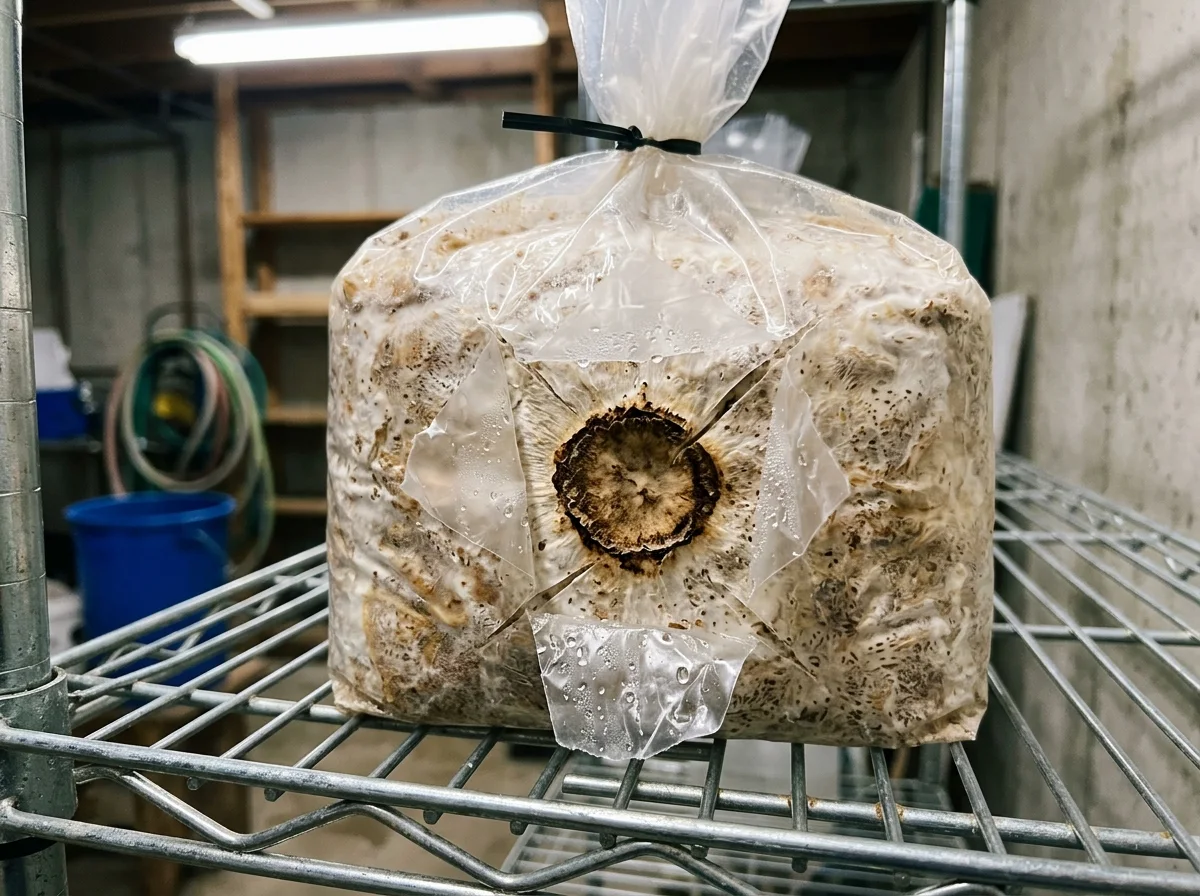
Once your bags complete their 2 to 3 week spawn run (or 3 to 5 weeks until pinheads appear) and the substrate turns completely white, transition the colonized blocks to fruiting conditions using our oyster mushroom growing kit humidity and fresh air guide. After twisting off your first harvest cluster, consult our oyster mushroom second-flush care guide before soaking or resting the block.
Takeaway: Verify with a thermometer that drained substrate is below 75°F (23.9°C) before adding spawn and stays below 90°F (32.2°C) inside the bag during the Day 3–5 metabolic heat peak.
When This Guide Does Not Apply
This guide covers calculating wet weight, moisture field capacity, spawn rates, and heat-treatment windows for indoor culinary mushroom substrates inoculated with purchased commercial spawn. It does not apply to:
- Choosing substrates by mushroom species or outdoor log/wood-chip bed cultivation: See our mushroom substrate selection guide for species matching across oyster, shiitake, lion’s mane, wine cap, and button mushrooms, as well as peat moss casing notes.
- Pure grain spawn manufacturing from agar, liquid culture, or spores: As Penn State and UF/IFAS Extension SS662 note, cooking and sterilizing grain with calcium carbonate to propagate pure spawn requires sterile laboratory facilities.
- Commercial Phase I and Phase II Agaricus button mushroom composting facilities: While Penn State’s Phase II microbiology explains why thermophilic actinomycetes and fungi matter during pasteurization, building a multi-ton aerated Phase II composting tunnel is outside home cultivation scope. For how mushroom compost differs from garden compost and liquid extracts, see our explainer on what compost tea is and how it differs from compost and leachate.
- Wild mushroom foraging, species identification, or edibility judgments: Never use indoor cultivation guides to identify wild fungi, and follow UF/IFAS Extension SS662 by discarding bags with active green, blue, black, or yellow contaminant mold rather than judging whether nearby mushrooms are safe to eat.
Method and Sources
Updated 27 October 2026. The dry-to-wet weight formulas, moisture targets, spawn rate comparisons, and thermal windows in this guide were compiled from primary university extension publications and commercial spawn-producer instruction sheets verified on 27 October 2026:
- Penn State Department of Plant Pathology and Environmental Microbiology — Specialty Mushrooms: Production Technology (accessed 27 October 2026), covering synthetic log formulations (
10%–40%dry-weight bran/grain supplements hydrated to~60%moisture and sterilized at121°Cfor60–120 minutes), the Penn State Mushroom Research Center (MRC) oyster mix (75%cottonseed hulls,24%wheat straw,1%ground limestone at67%–69%moisture), aerated steam pasteurization (60–65°Cfor1–2 hours), and wet-weight spawn rate trials (1.25%vs.5%). - Penn State College of Agricultural Sciences — Cultivation of Oyster Mushrooms by Daniel J. Royse (checked 27 October 2026), detailing
2–6 cmwheat straw milling,65°C1-hour aerated-steam pasteurization with1.5-hourHEPA cooling, and experimental data showing nearly a 50% yield increase and a> 7-dayreduction in days to production when raising spawn rate from1.25%to5%of substrate wet weight. - Penn State Extension — Growing Mushrooms: Microbial Activity in Substrate and Mushrooms Substrate Management by David M. Beyer, Ph.D. (accessed 27 October 2026), documenting thermophilic actinomycetes and fungi activity at
115–140°F (46–60°C), anaerobic acidification in overly wet substrates, and why high temperature overrides (160°F / 71°Cin compost) eliminate ~90% of beneficial microbes. - University of Florida IFAS Extension — Publication SL448/SS662, D.I.Y. FunGuide: Grow Your Own Oyster Mushrooms at Home (revised 2 September 2025; accessed 27 October 2026), specifying
4–5 inchstraw cutting, overnight pre-soak,165°Fhot-water bath pasteurization for1–2 hours,1-hourdraining,5%–10%spawn rate,24–25°C (75–77°F)incubation, and visual mold inspection (Trichoderma green mold). - University of Kentucky Cooperative Extension — Center for Crop Diversification Crop Profile CCD-CP-079, Gourmet & Medicinal Mushrooms (March 2021; accessed 27 October 2026), covering indoor bag and bottle substrates with bran supplements.
- Field & Forest Products — Growing Oyster Mushrooms on Straw and How to Make Oyster Mushroom Grow Blocks instruction sheets (Peshtigo, Wisconsin; checked 27 October 2026), providing the
3–5 inchstraw chop length,165°F ± 5°F(40–50 minute) hot-water bath protocol,< 75°F(~20-hour) cooling rule,1/8 cup (12 g) per galloncold hydrated-lime soak atpH ~12(18–20 hours), single-drop hand squeeze test at~65%moisture,5%–10%wet-weight spawn examples (1–2 lbspawn per20 lbwet straw bag),< 90°FDay 3–5 incubation core limit (100°Fspawn death), and the5-cupdry pellet +5.5-cupboiling water +1.5-cupgrain spawn single-block recipe.
Known Source Farms is an independent editorial publication and is not affiliated with the Texas farm business that previously used this domain. Browse more home growing and small-scale food production articles on our blog and in our mushrooms section.