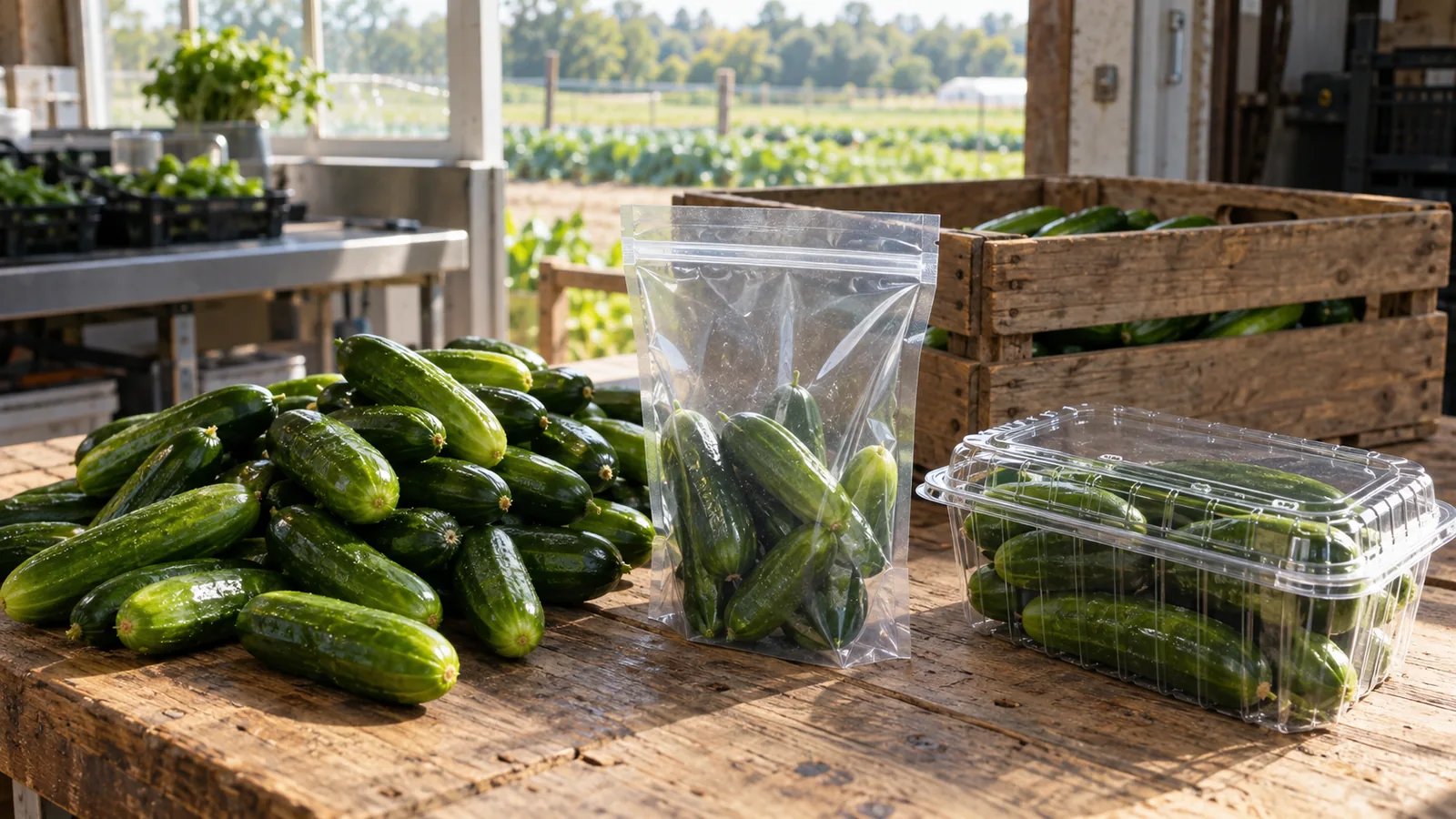
Picking the wrong pack for cucumbers costs product to wet decay on one side and shrivel on the other. StePacPPC’s Xgo PAZ Pouch, announced on 29 September 2026, is a patent-pending resealable stand-up pouch that the company says handles both problems at once, but the performance figures behind it come from 16-day simulated supply chain tests reported in the company’s own release, run before commercial expansion and not independently checked.
What is confirmed: StePacPPC’s own release, dated 29 September 2026, describes the pouch, names two North American users and reports a 16-day simulated supply chain test. What is not public: the test protocol, the film structure, the filling and sealing requirements, prices and US supply terms. This page compares the pouch with laminated, perforated, top-seal, clamshell and shrink-wrap packs, shows how to read the test figures, and lists what to ask before running your own trial.
This explainer is compiled from public sources by Known Source Farms, an independent information site with no link to StePacPPC or the companies named; it is part of our processing and packing coverage.
- StePacPPC says the pouch combines modified atmosphere, humidity control and condensation control in one pack.
- The company reports a 29 percentage-point quality advantage over a top-seal pack and 10 points over perforated packaging, measured on day 16 of tests described in its release.
- According to Packaging Europe, StePacPPC will show the pouch at IFPA’s Global Produce & Floral Show in Orlando on 15–16 October 2026.
What did StePacPPC announce?
StePacPPC announced the Xgo PAZ Pouch, a resealable stand-up zipper pouch built on its Xgo modified atmosphere (MAP) films, aimed first at cucumbers and also used for lychee, pitaya, rambutan and longan. The company describes it as “3-in-1”: modified atmosphere, modified humidity and condensation control in a single pack. StePacPPC describes the design as patent-pending; we have not checked any patent filing.
| Date | Event | Source | Source type |
|---|---|---|---|
| Not dated | 16-day shelf-life tests under simulated supply chain conditions, run before commercial expansion | StePacPPC release | Manufacturer claim |
| 29 September 2026 | Release published: Xgo PAZ Pouch, patent pending | StePacPPC | Manufacturer |
| 29 September 2026 | Same announcement reported | Packaging Europe | Trade media, based on the release |
| 14–16 October 2026 | IFPA Global Produce & Floral Show, Orlando, Florida | IFPA | Organiser |
| 15–16 October 2026 | StePacPPC to show the pouch, Booth #2933 | Packaging Europe | Single report |
Two users are named in StePacPPC’s release. Wholesum Family Farms packs its Lil’ Ones Organic Baby Cucumbers snack packs in 8 oz Xgo pouches. Florida-based Freshway Produce, according to the release, uses the pouch for its whole exotic fruit line, packing at source in the final retail format so the fruit does not have to be repacked after arriving in the US; Packaging Europe describes this as replacing traditional clamshells.
Every report we found traces back to the same release, so this is one source, not several.
Takeaway: Treat the pouch as a manufacturer announcement with two named users, not as an independently reviewed product.
How do cucumber pack formats compare?
Cucumbers sit between two failures: trapped moisture that speeds decay, and water loss that makes them shrivel. Each common pack handles that trade-off differently, and only some of them can hold a modified atmosphere at all. The table uses IFPA’s MAP white paper for the format behaviour and labels StePacPPC’s own descriptions as such.
| Pack | Can it hold a modified atmosphere? | Moisture behaviour | What to check |
|---|---|---|---|
| Laminated stand-up pouch, unperforated | Yes in principle, if the film’s gas transmission matches the product | StePacPPC says the low water vapour transmission traps moisture and speeds microbial decay | Condensation and decay at the end of your cold chain |
| Macroperforated bag or pouch | No: visible holes let gas move too freely (IFPA) | StePacPPC says it trades atmosphere for dehydration and still allows condensation | Weight loss and shrivel |
| Microperforated bag or pouch | Yes: holes of about 40–200 µm set the gas exchange (IFPA) | Not addressed in the sources used here | Hole count and consistency for your fill weight |
| Top-seal tray (rigid tray with sealed lidding film) | Yes, with the lidding film doing all the gas exchange (IFPA) | Depends on the lidding film | Leaking seals; the comparison pack in StePacPPC’s test |
| Clamshell | No: naturally aspirating (IFPA) | StePacPPC says lids collect condensation after temperature swings | Visibility of product after cold-chain breaks |
| Shrink-wrapped single cucumber | Not assessed in the WFLO manual; used as a moisture barrier on each fruit | WFLO: prevents moisture loss, widespread for European-type greenhouse cucumbers | Storage at 55°F (12.5°C), 1–2 weeks (WFLO) |
| Xgo PAZ Pouch | StePacPPC says yes, with films of variable water vapour transmission | StePacPPC says it controls humidity and condensation as well | Everything in the “unconfirmed” list below |
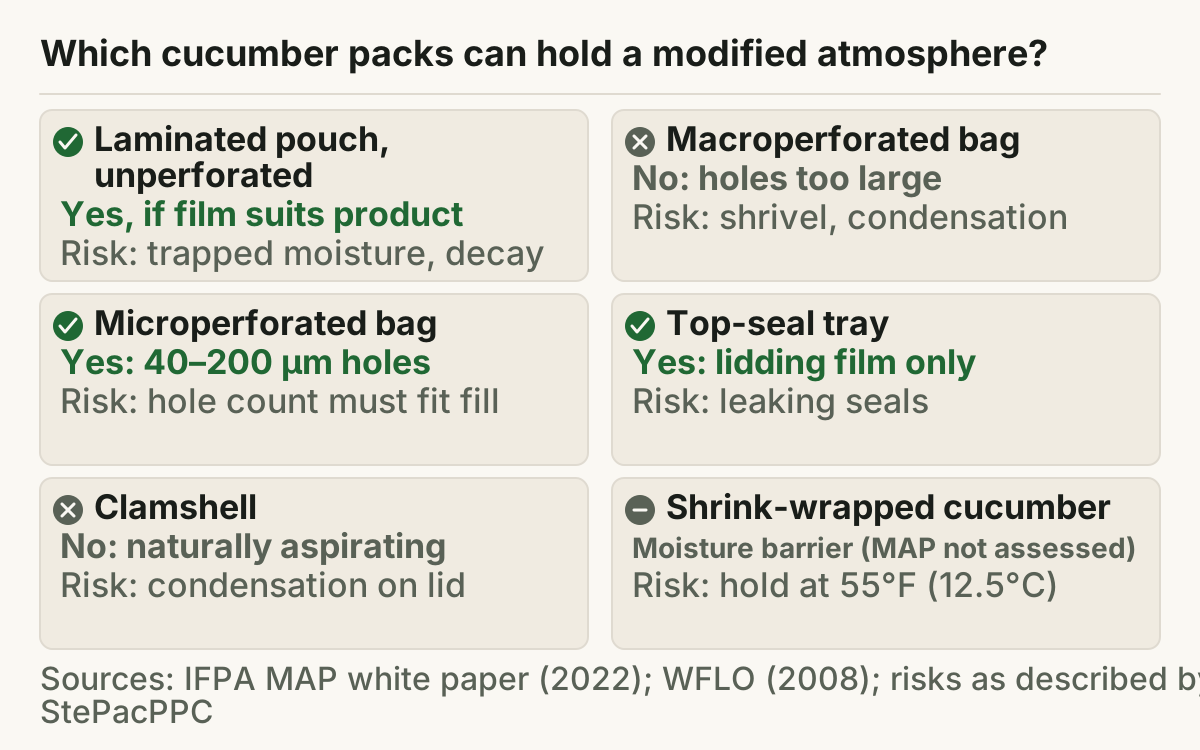
Figure 1. Which common packs can hold a modified atmosphere, according to IFPA’s MAP white paper, and the moisture risk StePacPPC and WFLO describe for each.
IFPA’s white paper adds a point that matters for any pouch decision: stand-up pouches are generally microperforated, because the stiffer films that let a pouch stand have low oxygen transmission. So if you already use microperforated stand-up pouches, those are the natural control for a trial; if you use clamshells or top-seal trays, compare against those instead. IFPA also notes that macroperforation suits packs where never going anaerobic is the top priority, and that it has historically been the choice for fresh mushrooms; the growing side of that crop is covered in our guide to mushroom substrates.
Common mistake: Treating “perforated” as one category. Microperforations (invisible, about 40–200 µm) can hold a modified atmosphere; macroperforations (visible holes) cannot. StePacPPC’s release and Packaging Europe’s report even disagree on which one was the comparison pack.
Takeaway: Decide first whether your product needs a modified atmosphere or only moisture control, then compare the formats that can deliver it.
How should you read the 16-day and 29-point figures?
The figures come from the company’s own tests before commercial expansion; they are not a shelf-life guarantee. On day 16 of a simulated supply chain test, StePacPPC reports a 29 percentage-point advantage in overall quality against a top-seal pack and a 10 percentage-point advantage against perforated packaging. Percentage points describe the gap between two quality scores, not a 29% cut in waste.
| Figure | What it measures | Compared with | Who reports it | What it does not show |
|---|---|---|---|---|
| “Up to 16 days” | Cucumber quality held from harvest to home refrigeration | Nothing stated | StePacPPC | Temperatures, variety or starting quality |
| +29 percentage points | Overall quality score on day 16, organic baby cucumbers | A top-seal alternative | StePacPPC, describing tests before commercial expansion | Scoring method, sample size, who scored |
| +10 percentage points | Overall quality score on day 16, organic mini cucumbers | “Traditional microperforated packaging” in the release; “macro-perforated” in Packaging Europe | StePacPPC; Packaging Europe | Which perforation type was actually used |
The release says the advantage showed up as reduced moisture, decay and mould and better visibility, appearance and overall quality, without separate numbers for each. It also leaves open who ran the test: the sentence follows the Wholesum paragraph and says only that “the company” conducted it.
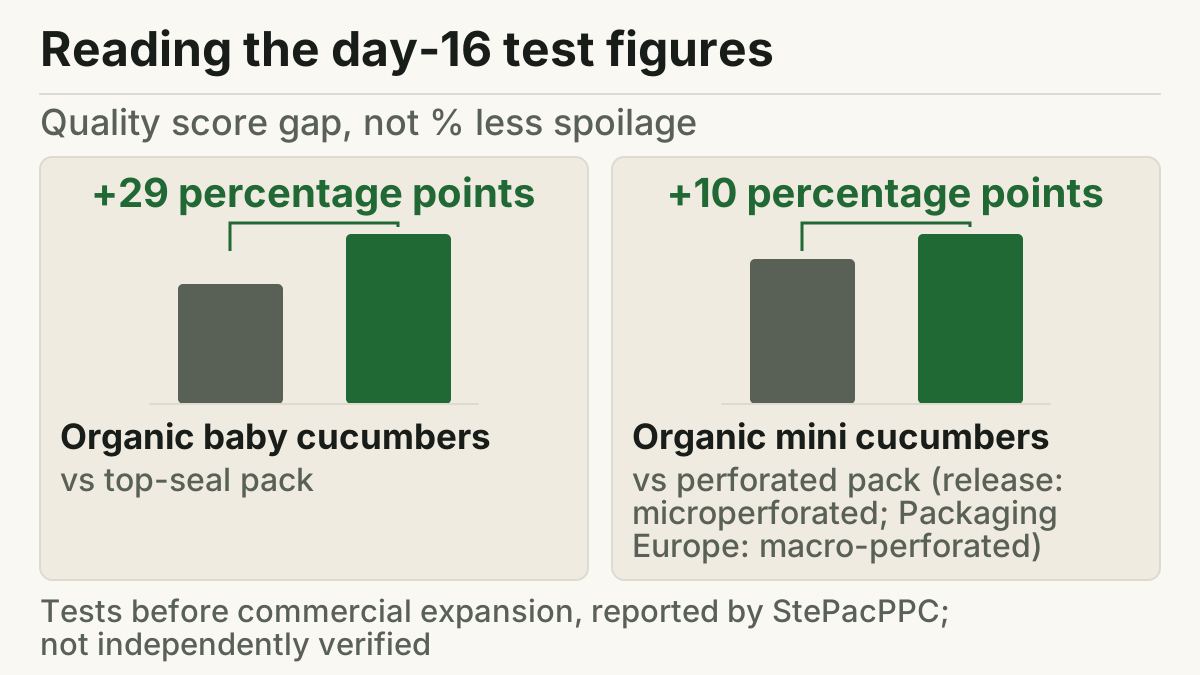
Figure 2. The two reported figures are gaps between quality scores on day 16, each against a different comparison pack.
Common mistake: Writing “29% less spoilage” or “16 extra days”. The release supports neither: 29 is a gap in percentage points of a quality score, and 16 days is the length of the test and the stated maximum, not an extension.
Takeaway: Use the figures as a reason to ask for the test protocol, not as a number to put in a business case.
Who is affected?
The announcement matters most to packers who already fight condensation or shrivel on cucumbers and moisture-sensitive exotic fruit, and to anyone weighing a move from clamshells to pouches. It matters less to packers whose current pack already performs well in their own cold chain.
| Who | Possible effect | Basis |
|---|---|---|
| Mini and baby cucumber snack packers | A pouch option aimed directly at their product | Wholesum use and the 16-day test (StePacPPC) |
| Exotic fruit importers (lychee, pitaya, rambutan, longan) | Packing at source in the retail pack instead of repacking in the US | Freshway use (StePacPPC) |
| Users of top-seal trays | A flexible alternative to compare against | Top-seal was the comparison pack for the 29-point figure (StePacPPC) |
| Users of clamshells | A flexible alternative for moisture-sensitive fruit | StePacPPC’s description of exotic fruit packing; no clamshell test data published |
| Users of microperforated or laminated pouches | A different way to balance atmosphere and moisture | StePacPPC’s description of the film |
| Packing lines that fill and seal pouches | Unknown until filling and sealing requirements are published | Not in any source |
Takeaway: If your losses come from condensation or decay in the pack, this is worth a look; if they come from poor cooling before packing, a new pouch will not fix them.
When should packers act?
There is no reason to change packs before seeing data, but the IFPA show gives a fixed date to ask for it. IFPA’s Global Produce & Floral Show runs on 14–16 October 2026 in Orlando, Florida, and Packaging Europe reports that StePacPPC will be at Booth #2933 on 15–16 October.
| When | What | Status |
|---|---|---|
| Now | Record how your current pack performs: decay, shrivel and condensation at the end of your cold chain | Your own data |
| 14–16 October 2026 | IFPA show, Orlando; StePacPPC due at Booth #2933 on 15–16 October | Show dates from IFPA; booth from Packaging Europe |
| After the show | Request the test protocol, film details and line requirements (list below) | To be confirmed |
| After documents arrive | Run a side-by-side trial pack against your current pack | Your decision |
| Commercial supply, price, lead times | Not published | To be confirmed with StePacPPC |
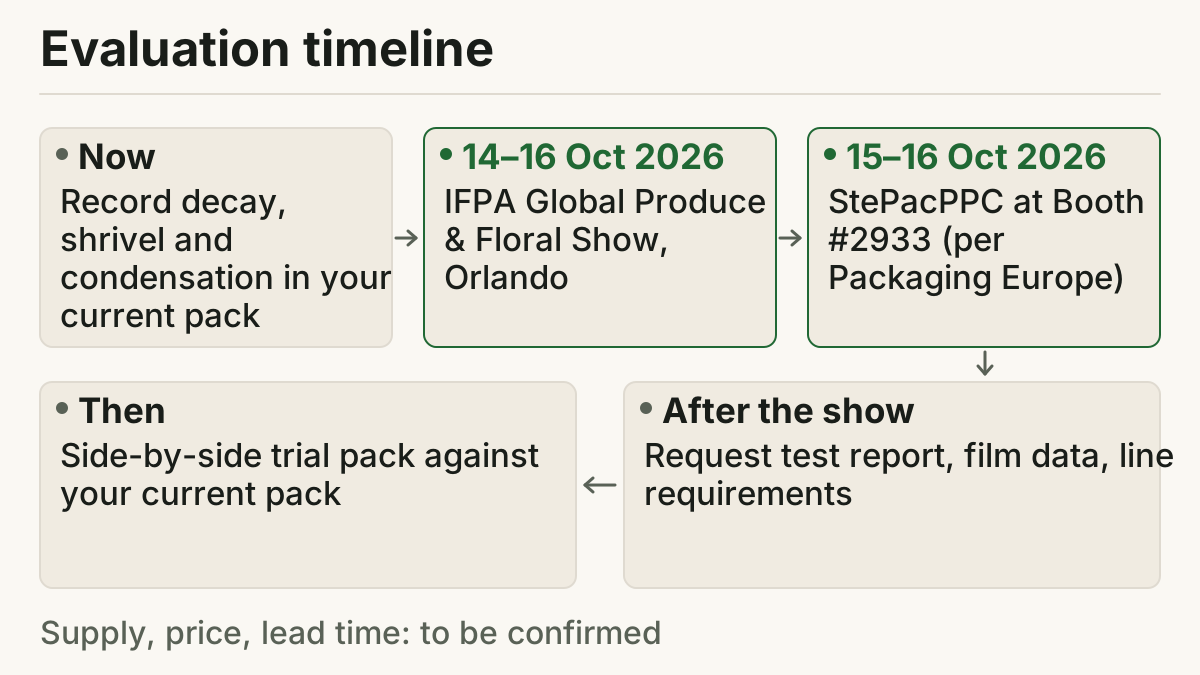
Figure 3. A sensible order of steps around the IFPA show. Only the show dates are fixed.
The show is a place to see the pouch and ask questions. Nothing in the sources describes it as a launch date or a date when supply opens.
Takeaway: Put the IFPA dates in the calendar as a deadline for questions, not as a buying date.
What is still unconfirmed?
Most of what a packer needs to plan a change is not in the release. Each item below needs a document from StePacPPC or a result from your own trial before it can be relied on.
| Open item | Who can confirm | What to ask for |
|---|---|---|
| Test protocol: who ran it, temperatures, sample size, scoring | StePacPPC or Wholesum | The test report |
| Which perforated pack was the comparison | StePacPPC | Pack specification of the control |
| Film structure and materials | StePacPPC | Technical data sheet |
| Recyclability | StePacPPC | A written statement; the release says nothing |
| Pouch sizes and formats (preformed or roll stock) | StePacPPC | Size range |
| Filling, sealing and zipper requirements | StePacPPC and your equipment supplier | Seal settings and line trial results |
| Patent status | Patent offices | Filing number and status; StePacPPC calls it patent-pending |
| US supply, price and lead time | StePacPPC | A quotation |
Takeaway: Ask for the test report and the line requirements first; the other items only matter if those two look right.
What should you check before a trial pack?
A fair trial compares the new pouch with your current pack under your own cooling, storage and display conditions. IFPA’s white paper is blunt that modified atmosphere packaging only works with consistent temperature control, never improves the quality that goes into the pack, and fails if packs leak.
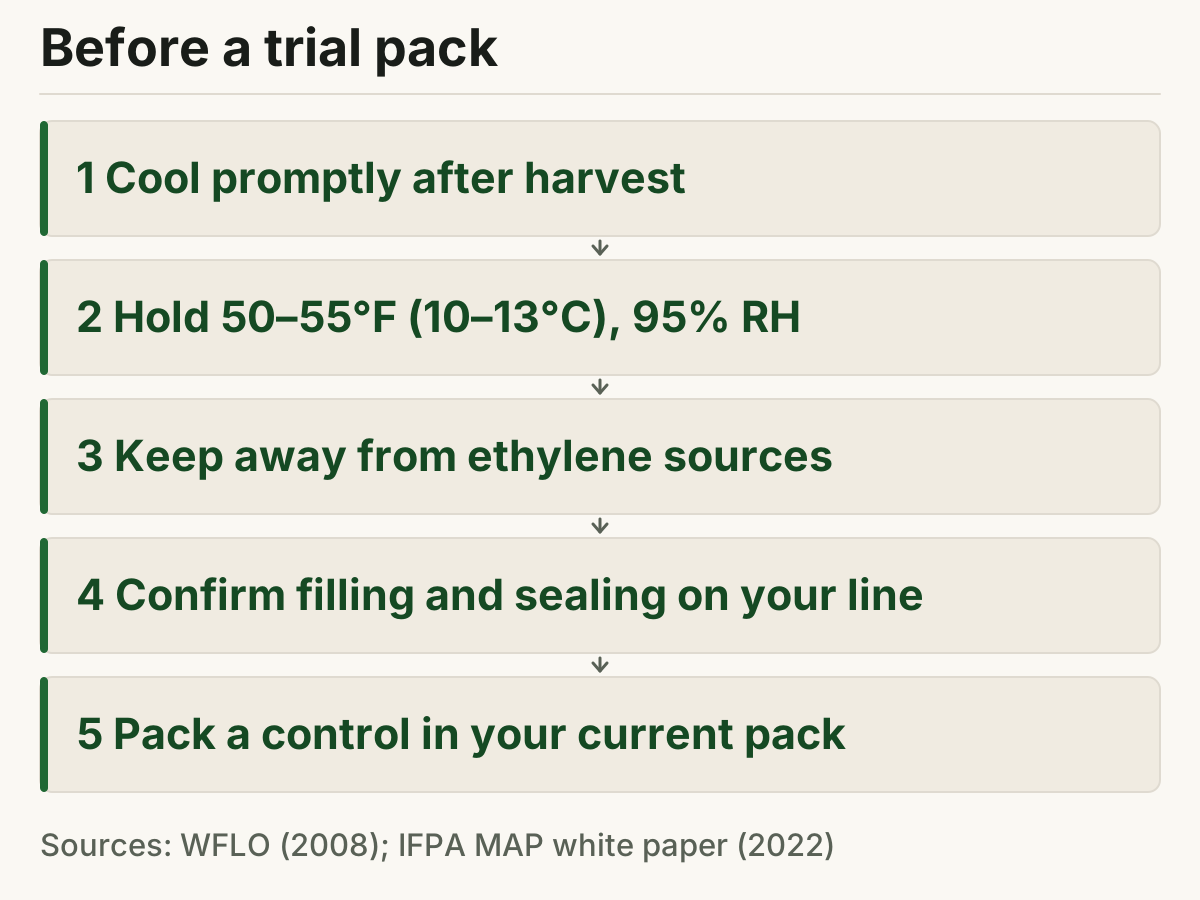
Figure 4. Conditions to control before comparing packs, drawn from the WFLO storage manual and IFPA’s MAP white paper.
- Cool before packing. WFLO calls rapid cooling after harvest critical, because cucumbers are harvested while still growing fast. StePacPPC itself says moisture problems are worse when cucumbers are not cooled enough before packing.
- Hold the right temperature. WFLO gives 50–55°F (10–13°C) and 95% relative humidity for fresh cucumbers, with a storage period of 10–14 days. Below 50°F for more than about 2–5 days, chilling injury can appear as pitting and water-soaked spots.
- Keep ethylene away. WFLO notes that even 1 ppm of ethylene may yellow cucumbers in a day, so do not store the trial next to tomatoes or apples.
- Confirm the line can run the pack. IFPA notes that pouches come preformed or on roll stock, and that vertical machines generally run flexible packs while horizontal machines run rigid trays. Ask how the PAZ pouch is supplied and how it must be sealed before booking line time.
- Run a control. Pack the same lot in your current pack and the trial pouch at the same fill weight, record starting quality, check seals for leaks, and score decay, shrivel and condensation on the same days with the same scoring method.
Our reading: the only comparison that matters to a packer is the new pouch against its own current pack in its own cold chain, and nothing in the release lets you predict that result.
Takeaway: Control cooling, temperature and ethylene first, so the comparison between packs is as fair as you can make it.
When this does not apply
This page covers fresh whole cucumbers and the exotic fruits named in the release, packed for retail. It does not apply to:
- Pickling cucumbers, which WFLO says can be held at 34–36°F for a week only if processed immediately.
- Controlled atmosphere storage rooms, where WFLO reports about 3–5% oxygen retards yellowing; that is a storage method, not a retail pack.
- Food safety decisions, which depend on rules and guidance from your food safety authority, not on this comparison.
Takeaway: Use this comparison for retail pack choice only.
Method and sources
Compiled on 7 October 2026 from StePacPPC’s release of 29 September 2026 (read in full), Packaging Europe’s report of the same date, IFPA’s 2026 show announcement, IFPA’s MAP white paper (edited January 2022) and the WFLO cucumber storage manual (revised 2008). We have not tested the pouch or any of the packs compared. We will update this page if StePacPPC publishes its test report or line requirements.
Takeaway: Every performance figure here is StePacPPC’s; check it against the test report before relying on it.