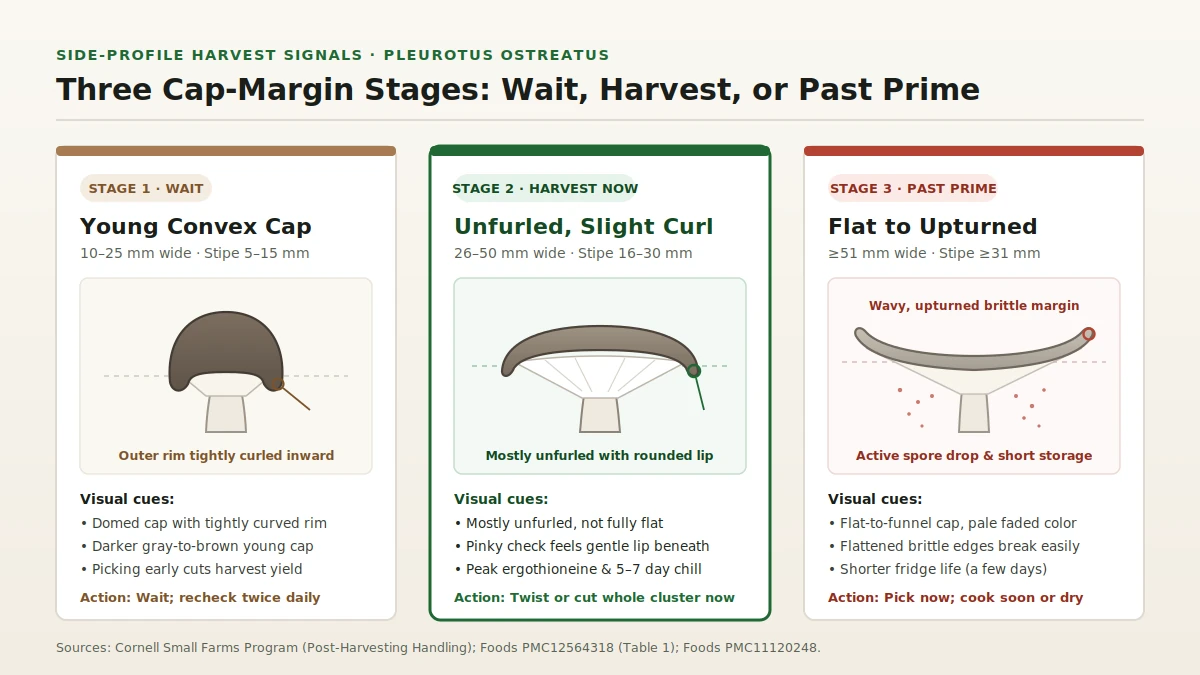
Harvest cultivated oyster mushrooms when the cap is mostly unfurled and shifting from a convex dome toward a flat margin, while the outer rim still keeps a slight downward roll. Picking clusters at this rounded-edge window prevents brittle upturned caps, heavy spore shedding, and short refrigerator life, keeping fresh clusters usable for 5 to 7 days at 4 °C.
Waiting for oyster mushrooms to grow as large as possible is the most common harvest mistake on indoor grow bags and ready-to-fruit blocks. While an overripe mushroom lasts only a few days in cold storage, clusters harvested at peak margin shape stay robust, retain stronger color, and can last a week or more in refrigeration (Cornell Small Farms Program). If your block is still pinning or stretching leggy stems before harvest, review our oyster mushroom growing kit humidity and fresh air guide; once you pick your first flush, follow our oyster mushroom second-flush care guide for recovery care.
How can you tell when cultivated oyster mushrooms are ready to harvest?
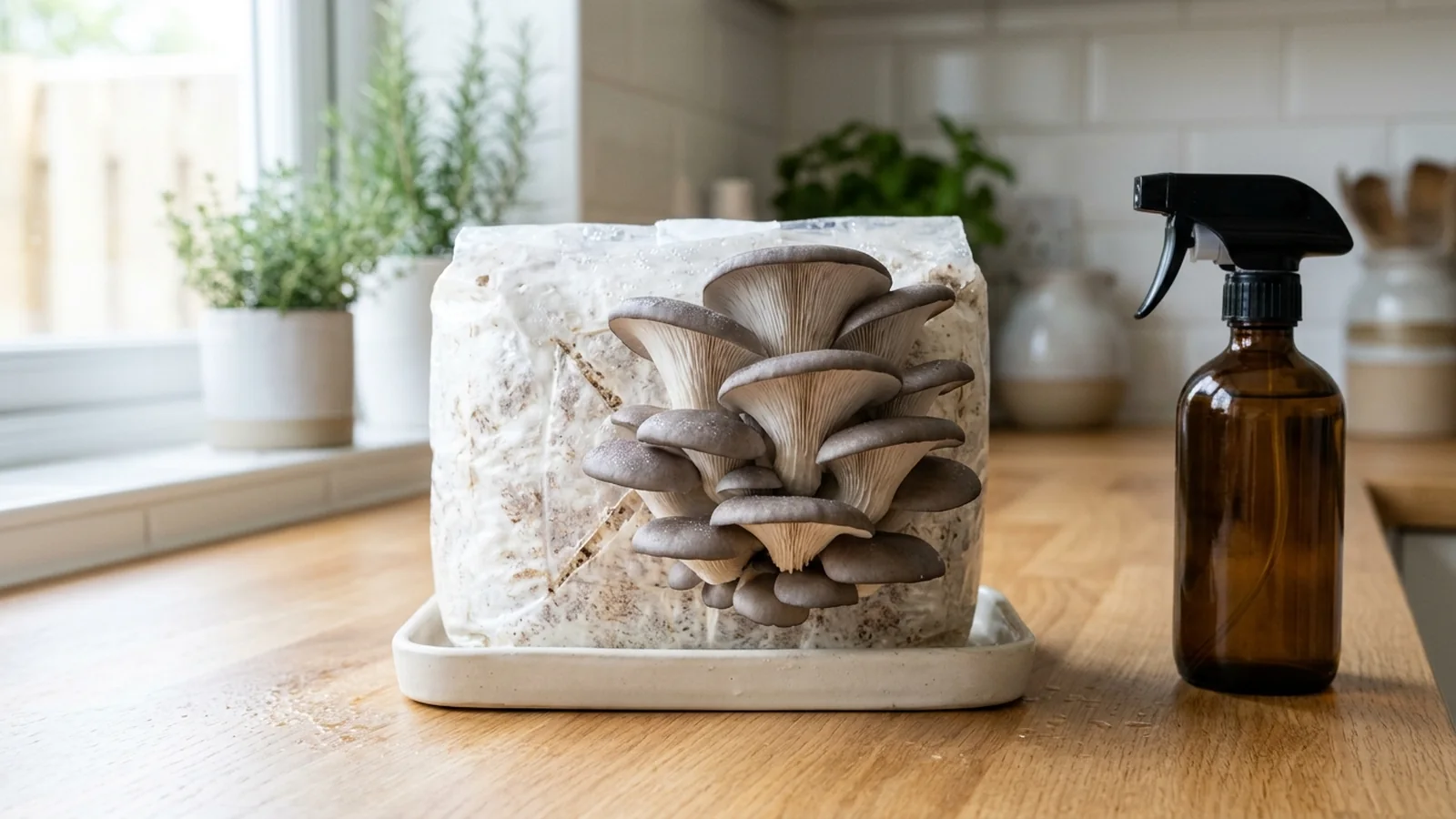
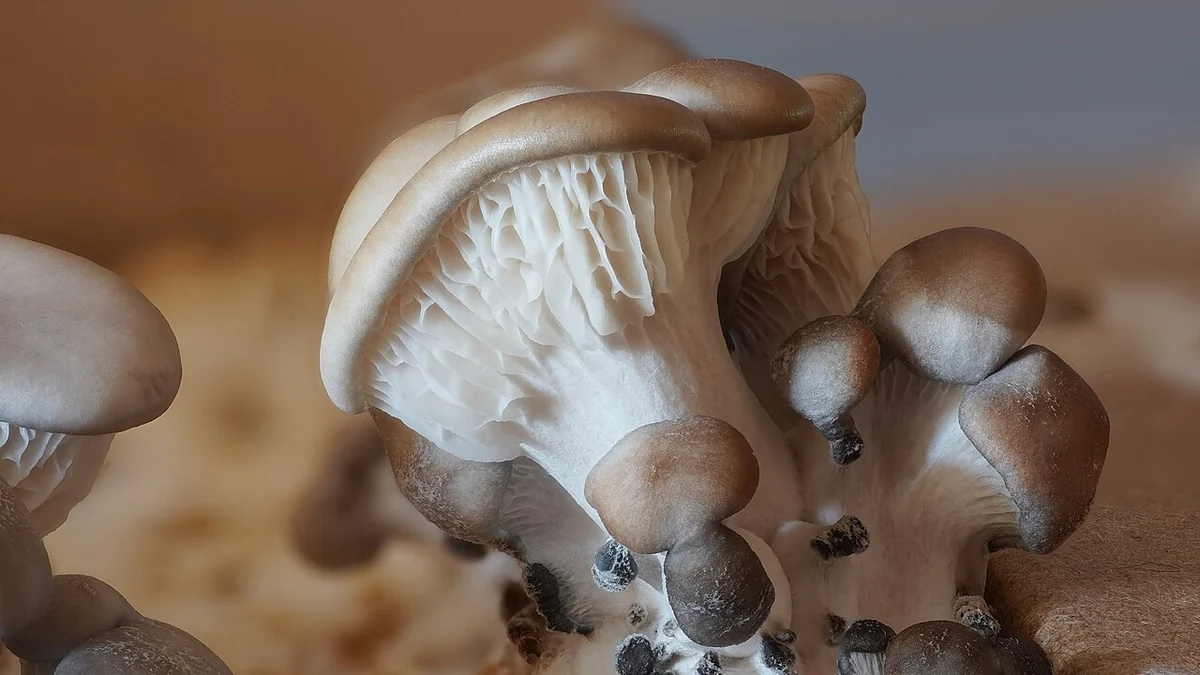
Cultivated oyster mushrooms are ready to harvest when the convex cap expands into a broad, mostly unfurled fan whose outer edge is approaching flat yet still curls gently downward (Cornell Small Farms Program; Foods). Checking the rim from underneath with a pinky finger confirms readiness before edges turn flat, brittle, and wavy.
Because oyster clusters overlap like shingles on a grow bag, looking strictly from above hides whether the outer lip has unrolled. Growers therefore check the underside margin with a pinky finger to feel whether the rounded edge is unfurling (Cornell Small Farms Program). In Pleurotus ostreatus, maturity shifts the cap from a domed convex shape toward a more or less flat edge at the margins, and letting clusters flatten completely makes the thin rim brittle and prone to cracking during handling (Foods; Cornell Small Farms Program).
Why cap shape predicts spore drop, nutrition, and storage life
Cap expansion is tightly coupled to spore release and senescence. Mushrooms sense light, gravity, and carbon dioxide to build a proper pileus for effective spore diffusion, and tissue aging accelerates during and after sporulation (Journal of Fungi). Under normal atmospheric air, Pleurotus ostreatus undergoes rapid pileus expansion within 48 hours and begins shedding basidiospores (Journal of Fungi).
Biochemical profiling across five commercial Pleurotus species in Foods confirms that developmental stage also governs composition: ergothioneine, total phenolic compounds, and antioxidant activity consistently peak at the middle developmental stage, whereas total macronutrient and polysaccharide fractions continue rising into the mature stage while overall moisture declines from young to mature caps.
| Cap Stage (Pleurotus ostreatus Baseline) | Measured Cap & Stipe Range | Margin & Color Cues | Quality & Storage Trade-Off | Harvest Action |
|---|---|---|---|---|
| Stage 1: Young (Immature) | Cap 10 to 25 mm wide; stipe 5 to 15 mm long | Gray to brown dome with tightly curved, inward-rolled edges | Picking too early lowers total crop yield | Wait and recheck twice daily |
| Stage 2: Peak Harvest Window (Middle to Early Mature) | Cap 26 to 50 mm wide; stipe 16 to 30 mm long | Light gray, mostly unfurled cap with a supple, slightly downturned lip | Robust texture, peak ergothioneine and phenolics, and a week or more potential cold storage (5 to 7 days at 4 °C) | Harvest entire cluster cleanly now |
| Stage 3: Overmature (Past Prime) | Cap 51 mm or wider; stipe 31 mm or longer | Pale gray to white, flat-to-funnel profile with brittle or wavy upturned edges | Brittle margins break easily, spore shedding is active, and fridge life drops to only a few days | Pick immediately; cook promptly or dehydrate |
When cap shape fails to unfurl normally
If caps stay tiny while stems stretch long and thin, the cluster is not simply immature—it is responding to poor aeration or inadequate light. In Pleurotus ostreatus, carbon dioxide above 0.1% produces a toxic effect on the sporocarp, and 5% carbon dioxide halts pileus differentiation altogether (Journal of Fungi). Inadequate light or inappropriate aeration similarly causes cap atrophy and stem elongation, and oyster mushrooms grown in darkness form coral-like stipes with no caps (Foods). Improve fresh air exchange and indirect lighting immediately before the next flush.
When do you harvest oyster mushrooms from a grow bag or kit?
Check colonized grow bags and countertop kits at least twice daily once pinheads appear, because oyster mushrooms expand from tiny pins into fully mature fruiting bodies within 2 to 3 days and can pass peak maturity within hours (Utah State University Extension; Foods). Harvest the whole cluster cleanly at the stem base as soon as the largest caps unfurl.
Total time from inoculation to first harvest depends heavily on substrate and strain. In Pleurotus ostreatus trials summarized in Foods, total cropping reached harvest maturity in 27 days on cottonseed compared with roughly 40 days on wheat straw, while warm-tolerant Pleurotus ostreatus variety Florida runs spawn at 22 to 28 °C (optimal 24 °C) and fruits at 15 to 22 °C. Across five commercial Pleurotus species in bag cultivation (Foods), primordia appeared one week after opening bags in the fruiting room and reached maturity within three days. For raw substrate options before inoculation, see our mushroom substrate selection guide.
Step-by-step clean cluster harvest from bags and blocks
- Sanitize hands and containers first: Wash hands with warm water and soap (or put on clean food-grade latex or vinyl gloves) and harvest directly into clean stainless or food-grade plastic containers washed and dried thoroughly beforehand (Cornell Small Farms Program).
- Release the cluster cleanly at the base: Gently pinch the bottom of the joined stem cluster close to the substrate, then carefully twist and pull just enough to pluck the cluster cleanly from the mycelium—or slice cleanly at the base with sanitized scissors or a sharp knife (Utah State University Extension; Cornell Small Farms Program).
- Trim only substrate debris: Use a clean blade to trim off the very bottom of the stem base where clinging substrate particles remain, removing no more mushroom tissue than necessary (Utah State University Extension).
- Inspect the block for mold before resetting: Watch for black, green, pink, or orange discolorations on the substrate that signal Trichoderma, cobweb mold, or black mold; discard contaminated substrate promptly so mold does not spread to neighboring bags (Utah State University Extension).
Timing decision check for uneven clusters
On a single grow-bag slit, outer caps can reach the 26 to 50 mm middle stage while inner caps still sit in the 10 to 25 mm young stage. Because oyster fruiting bodies share a fused stem base and mature over a rapid 2 to 3 day sprint (Utah State University Extension), waiting for the smallest pins to catch up pushes the dominant outer caps past prime into brittle, spore-shedding degradation. Harvest the entire cluster as soon as the largest caps finish unfurling while their outer margins remain slightly downturned, then transition the cleaned block into rest using our oyster mushroom second-flush care guide.
How does harvest timing differ for blue, pink, golden, and king oyster mushrooms?
Harvest cues vary by species because cap diameter, margin curl, color fading, and stem-to-cap proportions differ across cultivated oyster mushroom types—including pearl, blue, golden, pink, phoenix, and king oysters (Utah State University Extension). Use the peer-reviewed millimeter thresholds below to time each cultivated species accurately before margins fade or turn upward.
| Cultivated Species | Common Name | Young Stage (Wait) | Middle Stage (Target Harvest Transition) | Mature Stage (Upper Harvest Limit) | Primary Harvest Cue |
|---|---|---|---|---|---|
| Pleurotus ostreatus | Pearl / Blue / Grey Oyster | Cap 10 to 25 mm, gray to brown, tightly curved edges; stipe 5 to 15 mm | Cap 26 to 50 mm, light gray, tightly curved edges; stipe 16 to 30 mm | Cap 51 mm or wider, pale gray to white, flat to funnel-shaped; stipe 31 mm or longer | Pick as rounded cap margins unfurl toward flat before fading white or turning brittle |
| Pleurotus citrinopileatus | Golden / Yellow Oyster | Cap 5 to 20 mm, bright yellow, convex with curled edges; stipe 10 to 20 mm | Cap 21 to 40 mm, yellow, expanded and beginning to flatten; stipe 21 to 40 mm | Cap 41 mm or wider, yellow to pale yellow, flat with slightly downturned edges; stipe 41 mm or longer, slender | Pick while vivid yellow at 21 to 40 mm or right at 41 mm before caps fade pale yellow |
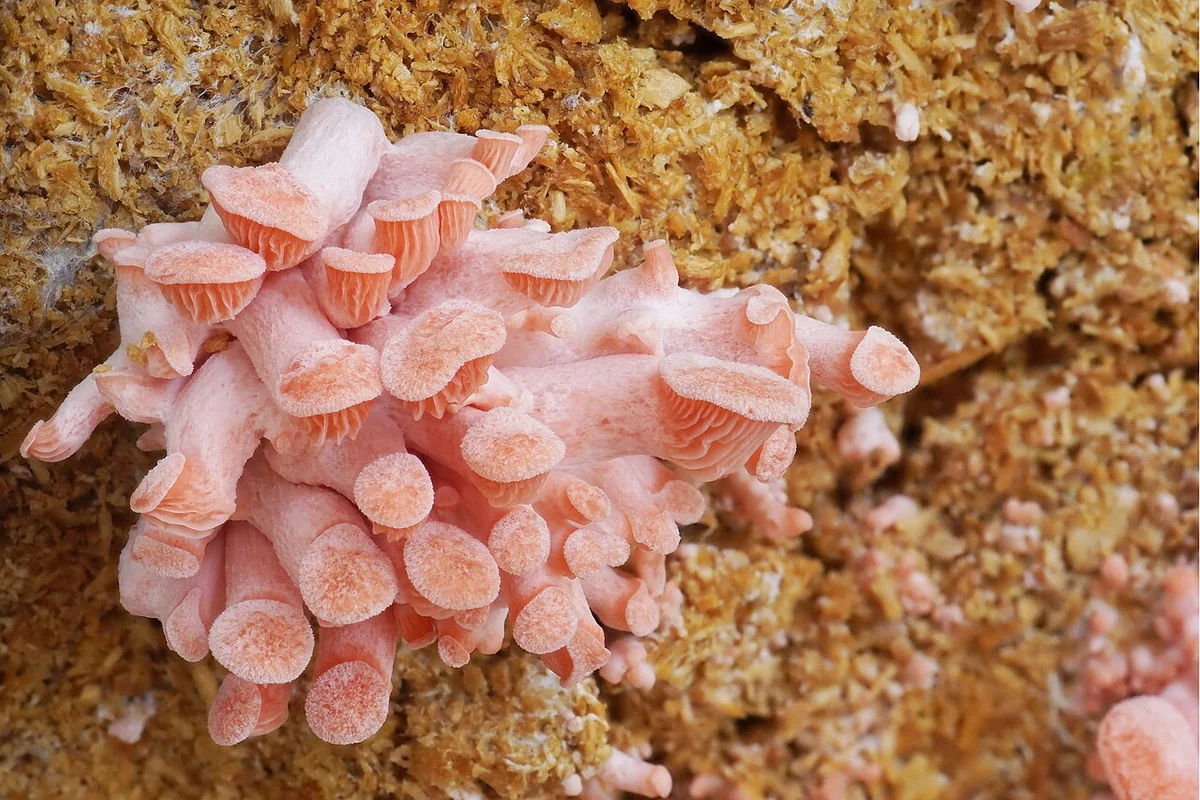
| Pleurotus djamor | Pink Oyster | Cap 10 to 25 mm, bright pink, edges curled inward; stipe 5 to 10 mm | Cap 26 to 50 mm, pink to light pink, flat with wavy edges; stipe 11 to 25 mm | Cap 51 mm or wider, pale pink to salmon pink, wide and flat with wavy edges that may curl upward; stipe 26 mm or longer | Pick while firm and pink with wavy margins before color fades and rims turn upward |
| Pleurotus pulmonarius | Phoenix / Italian Oyster | Cap 10 to 30 mm, light gray, convex with curled edges; stipe 5 to 20 mm | Cap 31 to 60 mm, light gray to pale gray, flattened; stipe 21 to 40 mm | Cap 61 mm or wider, pale gray to light brown, flat to funnel-shaped; stipe 41 mm or longer | Pick as light gray caps expand before thinning past 61 mm into funnels |
| Pleurotus eryngii | King Oyster | Upright pins emerging 12 to 28 days after bag inoculation depending on substrate | Thick, firm cylindrical white stipe building girth under a compact rounded cap | Can reach 180 to 200 g with 12 to 14 cm broad cap and 7 to 8 cm long, 5 to 6 cm thick stipe | Judge by plump, firm stem consistency and compact cap before upper caps flare wide |
Morphological millimeter benchmarks for P. ostreatus, P. citrinopileatus, P. djamor, and P. pulmonarius are drawn from developmental staging tables in Foods; P. eryngii measurements and pinning timelines are drawn from Scientific Reports.
Blue and pearl oyster mushrooms (Pleurotus ostreatus)
Blue and pearl strains of Pleurotus ostreatus follow the classic margin-roll progression. Young caps measure 10 to 25 mm wide with darker gray-to-brown pigment and tightly curved rims on 5 to 15 mm stipes, then expand through the middle stage at 26 to 50 mm wide with light gray caps still holding curved margins on 16 to 30 mm stipes (Foods). Harvest as caps finish unfurling before reaching 51 mm or wider, when caps turn pale gray to white, sink into a flat-to-funnel shape, and develop brittle edges (Foods; Cornell Small Farms Program).
Pink oyster mushrooms (Pleurotus djamor)
Pink oyster mushrooms transition quickly from compact coral-pink pins to wide ruffled rosettes. Young Pleurotus djamor caps start 10 to 25 mm wide in bright pink with edges curled inward on short 5 to 10 mm stems, then open into the middle stage at 26 to 50 mm wide in pink to light pink with flat caps and wavy edges on 11 to 25 mm stems (Foods). Harvest before caps exceed 51 mm, where color fades to pale pink or salmon pink and wavy edges begin curling upward (Foods).
Golden oyster mushrooms (Pleurotus citrinopileatus)
Golden oyster mushrooms form delicate, slender-stemmed bouquets whose cap diameter runs smaller than pearl or pink oysters. Young Pleurotus citrinopileatus caps measure 5 to 20 mm wide in bright yellow with convex curled rims on 10 to 20 mm stipes, expanding in the middle stage to 21 to 40 mm wide as yellow caps begin to flatten on 21 to 40 mm stipes (Foods). Harvest during this 21 to 40 mm window—or right as caps reach 41 mm with slightly downturned edges—before color fades to pale yellow and slender cylindrical stipes exceed 41 mm (Foods).
King oyster mushrooms (Pleurotus eryngii)
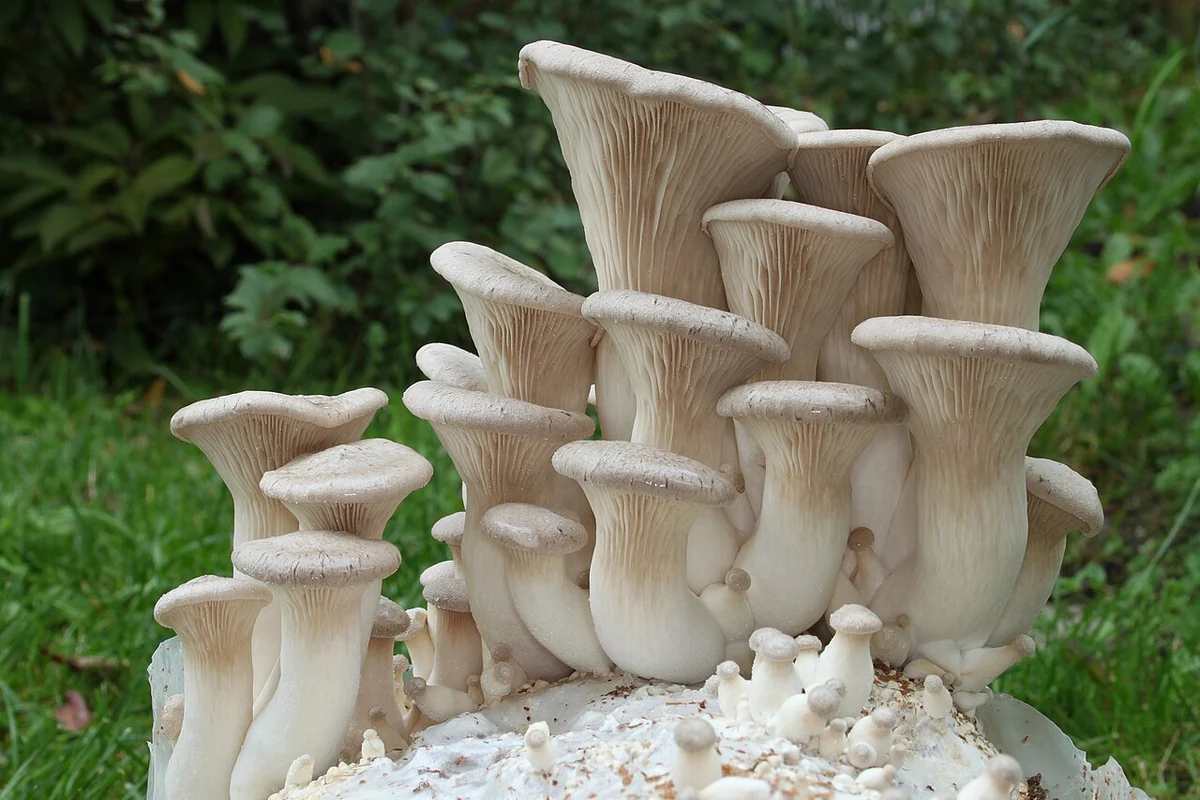
King oyster mushrooms behave differently from side-fruiting shelf oysters because growers cultivate them primarily for their thick, meaty upright stem alongside a compact cap. In peer-reviewed cultivation evaluations (Scientific Reports), Pleurotus eryngii is noted for the firm consistency of its thick stem and cap and a longer post-harvest shelf life than other oyster species, attributed to lower water content and firmer flesh. Depending on substrate, pinhead initiation takes 12 days on maize straw up to 28 days on rice-bran-supplemented wheat straw, and large cultivated fruiting bodies can reach 180 to 200 g with a 12 to 14 cm broad pileus and a 7 to 8 cm long, 5 to 6 cm thick stipe (Scientific Reports). Pick upright stems once firm and plump rather than waiting for caps to flare flat.
How should you clean and store fresh oyster mushrooms after harvest?
Clean freshly harvested oyster mushrooms dry—never by washing in water—using a soft mushroom brush or clean paintbrush, then chill promptly at 36 to 38 °F in breathable paper bags or loose-lid food-grade bins (Cornell Small Farms Program). At 4 °C, Pleurotus ostreatus keeps 5 to 7 days versus under 24 hours at 20 °C (Foods).
Why dry brushing beats water washing
Fresh oyster mushrooms typically hold 85% to 95% moisture by fresh weight—measured at 83.82% to 89.8% across five commercial Pleurotus species—and have no protective outer cuticle (Foods; Foods). Because moisture content exceeds 90%, washing them in water is not feasible and ruins both texture and shelf life (Cornell Small Farms Program). Follow this dry-cleaning sequence right after harvest:
- Brush substrate flecks dry: Keep clean mushroom brushes or inexpensive hardware-store paintbrushes in several bristle lengths and stiffnesses to sweep sawdust or straw off caps and stems before storage (Cornell Small Farms Program).
- Pat stubborn spots sparingly: If light residue clings after brushing, pat the cap gently with a barely damp towel rather than rinsing under running water (Cornell Small Farms Program).
- Tap out gill insects without blowing by mouth: If tiny thrips appear between gills, tap the cap gently once, wait a second, and tap again; gentle compressed air can help clear stubborn gills, while blowing with your mouth is unsanitary (Cornell Small Farms Program).
Breathable cold storage and temperature shelf-life benchmarks
Post-harvest Pleurotus ostreatus maintains an exceptionally high respiration rate of 200 to 500 mg per kg per hour at 20 °C (Foods). That rapid metabolism creates a two-sided storage hazard: sealing warm mushrooms inside plastic bags traps condensation and elevated humidity that hasten microbial growth and enzymatic browning, while leaving mushrooms uncovered in dry air accelerates transpiration so losing 5% to 10% of fresh weight destroys firmness and quality (Foods). Never store fresh mushrooms in plastic bags or sealed plastic containers; use paper bags for small home batches or food-grade storage bins with loose-fitting lids chilled at 36 to 38 °F (Cornell Small Farms Program).
| Storage Temperature | Expected Pleurotus ostreatus Shelf Life | Recommended Container | Primary Spoilage Risk |
|---|---|---|---|
| 20 °C (Room Temperature) | Cannot be held safely past 24 hours (1 to 2 days maximum) | Short harvest-tray transfer only | High respiration (200 to 500 mg/kg h) drives rapid water loss, softening, and bacterial decay |
| 4 °C (Standard Refrigerator; ~36 to 38 °F target) | 5 to 7 days (a week or more if picked at rounded-cap prime) | Breathable paper bag or food-grade bin with loose-fitting lid | Sealed plastic causes condensation and browning; dry open shelves cause 5% to 10% weight loss |
| 0 °C (Cold-Room Storage) | 8 to 11 days | Vented food-grade storage bin with loose lid | Mechanical bruising before cooling accelerates enzymatic browning |
Shelf-life intervals and respiration figures from Foods; container and 36 to 38 °F handling rules from Cornell Small Farms Program.
Using overripe clusters and cooking safely
Specialty oyster mushrooms remain edible across developmental stages (Cornell Small Farms Program). If a cluster flattens overnight before you can pick it, harvest it right away and reserve brittle overripe caps for immediate cooking or dehydration rather than week-long cold storage (Cornell Small Farms Program). Regardless of harvest stage, cook cultivated oyster mushrooms thoroughly on medium heat for at least 5 minutes before eating (Cornell Small Farms Program).
How can you track cap stages and post-harvest handling across flushes?
Keeping a simple six-row observation log for each cultivated grow bag lets you spot how fast your specific strain moves from pinhead emergence to unfurled cap margins, verify dry-brush cleanup, and record refrigerator holding time across flushes. Recording these baseline observations helps you catch the narrow 2 to 3 day harvest window reliably on subsequent flushes (Utah State University Extension).
| Observation Field | What to Record for Your Cultivated Block | Benchmark Reference |
|---|---|---|
| Species & Strain | Pearl/blue (P. ostreatus), pink (P. djamor), golden (P. citrinopileatus), phoenix (P. pulmonarius), or king (P. eryngii) | Match cap diameter range to species developmental benchmarks |
| Pinhead Emergence Date | Date tiny primordia first appear at bag slit | Expect full maturity in 2 to 3 days; inspect twice daily (USU Extension) |
| Cap-Margin & Pinky Check | Margin rolled tightly inward / mostly unfurled with rounded lip / flat or upturned | Harvest while mostly unfurled and not flat (Cornell Small Farms Program) |
| Harvest Method & Cleanup | Clean twist-and-pull or base knife cut; bottom substrate trimmed; mold check clear | Discard blocks showing green, black, pink, or orange mold (USU Extension) |
| Dry Cleaning Method | Soft dry brush used; damp towel pat if needed; two-tap thrips check | Never wash fresh mushrooms in water before storage (Cornell Small Farms Program) |
| Cold Storage & Shelf Life | Paper bag or loose-lid bin at 36 to 38 °F; date stored and days held fresh | Target 5 to 7 days at 4 °C; never leave past 24 hours at 20 °C |
Browse more indoor block management, substrate preparation, and post-harvest guides in our mushrooms section.