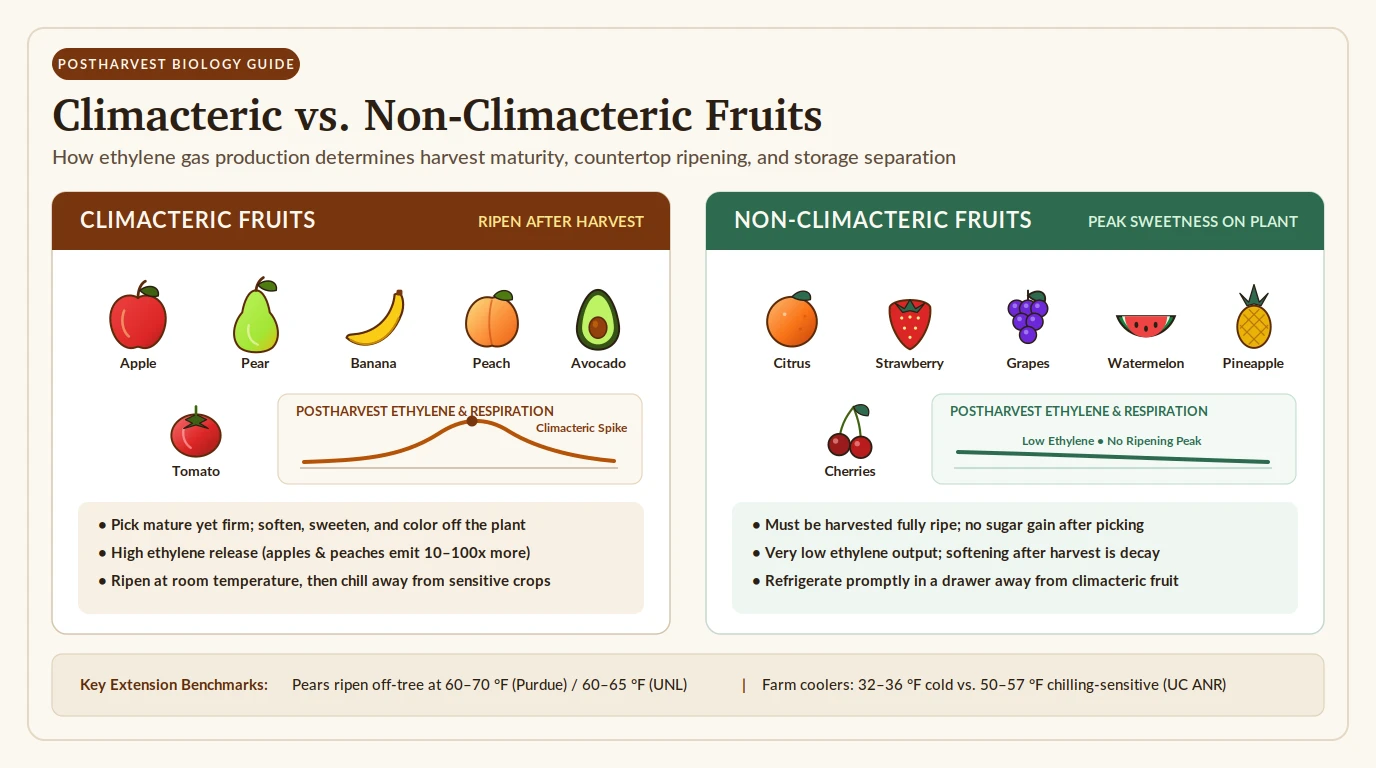
Climacteric fruits are fruits that continue to ripen after harvest because rising ethylene gas production and elevated respiration soften their flesh, increase sweetness, and change peel color off the plant. Pick climacteric crops mature yet firm, ripen them at room temperature, and refrigerate them separately from ethylene-sensitive produce to prevent premature spoilage.
Postharvest physiology divides all orchard and garden harvests into two practical workflows, setting harvest timing as well as packinghouse and kitchen storage rules. Iowa State University Extension notes that recognizing whether a crop is climacteric or non-climacteric determines whether fruit should sit on the counter or move straight into cold storage. Across our field guides and processing and packing coverage, this physiological boundary connects tree-care prep in our fruit tree organic fertilizer guide with moisture and gas control in our cucumber packaging comparison, as well as dry-crop postharvest workflows such as curing onions for storage and curing sweet potatoes.
What Does Climacteric Mean in Fruit Ripening?
In fruit ripening, climacteric refers to the physiological ripening phase after maturity in which fruits produce sharply larger amounts of gaseous ethylene alongside an increased rate of cellular respiration, accelerating postharvest softening, sweetening, and color development even after the fruit is picked from the plant.
University of Maine Cooperative Extension explains that ethylene levels stay very low inside under-ripe fruit, then climb rapidly as fruit develop to speed up ripening during the stage called the climacteric. UC ANR similarly defines climacteric fruits as crops that enter this climacteric phase after harvest, emitting ethylene while their respiration rate rises.
Respiration matters just as much as hormone output once fruit leaves the branch. Utah State University Extension describes postharvest respiration as the breakdown of sugars, fats, and proteins that generates carbon dioxide, water, and heat of respiration. Because UC ANR notes that respiration increases 2 to 4 times for every 18 °F rise in temperature, warm holding temperatures accelerate both ethylene activity and tissue aging.
How Do Climacteric Fruits Differ from Non-Climacteric Fruits?
Climacteric fruits are generally picked mature yet firm and continue ripening, sweetening, and emitting substantial ethylene off the plant, whereas non-climacteric fruits reach peak sweetness and flavor on the plant, produce very low ethylene, and cannot improve in sweetness or flavor after harvest.
The contrast between the two fruit groups governs both harvest maturity and postharvest loss. Iowa State University Extension points out that while non-climacteric fruits may eventually soften after picking, that softening comes from decay rather than true ripening. Quantitative emission levels differ sharply as well: UC ANR reports that non-climacteric cherries and strawberries produce very low amounts of ethylene, whereas climacteric apples and peaches emit 10 to 100 times higher levels.
| Postharvest Trait | Climacteric Fruits | Non-Climacteric Fruits |
|---|---|---|
| Postharvest ripening behavior | Enter a climacteric phase after harvest, continuing to soften, sweeten, and change color (ISU Extension; UC ANR) | Reach peak sweetness and flavor on the plant and stop developing once harvested (ISU Extension; UC ANR) |
| Ethylene output and respiration | Emit high ethylene alongside rising respiration; apples and peaches produce 10 to 100 times more ethylene than cherries and strawberries (UC ANR) | Produce very low amounts of ethylene with no climacteric ripening surge (UC ANR) |
| Target harvest maturity | Generally picked mature yet firm; apples stored longer than two months must be picked before rapid ethylene rise (ISU Extension; UMaine Extension) | Must be harvested fully ripe on the plant because flavor will not improve off the stem (ISU Extension; UC ANR) |
| Countertop vs. cold storage | Ripen at room temperature first (or hold cold unripened, as with pears), then refrigerate to extend shelf life (ISU Extension; Purdue Extension) | Refrigerate promptly after harvesting and keep away from climacteric fruits (ISU Extension) |
| Response to ethylene exposure | Ripening accelerates in trapped ethylene, such as a paper bag with a ripe banana or commercial 100 ppm ethylene for mature-green tomatoes (ISU Extension; UC ANR) | Exposure does not increase sweetness; bell peppers generally do not respond to ethylene, and nearby sensitive produce suffers premature spoilage (ISU Extension; UC ANR) |
Which Common Fruits Belong on the Climacteric Fruits List?
Common climacteric fruits span pomes (apples, pears, quince), stone fruits (peaches, nectarines, apricots, plums), tropical and exotic fruits (bananas, avocados, mangoes, papayas, kiwifruit, guavas, passion fruit), netted and smooth melons (cantaloupe, honeydew), and culinary crops including tomatoes, persimmons, and plantains.
Both Iowa State University Extension and UC ANR align closely on the core climacteric fruit groups growers handle in orchards, markets, and home kitchens:
- Pomes: Apples, pears, and quince (ISU Extension; UC ANR).
- Stone fruits: Peaches, nectarines, apricots, and plums (ISU Extension; UC ANR).
- Tropical and exotic fruits: Bananas, avocados, mangoes, papayas, kiwifruit, guavas, and passion fruit (ISU Extension; UC ANR).
- Melons and fruiting vegetables: Cantaloupe, honeydew, tomatoes, persimmons, and plantains (ISU Extension; UC ANR).
Cultivar Differences and Minor Extension-List Variations
Even within one climacteric species, ethylene output and ripening speed are variety-dependent. University of Maine Cooperative Extension highlights McIntosh apples as prodigious ethylene producers that rapidly soften and senesce in storage if harvested after the ethylene surge begins, whereas other apple varieties show a slower rise. Plums show an equally wide spread: Early Golden plums ripen very rapidly and demand tight harvest timing so fruit do not arrive over-ripe, while suppressed-climacteric cultivars such as Shiro produce very little ethylene and may remain under-ripe if harvested too early.
Growers comparing extension checklists will also spot minor edge-case differences across crops with variable physiology. For example, Iowa State University Extension lists blueberries among climacteric fruits and mentions figs on both lists, while UC ANR includes blackberries on its climacteric slide examples even though Iowa State groups blackberries with non-climacteric berries. For berries and figs in practice, harvesting near full eating quality and cooling promptly protects flavor regardless of list conventions.
What Are Common Examples of Non-Climacteric Fruits?
Common non-climacteric fruits include all major citrus fruits (oranges, lemons, limes, grapefruits, tangerines, kumquats, tangelos), berries (strawberries, raspberries, blackberries), watermelon, grapes, pineapples, pomegranates, cherries, cashews, and culinary fruiting crops such as bell peppers—all of which reach peak sweetness on the plant and stop developing once harvested.
Across Iowa State University Extension and UC ANR postharvest lists, non-climacteric crops fall into four practical harvest groups:
- Citrus fruits: Oranges, lemons, limes, grapefruits, tangerines, kumquats, and tangelos (ISU Extension; UC ANR).
- Berries: Strawberries, raspberries, and blackberries (ISU Extension; UC ANR).
- Vine and tropical non-climacteric fruits: Watermelon, grapes, pineapples, pomegranates, cherries, and cashews (ISU Extension; UC ANR).
- Non-climacteric fruit vegetables: Bell peppers, which UC ANR postharvest trials note generally do not respond to ethylene.
Home growers and shoppers sometimes mistake minor texture shifts in non-climacteric fruit for ripening. Addressing oranges that become easier to peel after sitting on a counter, Iowa State University Extension clarifies that oranges only ripen on the tree; resting for a few days at room temperature merely gives the white pith time to pull back slightly from the peel, reducing adhesion without adding sweetness. Because non-climacteric fruits cannot sweeten off the plant, harvest them at peak flavor and refrigerate them promptly away from climacteric fruit.
What Plant Hormone Drives Ripening After Harvest—and How Do Growers Control It?
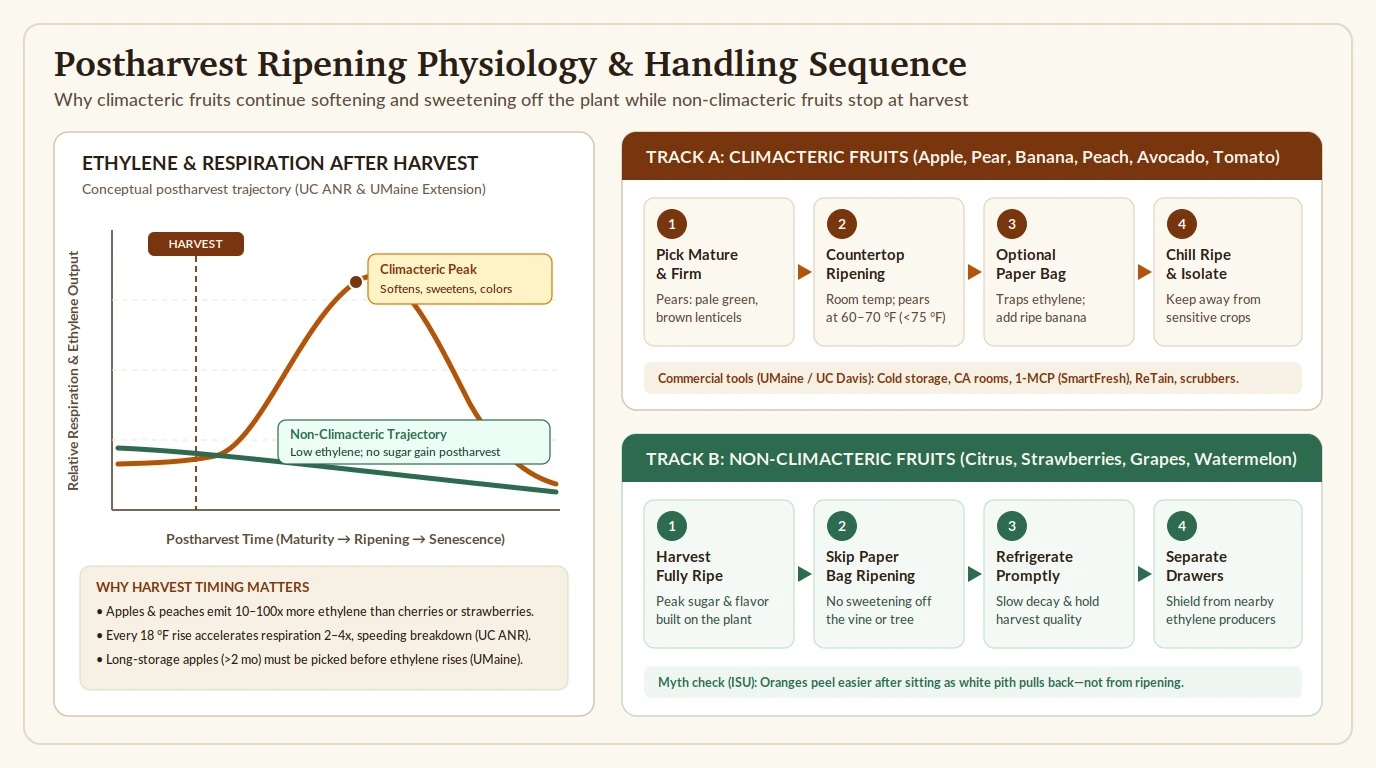
Ethylene gas is the natural plant hormone that triggers and accelerates postharvest ripening in climacteric fruits even at very low parts-per-million concentrations, allowing households to speed up firm fruit in a paper bag while commercial orchards and packers slow ripening through pre-climacteric harvest, cold storage, and ethylene inhibitors.
Because climacteric fruit keeps emitting ethylene gas after picking, managing that gas either speeds ripening for eating or slows it for storage.
Speeding Up Ripening at Home and in Commercial Rooms
At home, Iowa State University Extension explains that trapping released ethylene inside a paper bag accelerates ripening—for instance, placing a firm peach in a paper bag alongside a ripe banana. Purdue University Consumer Horticulture applies the same principle to firm pears placed together in a closed paper sack.
Commercial handlers standardize both gas concentration and holding temperature. UC ANR tomato handling data specify ripening mature-green tomatoes at 15 to 20 °C with high humidity using 100 ppm ethylene for 3 days, while noting that ripe storage fruit should stay at 12.5 °C and no lower than 10 °C at 85% relative humidity for 2 to 3 weeks.
Delaying Ripening for Multi-Month Storage
Slowing ethylene production begins before fruit leaves the orchard. University of Maine Cooperative Extension emphasizes that apples destined for storage longer than two months must be harvested before internal ethylene begins its rapid increase. Once harvested, cold temperatures directly slow ethylene generation and respiration (UC ANR).
When cold air alone is not enough, commercial orchards and packinghouses layer additional controls documented by University of Maine Cooperative Extension and UC ANR:
- Preharvest ethylene suppression: Applying aminovinylglycine (ReTain) before harvest to delay the ethylene surge.
- Postharvest ethylene receptor blocking: Applying 1-methylcyclopropene (1-MCP, sold as SmartFresh) after harvest to retard ripening in apples and tomatoes.
- Atmosphere and air management: Using controlled atmosphere storage, ventilating storage spaces, or installing ethylene scrubbing and absorption systems (UMaine Extension; USU Extension).
Is a Pear a Climacteric Fruit—and Why Should Pears Ripen Off the Tree?
Yes—pears are classic climacteric fruits, and unlike most tree fruits they reach their best flavor and smooth texture when harvested mature yet firm and ripened off the tree at 60 to 70 °F (Purdue) or 60 to 65 °F (Nebraska Extension), because tree-ripened pears ripen from the inside out and turn grainy and brown at the core.
University of Nebraska–Lincoln Extension explains that leaving pears to soften on the branch encourages gritty stone cells, mealy flesh, and core breakdown: by the time a tree-ripened pear feels slightly soft outside, the interior flesh is already soft and brown. Purdue Extension confirms that picking mature green pears and ripening them indoors produces superior texture and longer shelf life.
Checking Pear Maturity Before Harvest
Because ripe skin color arrives too late on the tree, rely on four orchard harvest cues from Purdue Extension and Nebraska Extension:
- Ground color shift: Pick while fruit remain relatively firm as base skin color lightens from dark green to pale green or yellowish-green, before pears turn fully yellow.
- Lenticel browning: Check the tiny dots (lenticels) across the pear skin; they turn from whitish or green on immature fruit to corky brown at harvest maturity.
- Stem separation (except Bosc): Mature pears separate easily from the fruiting spur when lifted and tilted upward with a gentle twist, though Nebraska Extension notes that Bosc pears usually require clipping with pruners even when mature.
- Seed coat color: Slicing one test fruit confirms maturity when inner seed coats have turned from white to brown (Purdue Extension).
Indoor Pear Ripening vs. Multi-Month Cold Storage
Watch the upper temperature ceiling closely after harvest. Nebraska Extension warns that holding picked pears at 75 °F and higher causes the fruit to break down without ripening properly. Instead, ripen immediate-use batches at moderate cool room temperatures and chill surplus unripened fruit right away so you can pull small batches out to ripen as needed.
| Pear Postharvest Stage | Extension Temperature & Humidity Target | Timing & Readiness Check |
|---|---|---|
| Immediate indoor ripening (Purdue Extension) | 60 to 70 °F with 80 to 85% relative humidity; faster in a closed paper sack | Ripens within a few days; ready when flesh gives slightly when pressed near the stem end |
| Indoor ripening window and heat ceiling (Nebraska Extension) | 60 to 65 °F; strictly avoid 75 °F and higher to prevent breakdown without ripening | 1 to 3 weeks depending on cultivar; ripen chilled storage batches at 60 to 65 °F for a few days as needed |
| Long-term unripened cold storage (Purdue Extension) | 32 to 35 °F promptly after harvest in perforated plastic bags | Holds most cultivars for two to four months; avoid bruises or punctures that admit decay |
| Long-term unripened cold storage (Nebraska Extension) | 29 to 31 °F at 90% relative humidity in perforated bags or partially sealed containers | Lasts 2 to 4 months; perforated packaging holds moisture while venting ethylene away from apples, onions, and potatoes |
How Should You Separate Climacteric Fruits and Set Storage Temperatures?
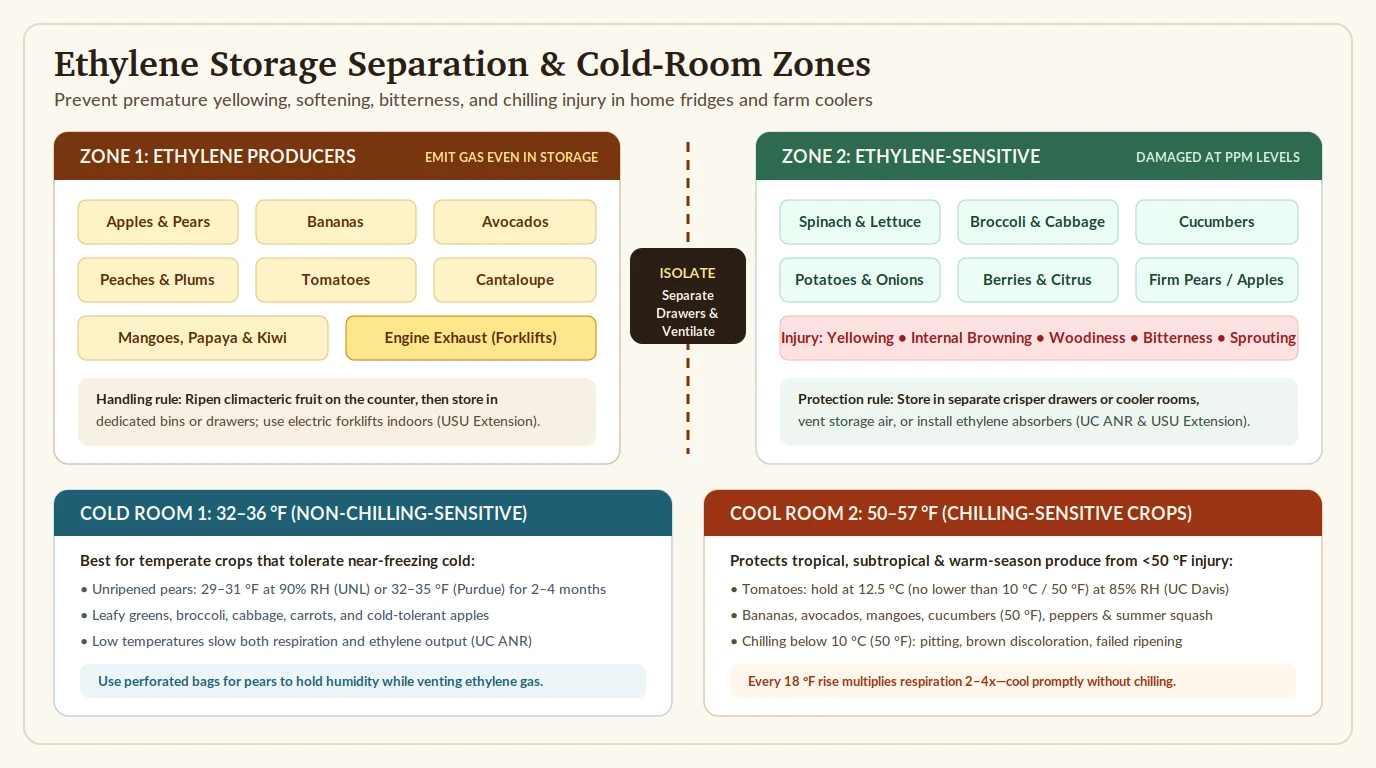
Separate ethylene-producing climacteric fruits from ethylene-sensitive produce in different refrigerator drawers or storage rooms, ventilate air or install ethylene absorbers, use electric forklifts indoors, and split cold storage between 32 to 36 °F for non-chilling-sensitive crops and 50 to 57 °F for chilling-sensitive tropical and subtropical produce.
Even inside cold storage, climacteric fruits continue emitting ethylene gas (ISU Extension). When mixed with sensitive vegetables or unripened fruit, trace ethylene triggers costly visual and flavor defects documented by UC ANR and Utah State University Extension:
- Leafy greens and brassicas (spinach, lettuce, broccoli, cabbage): Leaf yellowing, green color loss, leaf spotting, and leaf abscission.
- Root and storage crops (potatoes, onions): Sprouting in potatoes, internal browning, lignification (woodiness), bitterness, and off-flavor development.
- Unripened fruit and flowers (apples, pears, cantaloupe, carnations): Premature softening and shortened storage life.
Balancing Cold Temperatures Against Chilling Injury
Cooling slows respiration and ethylene output—remembering UC ANR’s rule that every 18 °F rise multiplies respiration 2 to 4 times—yet dropping temperatures too low ruins warm-season crops. UC ANR reports that tropical and subtropical species suffer chilling injury at non-freezing temperatures below 10 °C (50 °F), showing irregular or failed ripening, surface pitting, brown discoloration, off-flavors, softening, and increased decay. Utah State University Extension likewise highlights a broad chilling-sensitivity band between 35 °F and 55 °F across many fruits and some leafy greens.
For small farms running two walk-in coolers, UC ANR sets a clean two-room split, and packinghouses should also eliminate non-fruit ethylene sources by running electric forklifts rather than internal combustion engines whose exhaust fumes emit ethylene (USU Extension).
| Storage Zone or Setting | Target Temperature & Airflow | Crops & Compatibility Rules |
|---|---|---|
| Home kitchen countertop | Room temperature (60 to 70 °F for pears; keep pears below 75 °F) | Ripen firm climacteric fruits; optional closed paper bag with a ripe banana to speed ripening (ISU; Purdue; UNL) |
| Home refrigerator crisper separation | Separate drawers for climacteric fruit vs. non-climacteric and ethylene-sensitive produce | Move ripe climacteric fruit to chill after softening; chill non-climacteric berries, grapes, and citrus promptly away from ethylene producers (ISU Extension) |
| Farm Cold Room 1 (non-chilling-sensitive) | 32 to 36 °F (unripened pears at 29 to 31 °F and 90% RH per UNL or 32 to 35 °F per Purdue) | Temperate crops that tolerate near-freezing cold; vent air or use ethylene absorbers and isolate high-ethylene apples from leafy greens, broccoli, cabbage, and storage pears (UC ANR; USU; UNL) |
| Farm Cool Room 2 (chilling-sensitive) | 50 to 57 °F (tomatoes at 12.5 °C and no lower than 10 °C at 85% RH per UC Davis) | Tropical and subtropical fruits plus warm-season crops injured below 10 °C (50 °F); keep ethylene-producing tomatoes and bananas away from sensitive vegetables and run electric forklifts only (UC ANR; USU) |